Posts Tagged ‘resistance’

Nothing is perfect, nothing is permanent, nothing is complete

June 5, 2021

Pentecost 2 – 2021
Mark 3:20—35
Marian Free

In the name of God – changeless yet ever new. Amen.

I am sure that many of you have heard about the Japanese practice of Kintsugi or golden joinery. The history of Kintsugi is shrouded in mystery, but legend has it that a Japanese shogun, Ashikaga Yoshimasa sent a cracked tea bowl to China to be mended. When it was returned to him, he was distressed by the crude repair. Ugly metal staples had been used so to hold the broken pieces together. In response, Japanese craftsmen determined to find a more aesthetically pleasing method of repairing broken bowls. The practice of Kintsugi uses lacquer mixed with gold, silver or platinum to join broken pieces of pottery with the result that though the breaks are clearly visible, the repaired bowl is often more beautiful than the original.

A number of Japanese philosophical ideas are associated with this practice. Foremost among these is the principle of wabi-sabi which acknowledges that everything is imperfect, everything is impermanent, and everything is incomplete. In Kintsugi, the repairs allow the imperfections to be visible, thus illustrating the impermanence of the original bowl and pointing to the incomplete nature of all things. An associated philosophy is that of mushin (no mind) which emphasises non-attachment and the acceptance of change. Instead of trying to hold onto or to recreate an unblemished past, the repaired vessel bears its scars boldly, proudly carrying them into the future.

Kintsugi illustrates the fact that change is not to be feared or resisted but is an integral part of existence. What is more, it demonstrates that change has the potential to forge something new and beautiful.

One of the problems with institutions is that they tend towards stasis. Once established, organisations develop practices, traditions and customs that can become very difficult to change. “We’ve always done it that way.” “It’s worked in the past,” workers or members say. A person who has a vision to improve a company’s bottom line by changing the way it does things is liable to be ridiculed, treated with suspicion and even ostracised. People who see flaws in the way our society operates are likely to be called troublemakers, radicals or revolutionaries. This is as true of the church as it is of any enterprise. People become comfortable with the way things are done and, in the worst-case scenarios, actively resist any attempt to innovate preferring a slow death to a revitalised, but different way of being.

The problem with Jesus was that he represented change. He refused to conform to the societal norms of his time, and he actively defied attempts to make him fit in. Instead of supporting the religious institutions of his time, he seemed to be undermining everything that they stood for. This I suspect is part of the tension that is recorded in today’s gospel. Jesus’ actions are making people uncomfortable. He is behaving in ways that are unconventional. He seems to have some sort of hold over the crowds. He is putting the whole fabric of society and of the church at risk. Who knows what might happen if he is allowed to continue unchecked?

Jesus’ behaviour is causing anxiety at every level – from his family to the state (as represented by the Temple). Jesus’ notoriety has grown to the point where he cannot find time or space even to eat. His family, who have heard that people are saying: “He is out of his mind,” have come to constrain him. In a world in which the honour of a family depends on all its members conforming to the cultural customs of their society, Jesus’ behaviour was a source of embarrassment. His family needed to stop him, to bring him back into line so that their reputation could remain intact.

While the people attribute Jesus’ behaviour to madness, the scribes take it even further and accuse him of being possessed by Beelzebul. After all, how else could he have such a sway over the crowds unless he was possessed by some supernatural power? Jesus’ influence over the people threatened the authority of the scribes (the Pharisees, the Sadducees and the High Priests). Worse, Jesus’ popularity threatened the whole religious establishment. If Jesus could heal and teach and cast out demons, what role was there for the Temple, its representatives and its sacrifices? If Jesus was able to point out the flaws in the religious practices of his time, how could the church continue to exist? The stakes were high. No wonder the scribes accused Jesus of being in league with the devil. They needed to bring him to heel, to discredit him, to make him conform.

Centuries of religious practice could come tumbling down if the people discovered that healing and forgiveness could be found beyond the walls of the Temple. The institution of the church would break apart if the people refused to be bound by age old traditions and customs. It was impossible for the scribes and other religious leaders to see that the change Jesus heralding would lead not to the destruction of all that they knew, but to a renewed and revitalised relationship with the living God. They were so sure that they were doing all that God wanted that they had lost sight of the fact that God was dynamic, vital and creative not static, lifeless and unchanging. They had become so comfortable in their own ways that they could not see that God in Jesus was trying to break open their narrow vision and their stagnant practices. They were blind to the fact that Jesus was attempting to re-energise their relationship with a life-giving and innovative God. They could not see that if only they could allow their rigidity and their conformity to be cracked and broken that they would be put back together, stronger, more resilient and even more beautiful than they had been before.

The scribes wanted things to stay the same, so they chose stasis over growth, stagnation over change and their current practice over the possibility of new life in Jesus.

Our present situation is a stark reminder that nothing stays the same. Let us pray that we might always be open to the living God, expectantly waiting to see what it is that God will do next and ready and willing to join God in whatever it is that God has planned.

Why resist

August 10, 2019

Pentecost 9 – 2019

Luke 12:32-40

Marian Free

In the name of God whose generosity and love know no bounds. Amen.

In the mini series, North and South, there are a number of poignant scenes as the story takes us into the ‘dark Satanic mills’ of the newly industrialised England. Families crowded into single room dwellings struggle to make ends meet on the pittance that the recently rich industrialists pay them. Children are put to work as soon as they are able and those who are not at work stay at home to look after those too young to earn a living. Life expectancy is low, not least because the cotton fibers fill the lungs of the workers. The poverty is heart-breaking. At one point, the heroine, Margaret Hale, ventures into the slums to visit a friend. Margaret, the daughter of a former country vicar, is used to accompanying her father on his visits and taking with her baskets of food to alleviate the suffering of the poor. As she is making her way, Margaret passes a woman who is trying to pacify a crying child. In response to Margaret’s look of sympathy, the woman tries to reassure her: “Don’t worry,” she says, “the child is only hungry.” Without hesitation Margaret takes out her purse intending to give the family a coin with which to buy food. However, rather than expressing relief and gratitude, the woman turns away – offended by the proffered gift.

There are all kinds of reasons why a person might refuse or resist a gift – embarrassment, pride, a sense of unworthiness, a fear of ensuing indebtedness or obligations, or a desire for independence among others. In the the story, it seems as if the woman’s refusal relates to more than one of these possibilities. To her the offer of help is both patronizing and humiliating. She does not need to have her poverty so rudely exposed and Margaret’s pity is unintentionally demeaning. It reveals the great divide between the rich and the poor and, rather than bridge that divide, Margaret’s charity only exaggerates it.

Today’s gospel includes a number of unrelated sayings and a parable. It occurs in the midst of a long teaching section which Luke places in the context of Jesus’ journey to Jerusalem. The sayings express Jesus’ frustration and grief, his confidence in God’s benevolence, his anger at the Pharisaic view of the world and more general teaching about discipleship. Included in the teaching are many warnings: ‘Be on your guard against greed’, ‘you must be ready’, ‘unless you repent, you will all perish’, and ‘from everyone to whom much has been given, much will be required.’.

In the midst of such disparate sayings and dire predictions we come across two extraordinary revelations about the nature of God. The first is one that is easily overlooked. It does not seem to fit the context and is often passed over so quickly that it is missed and yet it tells a great deal about God and God’s relationship with us. ‘Do not be afraid, little flock,’ Jesus says, ‘for it is your Father’s good pleasure to give you the kingdom.’ This one sentence is filled with affection, warmth and reassurance – ‘Little flock’ – Jesus recognizes our vulnerability and wants to take away our fear. ‘Good pleasure’ – God’s deepest desire is to give us the kingdom expecting nothing in return.

Jesus follows up this saying with a parable. ‘Do not be afraid.’ God is not an overbearing slave master who makes unreasonable demands – just the opposite. The conclusion of the parable both reverses the normal image and expectation of God and completely upsets the social norms of his time, (and to some extent of ours). The parable imagines servants waiting for their master to return from a wedding banquet. Imagine their surprise when, instead of demanding that they prepare his supper or his bed, the master tightens his belt and proceeds to serve them at table. The story abounds with love and generosity – God’s free gift of Godself to all who are open, willing and ready to accept it!

Hidden in the midst of Jesus’ other sayings we find these two expressions of God’s tenderness and selflessness. From this perspective, much of the remainder of Jesus’ teaching in these chapters appears as an expression of Jesus’ exasperation at our stubborn refusal to accept God’s gracious gift of the Kingdom, indeed of Godself. We refuse because we cannot believe that the kingdom is offered at no cost to ourselves; because we are afraid of losing our independence; because we are too dependent on our possessions and cannot see that true wealth comes from dependence on God. We resist because we are uncomfortable about being served (and the implication that somehow we are somehow incompetent or immature).

Jesus is clear: it is God’s good pleasure to give us the kingdom. If the kingdom is not yet a reality, perhaps it is because we are not yet ready, because despite the promise we still struggle, choosing things as they are (however imperfect) rather than things as they could be.

No easy answers

March 26, 2016

Go back

Your message has been sent

Warning
Warning
Warning
Warning

Warning.

Today we meet, not only in the shadow of an act of terror over two thousand years ago, but also in the shadow of events in our own day. We draw comfort from the knowledge that God in Jesus shares our suffering. We know too that in Jesus God wrought victory from defeat, joy from sorrow and life from death and we believe that good will triumph over evil and that love will conquer hate.


Service of the Passion

and

Recognition of the Cross
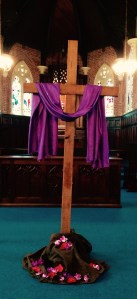
 

The contradiction of the cross

The contradiction of    the cross


(On this most solemn of days we would invite you to enter
and leave the church in silence.)


Procession with cross:

Hymn: 349 in the cross of Christ

Greeting:

The Lord be with you.

And also with you.


Let us pray:

God of contradiction,

give to us wisdom and understanding,

patience and humility,

and the courage to live with uncertainty,

so that we may hope for the right things

and arrive at what we do not know[1].

We ask this through your Son our Saviour Jesus Christ. Amen.


Poem: T. S. Eliot – from The Four Quartets


I said to my soul, be still, and wait without hope

For hope would be hope for the wrong thing; wait without love

For love would be love of the wrong thing; there is yet faith

But the faith and the love and the hope are all in the waiting.

Wait without thought, for you are not ready for thought:

So the darkness shall be the light, and the stillness the dancing.

Whisper of running streams, and winter lightning.

The wild thyme unseen and the wild strawberry,

The laughter in the garden, echoed ecstasy

Not lost, but requiring, pointing to the agony

Of death and birth.


You say I am repeating

Something I have said before. I shall say it again,

Shall I say it again? In order to arrive there,

To arrive where you are, to get from where you are not,

You must go by a way wherein there is no ecstasy.

In order to arrive at what you do not know

You must go by a way which is the way of ignorance.

In order to possess what you do not possess

You must go by the way of dispossession.

In order to arrive at what you are not

You must go through the way in which you are not.

And what you do not know is the only thing you know

And what you own is what you do not own

And where you are is where you are not.


In the name of God who suffers for us and with us, and who longs for us to turn and be made whole. Amen.

“And what you do not know is the only thing that you know.”

Shortly after five pm on Tuesday the world was shocked by the news of yet another act of terror – this time in Brussels. At least thirty people were dead and more than two hundred wounded many seriously. For those of us in Australia this news followed a grueling day in which, through the inquest into the police response, we revisited the final moments of the Lindt Café siege and the deaths of two hostages. At times like this, it is difficult not to ask: “Why?” “Why now?” “Why them?” As the story of the Brussels explosions unfolded, we learnt that a simple decision such as not buying a coffee made the difference between life and death, between being in the line of fire and being a safe distance away from the explosions.

Times like these remind us that there is a fine line between life and death, and that sometimes there is no rhyme or reason as to why one person lives and another dies, why some people live lives seemingly unfettered by grief or disaster and others live lives of quiet desperation, burdened by pain, sorrow or misfortune.

This side of the grave there are no easy answers. Life as we know it is vulnerable and fragile – susceptible to disease and constantly exposed to hazards and dangers – known and unknown. At the same time, humans are complex beings – capable of acts of great selflessness but also of unfathomable depravity, capable of great love, but also of immense hatred. We live in a world in which the good do die young, and the bad sometimes escape unpunished, in which only chance determines the country of our birth or the quality of our parenting, whether we stop for coffee or go straight to the departure gate. In this life, nothing is certain. We cannot predict what joys or heartache lie ahead.

There are two possible responses to this awful uncertainty – we can resist with all our might, refuse to take risks and try to force the world to conform to our expectations. This road will lead to frustration and disappointment, anger and bitterness. Our lives will be narrow and constrained and there will be no guarantee that we will be spared the pain of suffering and loss.

Alternately, we can willingly surrender. We can accept that life is filled with risk and uncertainty and choose to live boldly, courageously and confidently – no matter in what circumstances we find ourselves. This road will not be free of pain, but it will leave us open to joy and laughter, to adventure and hope. We will be able to ride out the bad times because we know that they will come to an end and that it is the good and the bad together that make life worth living.

Jesus chose the latter course. He willingly gave in to the future that was his. He surrendered himself completely to what life had in store. He submitted himself to the humiliation of a kangaroo court, the indignity of a flogging and the certainty of death of the cross. He did not ask: “Why?” or “Why me?” He simply walked the path that was his to walk, believing that somehow, in some way, God would give him both courage and strength in the present and that in the future, it would all begin to make sense. Jesus faced the cross not knowing what lay on the other side. As a consequence he learnt that through death comes life, that joy can be wrought from sorrow and victory from defeat.

Life is filled with uncertainty. The best that we can do is to place ourselves entirely in God’s hands and trust that in this life God will give us courage to face whatever it is that life throws at us and that in death, God will raise us to life eternal.

Reflection:

An abandoned God;

a dying God

confronts our sense of decency

and at the same time opens us to new possibilities –

to new ways of understanding God and ourselves.


Collect:


Holy God,

who teaches us that this day

which is so bad, is good.

Help us to live with incongruity

to know how much we do not know,

that understanding our limitations,

we may be open to the wisdom that comes from you alone. Amen.


Ministry of the Word

Isaiah 52:13 – 53:12

Hear the word of the Lord,

Thanks be to God.

Psalm 22

My God, my God, why have you forsaken me:

            why are you so far from helping me

            and from the words of my groaning?

My God, I cry to you by day, but you do not answer:

            and by night also I take no rest.

But you continue holy;

            you that are the praise of Israel.

In you our forebears trusted:

            they trusted and you delivered them.

To you they cried and they were saved:

            they put their trust in you and were not confounded.

But as for me, I am a worm and no man:

            the scorn of all and despised by the people.

Those that see me laugh me to scorn:

            they shoot out their lips at me

            and wag their heads, saying,

“He trusted in the Lord – let him deliver him:

            let him deliver him, if he delights in him.”

But you are he that took me out of the womb:

            that brought me to lie at peace on my mother’s breast.

On you have I been cast since my birth:

            you are my God, even from my mother’s womb.

O go not from me, for trouble is hard at hand:

            and there is none to help.

Many oxen surround me:

            fat bulls of Bashan close me in on every side.

They gape wide their mouths at me:

            like lions that roar and rend.

I am poured out like water,

and all my bones are out of joint:

            my heart within my breast is like melting wax.

My mouth is dried up like a potsherd:

            and my tongue clings to my gums.


My hands and my feet are withered:

            and you lay me in the dust of death.

For many dogs are come about me:

            and a band of evildoers hem me in.

I can count all my bones:

            they stand staring and gazing upon me.

They part my garments among them:

            and cast lots for my clothing.

O Lord, do not stand far off:

            you are my helper, hasten to my aid.

Deliver my body from the sword:

            my life from the power of the dogs;

O save me from the lion’s mouth:

            and my afflicted soul from the horns of the wild oxen.

I will tell of your name to my companions:

            in the midst of the congregation will I praise you.

O praise the Lord, all you that fear him:

            hold him in honour, O seed of Jacob,

            and let the seed of Israel stand in awe of him.

For he has not despised nor abhorred

the poor man in his misery:

            nor did he hide his face from him,

            but heard him when he cried.

The meek shall eat of the sacrifice and be satisfied:

            and those who seek the Lord shall praise him –

            may their hearts rejoice forever!

Let all the ends of the earth remember

and turn to the Lord:

            and let all the families of the nations worship before him.

For the kingdom is the Lord’s:

            and he shall be ruler over the nations.

How can those who sleep in the earth do him homage:

            or those that descend to the dust bow down before him?

But he has saved my life for himself:

            and my posterity shall serve him.

This shall be told of my Lord to a future generation:

         and his righteousness declared to a people yet unborn,

         that he has done it.

1 Corinthians 1:18-31

Hear the word of the Lord,

Thanks be to God.


Hymn: 339 O sacred head sore wounded


The Gospel of our Lord Jesus Christ according to John Chapter 18 beginning
at verse 1.

Glory to you Lord Jesus Christ.

For the Gospel of the Lord.

Praise to you Lord Jesus Christ.


Hymn: 341 My Song is love unknown.

(During the hymn a collection will be taken up for the Anglican Diocese of Jerusalem)


Intercessions:

Living, loving God, help us to relinquish our confidence in ourselves and our desire to go it alone;

to accept the vagaries of life and to let go of our need to be in control;

to recognise that we do not and cannot have all the answers and to understand that our knowledge is only partial and our insights limited by our humanity.

God when our hearts are aching,

Help us to find you in and among the suffering of the world.

Give us grace to acknowledge that life consists of the good and the bad and that our lives are enriched as a result;

to admit that hatred and fear only limit and bind and that love frees us to be fully alive

and to learn that it is only in your that true peace and joy are to be found.

God when our hearts are aching,

Help us to find you in and among the suffering of the world.


Be with all those whose lives are marred by violence, terror and war,

and with those who perpetrate acts of cruelty against others.

God when our hearts are aching,
Help us to find you in and among the suffering of the world

Support and encourage those whose lives are restricted by poverty, ill-health and disability,

and challenge those who have the means to help but do not.

God when our hearts are aching,
Help us to find you in and among the suffering of the world

Be a friend to those who are overlooked and discounted

and open our eyes to the suffering of those around us.

God when our hearts are aching,
Help us to find you in and among the suffering of the world.

Help us all to reevaluate our lives in the light of the cross and take our place among those who live life to the full and who make a difference in the lives of others.

God when our hearts are aching,
Help us to find you in and among the suffering of the world.


Lord’s Prayer: Accept our prayers through Jesus Christ our Lord,

who taught us to pray.

            Our Father in heaven,

                        hallowed be your name,

                        your kingdom come,

                        your will be done,

                        on earth as in heaven.

            Give us today our daily bread.

            Forgive us our sins

                        as we forgive those who sin against us.

            Save us from the time of trial

                        and deliver us from evil,

            for the kingdom, the power, and the glory are yours

                        now and forever. Amen.

Confession:

Our God whose love knows no bounds

comes to you – naked, weak and bleeding,

holding out holey hands, holy hands and asking only for your love in return.


Let us offer our hearts to God, confessing our sins – the barriers that separate us from each other and from God.

Suffering God,

who gave everything for us

forgive us our arrogance and presumption,

our greed and self absorption,

our neglect of the vulnerable,

our carelessness with the world’s resources,

our unwillingness to trust in you

and our failure to accept and to share your love and compassion. Amen


Absolution:

God whose love knows no bounds

forgives you and sets you free

to love God and to love one another.

Forgive others,

Forgive yourself. Amen.

Recognition of the cross:

730 Jesus remember me when you come into your kingdom.

(Recognition of the cross – you may like to place a flower at the foot of the cross, as a reminder that today is a day of contradiction, a reminder that God continually overturns our expectations so that we might rely on God and not ourselves. Alternately you are welcome to sit or stand in quiet reflection.)

Blessing: May the God who died for you, inspire you to live for God,

and the blessing of God almighty, Creator, Redeemer and Sanctifier be with you now and always. Amen.


Hymn: 262 When pain and terror


Please leave the church in silence


Copyright: Marian Free , 2014 (revised, 2016)


ANZAC DAY

There will be a service to commemorate Anzac Day

Monday 25th April – 8:00am


(If there is anyone for whom you would like us to pray,

Please add their name to the list at the back of the church.)


Rector:          The Rev’d Marian Free: m) 0402 985 593

  1. e) staugust@bigpond.com


Curate:                 The Rev’d Professor Rodney Wolff,

  1. e) staugust@gmail.com, 0426 287 283


Parish Office:       3268 3935 / Fax 3268 4245

Office Hours:       Monday, Thursday & Jumble Wednesdays

                               9.30am – 12.30pm


staugust@bigpond.com

www.staugustineshamilton.com.au


Sermons:            If you would like to read the weekly sermon,

                                 go to the home page and click on sermon.


            St Augustines Anglican Church


@StAugustines


Music Director:      Lesley de Voil: 0418 561 663 or

                                         lesleymdv@gmail.com


Service Times:      Sunday 7:30am & 9:30am

                               Tuesday & Thursday 7:00am

Wednesday 10:00am


Columbarium:      Robin Loan: 0417 799 400 or

                                 r.loan@optusnet.com.au

Columbarium Service: First Saturday of the month 7:30am


[1] “For hope would be hope for the wrong thing.” “In order to arrive at what you do not know you must go by a way which is the way of ignorance.” T.S. Elliot from “East Coker, The Four Quartets”

Gloria revisited – authenticity exposed

January 31, 2015

Epiphany 4 – 2015

Mark 1:21-28

Marian Free

In the name of God who gives us freedom to stay as we are or to grow into the fullness of life. Amen.

In a different lifetime, I studied Psychology at the University of Queensland. One of my subjects was Counselling Psychology. The course introduced us to the wide variety of techniques and theories that were in vogue at the time. During one of the lectures we were shown a video of three different therapies. The client, Gloria was a real person who was to be rewarded for her participation by being allowed to choose one of the three to be her therapist. The film had such an impact that a Google search shows that the film is still being used and that as recently as 2013 Counselling tutors and others were uploading the video on their blogs.

Of the three techniques explored, by far the most direct and confrontational was that of Fritz Perls, who with his wife developed Gestalt Therapy. This form of therapy aimed to try to get hold of what was obvious, to focus on the surface, the present moment, rather all the client to retreat into the past or worry about the future. The role of the therapist was, among other things, to identify game playing and to assist the client to be authentic.

Perls’ session with Gloria was fascinating. Throughout the half hour he continually drew attention to what Gloria was doing – that fact that she smiled even though she said she was anxious, that she was swinging her feet, rolling her arms and so on. Gloria’s reaction to this was to resist. She became angry and frustrated. Instead of backing off, the therapist kept focusing on her and how she was reacting. Time after time he called her on her attempts to hide her real feelings and time after time he accused her of being phony. Gloria became very uncomfortable, at times fighting back angrily and telling the therapist not only what she thought of him, but how she thought he should behave, how he should treat her. Perls was not deterred. Instead, he encouraged Gloria to express herself, pointing out that it was when she let fly, that she was more truly herself than when she was putting on a face in order to hide her true feelings, or to protect herself from hurt.

Gloria did not appreciate being accused of being a phony, but it was very clear that she did not want Perls to see that she was vulnerable and anxious. It was equally obvious that she did not want to admit that it was her very refusal to be authentic that was the source of the problem that had brought her to therapy. She would have preferred the therapist to be more paternal rather than confronting and challenging her.

Whenever Perls challenged Gloria to recognise that she was putting on an act, Gloria reacted strongly. She didn’t like being seen for who she really was, she didn’t want to believe that she was phony and she didn’t like being exposed. She admitted that it was easier to retreat into her corner where she felt safe and secure. There was a sense that in some way she would rather stay as she was than to do the hard work that it would take to achieve her goal.

In the first century there was nothing like medical science as we know it and certainly nothing like therapy. The explanation for illness or disability of any kind tended to be that it was the result of sin or of demon possession. In today’s gospel, Jesus is teaching in the synagogue when he is confronted by an unclean spirit who calls out: “What have you to do with us, Jesus of Nazareth? Have you come to destroy us? I know who you are, the Holy One of God.” To our twenty first century ears, it seems like an odd reaction – especially given what we know of Jesus. Why would someone who was sick or possessed repel Jesus? Why would someone who was suffering think that Jesus had come to destroy and not help him?

Gloria’s story gives us some clues to the man’s reaction to Jesus. The unclean spirit apparently sensed that Jesus saw straight through him. Knowing his that his weaknesses were exposed, he like our modern day Gloria, came out fighting. The man did not want to be helped by Jesus if it meant that his vulnerabilities and weaknesses had first of all to be identified and exposed. He would rather remain bound by his afflictions than let anyone – especially not Jesus – see who he really was.

Like Gloria and the man with the unclean spirit, many of us try to conceal the aspects of ourselves that we are afraid will expose us to ridicule or disdain. We cover up our vulnerabilities and weaknesses because we worry that people would think less of us if they knew who we really were. Some of us would rather live with pain and discomfort than admit that we need help. We don’t want others to think that we can’t cope or that our families are less than perfect. We hide our uncertainties so that others can’t accuse us of being weak or indecisive.

All this deceit and self-deception is exhausting and futile. In the end, the only person whom we deceive is our self. We waste so much time pretending, when we could be expending that time living.

The gospel assures us that God loves us as and where we are, that we have nothing to hide and nothing to fear. Jesus came to offer wholeness and healing, to give to each and everyone of us the opportunity to live life to the full, unfettered by anxiety, timidity or fear and unconcerned by what others might think.

In the end, we can’t hide from God, so why would we hide from ourselves? God wants to work in our lives. Jesus wants us to experience his dynamic, healing presence in our lives, but we have to want to be changed. We have r allow the Holy Spirit to work in and with us to radically transform and empower us and to bring us to wholeness and peace.