Posts Tagged ‘Richard Rohr’

God Incarnate

December 23, 2022

Christmas – 2022
Marian Free

In the name of God who comes among us silently, unobtrusively and unremarkably. Amen.
A73B3131-3B24-4954-8E33-6588DF7BB8A0

In the beginning was the Word, and the Word was with God, and the Word was God. . . . All things came to be through him, and without him nothing came to be. —John 1:1, 3

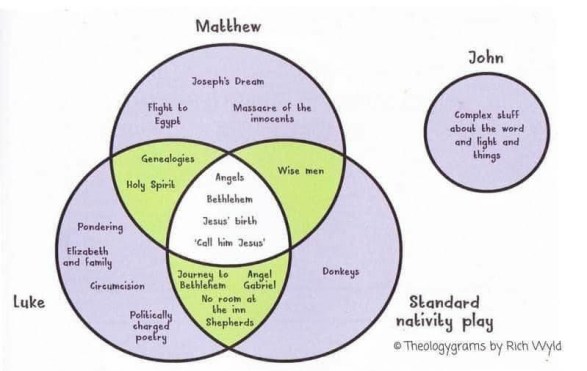
During the week our Bishop posted the above photo in Facebook. It is a light-hearted attempt to compare the accounts of Jesus’ birth in the four gospels. At the same time, it reminds us that when it comes to Christmas, we conflate two versions of the story – our nativity scenes. have the shepherds and the magi even though the shepherds are found only in Luke and the magi only in Matthew. (Mark is missing, because in Mark’s gospel, Jesus bursts on to the scene fully grown.) When the post appeared, discerning viewers noticed at once that Mary was not included in the diagramme. You might like to compare the first few chapters of Luke and Matthew and see if anything else needs to be added. The four gospels begin quite differently and as might be expected, the beginnings reflect the interests of the authors. Matthew is concerned to stress the Jewishness of Jesus and the way in which his early years demonstrate the fulfillment of Old Testament promises. (“This was to fulfill what was spoken by the prophets” occurs 5 times in the birth narrative.) What is more Matthew’s genealogy goes back to Abraham – the founder of the Jewish faith. Luke, on the other hand is more concerned with the universal implications of Jesus’ birth and with the historical context in which the story takes place. Luke includes the census and mentions Herod. His genealogy goes all the way back to Adam – indicating that Jesus is for everyone, not just for a few. Mark, as I said is not concerned with Jesus’ origins and John’s poetic start gives us – not a birth, but a cosmic beginning. From John’s point of view Jesus always was.

Does it matter that we do not have a consistent account to explain Jesus’ presence among us? Do we need to explain the differences? Of course not. Each story tells us something different, helps to satisfy our curiosity about Jesus’ beginnings and enriches our understanding of something that is essentially beyond our understanding. Indeed, Richard Rohr would argue that Jesus’ birth is only one expression of God’s incarnation among us – the account/s of Jesus’ birth are only one expression of God’s presence among us. That is to say, prior to Jesus’ birth, God was not absent in creation, invisible to God’s people or inactive in relation to the world. From the moment God said: “Let there be light” God has been dynamically engaged with creation and constantly in relationship with God’s people.

As Rohr says, we will never know the how, why or when of creation, but most traditions suggest that everything that it is the creation of some “Primal Source, which originally existed only as Spirit.” He goes on to say that “This Infinite Primal Source somehow poured itself into finite, visible forms, creating everything from rocks to water, plants, organisms, animals, and human beings. This self-disclosure of whomever you call God into physical creation was the first Incarnation (the general term for any enfleshment of spirit), long before the personal, second Incarnation that Christians believe happened with Jesus.”

What this means is that from the beginning of creation God has existed/been incarnate within all creation – animate and inanimate. When God ‘became flesh’ in the person of Jesus, God became incarnate in a very particular way – uniting Godself to us. At that point in time, God the creator, with the Logos/Word, fully identified with humankind, proving once and for all, that humanity is created in the image of God and that God is incarnate in and with us – not simply in creation or in some indistinct, immaterial form out of sight and out of reach. God, through God’s incarnation in Jesus that God chooses not only to be incarnate in the beauty of a sunset, the perfection of a flower, the majesty of a mountain, but in the frailty of human flesh, the imperfection of human behaviour, and the weakness of human will. Thanks to God’s coming in flesh – in Jesus – we can see God in one another and in ourselves and, in Jesus, we can see too what it is that we can be.

So, this year, let us not look back with longing to the infant in the stable or forward with anticipation to the coming of the Son of Man, but let us simply look – around and within – so that we might perceive God’s incarnation in its many and myriad forms – in the world and in ourselves. Let us celebrate God, with us throughout all time.
Order and chaos

August 29, 2020

Pentecost 13 – 2020

Matthew 16:16-21

Marian Free

In the name of God who shatters our certainly and our preconceptions and who continually reforms us in God’s image. Amen.

In his daily reflections over the past three weeks, Richard Rohr has been examining the theme of Order, Disorder and Reorder.[1] He writes: ‘It seems quite clear that we grow by passing beyond some perfect Order, through an often painful and seemingly unnecessary Disorder, to an enlightened Reorder or resurrection. This is the universal pattern that connects and solidifies our relationships with everything around us.’ Rohr argues that this pattern is found in all the world religions. In Christianity this pattern is expressed/lived out in the life, death and resurrection of Jesus or in Paul’s confidence that “in Christ everything old has passed away; see, everything has become new!” (2 Cor 5:17) or that we must be “transformed by the renewal of our minds” (Rom 12:2). 

It is impossible to live in a world in which everything is constantly changing, in which our footing never seems secure. We all need some stability and consistency if we are to develop trust and confidence, if we are to build a sense of self and to grow. Thankfully a great many of us have that experience as children and adolescents. The problem is that a sense of order and security can be so comfortable that some of us never want to leave it. A few people stay in a state of perpetual childhood, terrified of facing the real world. Others put up strong defences to protect them from hurtful or damaging experiences. Still others rigidly hold on to “truths” learned when they were young even though all the evidence proves them to be lies. By surrounding themselves with a safety net, many people avoid pain, but they also deny themselves the opportunity to grow and to experience the richness that life has to offer – love/loss, achievement/failure, order/chaos and so on.

In a spiritual sense as well, holding on to the past can be both stultifying and life-denying. A reliance on order and security can lead to an over-dependence on self or on worldly things such as wealth, recognition or power. It is only when that sense is unsettled or disturbed that that dependence can be broken, and (ideally) a person is forced to turn once again to God and to those things that really matter – the things of the kingdom. In the same way a failure to more from the simplistic teachings of our Sunday School days leaves us ill-equipped to face the complexities of the world. (How many people have lost their faith because the image of God brought over from their childhood failed them as adults?)

I have found these past three weeks of reflections particularly useful for two reasons. One is that they have nicely complemented my reflections on the gospel readings for those weeks and the second is that of course, the pattern of Order, Disorder and Reorder perfectly fits the current situation in which certainty and security have been stripped from all of us. Thanks to COVID few of us have control over our lives in the way that we used to and many of us are wondering what the future will look like. None of us know how, let alone when, the virus will leave us. In this situation – brought upon us by external circumstances that affect the whole world – not many have the capacity or the tools to predict, let alone determine our futures.

It is perhaps not surprising that the movement from order through disorder to reordering is reflected in our gospel readings for this same period. After all the theme of life, death and resurrection lies at the heart of the gospels. 

On August 16 we heard once again the account of the Canaanite woman who changed Jesus’ mind. She challenged Jesus’ long-held convictions of right and wrong, about who belongs and who does not. Jesus’ inherited beliefs were challenged, shattered and replaced. Through this process Jesus’ understanding that his ministry was only for the house of Israel was torn apart and replaced by a view that the gospel was for all people. 

Last week Peter, in response to Jesus’ question, “Who do you say that I am?” responds that Jesus is “the Christ, the Son of the Living God”. However, today’s gospel makes it quite clear that despite his declaration, he has no idea what this really means. His understanding of “the Christ” has been determined by the teachings of the synagogue and the community in which he lived. Even though he was the first disciple to be called and has been a part of Jesus’ inner-circle, Peter’s views and expectations have not been shattered to the point at which he is able to relinquish the past and envision a new sort of future. As we can see, the idea that the Christ might suffer is completely abhorrent to Peter – so much so that he tries to dissuade Jesus from this trajectory.  (In fact, Peter’s determination that things stay the way that they have always been is tenacious. His thinking will not change until he is completely unmade by his denial of Jesus.)

Life does not always run smooth. Its ups and downs will, if we let them, build us into people of compassion, wisdom and resilience. 

Jesus does not promise us that discipleship will spare us from trouble, pain or sorrow. Just the opposite. Jesus asks his disciples to give up everything that until now has given their lives meaning – family, occupation, reputation and he tells them that they must take up their cross if they are to follow him. In return he offers them only the hope of a kingdom that they cannot see and which they do not as yet understand. 

As disciples of Christ, we are challenged to place our trust not in the comfort, security and safety of the values of this world, but to open ourselves to the abundant love of God and to trust that in following Jesus we will be enriched and rewarded in ways far beyond our ability to comprehend.

At this time, we can (and often will) look back to the ways things have been, but the lesson of the gospels is that our lives will be far more productive if we can let go of the past and make our first tentative steps into whatever it is that the future will be. 


[1] You can sign up for the daily meditations on the CAC website.

One God

June 6, 2020

Trinity Sunday – 2020
Matthew 28:16-20

Marian Free

In the name of God – Earth-Maker, Pain-Bearer, Life-Giver. Amen.

There is a wonderful scene in a movie adaptation of Graham Greene’s novel The Power and the Glory. The story is set in Mexico in the 1930’s in a time when Catholicism was banned. An unorthodox priest and the socialist police officer who captures him forge an odd friendship and each in different ways is redeemed. One day over lunch the lieutenant challenges the priest to explain the Trinity. There are three bottles of wine in the basket and, from memory, the priest explains that the wine in the bottles is the same wine even though it is in different bottles. The next morning, when the priest awakes, he is overcome with guilt because the bottle he designated as the Holy Spirit was the one from which the two had drunk thus implying that the Spirit was somehow lesser.

Today we celebrate one of the key feast days of the Church – Trinity Sunday – and yet it is not announced with the colour of Pentecost, the excitement of Easter or the wonder of Christmas. How many of you are present today because you are fired up by the Trinity? Too often in fact the subject matter is skirted over, ignored, or, as my father used to bemoan, simplified to the point of heresy.

The problem is, that when it comes to the Trinity, most of us feel awkward and inarticulate, not up to the task of expressing what we are told (or what we know) to be true. Without necessarily understanding, some of us are able to intuit the threeness of the Godhead, others accept the idea that God is three and God is one because that is their faith, and others come up with poor analogies that don’t really do justice to the concept but in general most of us are aware that we can’t adequately put what we think and feel into words. This is distressing because the Trinitarian nature of the Christian God is what sets us apart from other religions and gives us the richness of understanding God as community. It is sad reflection on who we are because we assert that God is one and God is three and yet most of us find ourselves in a position where we simply cannot explain the Trinity to the curious or defend it against the sceptical.

In the last four years I have had the good fortune to stumble on two books that have helped me to really make sense of the Trinity. When I read The Divine Dance by Richard Rohr , I experienced a clarity that had eluded me until then. As the poem with which the book begins says in part:
“One is Alone
Self-Centred
Not love
Two is at best
Face-to Face
but never community
Three Face-to-Face-to-Face
Community,
love for the Other and for the Other’s love
A fourth is created
Ever-loved and loving” .
God as community invites each one of us to be a part of that community. Extraordinary as it seems, if God is community, we are included in the divine energy that is God.

This year I came across the book, The Trinity, how not to be a heretic by Professor Stephen Bullivant from St Mary’s University London. I highly recommend it . Bullivant expresses his grief that the Trinity, the central doctrine of the Christian faith, is one that no one (catechists, priests, pastors, Sunday School teachers, theology students, online evangelists) ever talks about. It is, he says, passed over in silence and ignored as something that Christians supposedly cannot, and are not meant to understand (loc 127).

Yet, “the doctrine of the Trinity did not arise out of speculation about God” or from “philosophical thinking” but rather “out of the effort to digest real historical experiences” (Joseph Ratzinger, quoted loc 383). In other words, the Trinity is a concept that tries to capture the fact that the early Christians experienced God as Father, Son and Holy Spirit and used the terms interchangeably and unselfconsciously, without in any way splitting God into three. For example, at Jesus’ baptism God and the Holy Spirit are also present. In the Gospel of John Jesus claims that anyone who has seen him has seen the Father, and that he (or the Father) will send the Spirit. In chapter 8 of Romans Paul refers to the Father, Lord (or Jesus) and the Holy Spirit in such a way that it is clear that he thinks of them as one and the same .

While the Trinity is a unique Christian doctrine, and while it is important that we should not read the Christian experience back into the Old Testament, it can be argued that the Old Testament revelation of God is not singular. Within the very first chapter, God refers to Godself in the plural: “Let us make humankind in our own image” (Gen 1:26). In chapter 18 of Genesis the Lord appears to Abraham in the form of three men, but Abraham addresses them in the singular, “My Lord”. In the Book of Proverbs Wisdom is both separate from God and yet is God and throughout the Old Testament there are references to the Spirit. God is experienced as Lord, as Wisdom and as Spirit without any hint that there are three Gods.

The Trinity then is not a complicated formula devised by theologians or philosophers in their ivory towers, but a word that sums up the lived experience of the early Christians, captures the ways in which God was known in the Old Testament and expresses our own intuition of who and what God is.

Bullivant suggests that the doctrine of the Trinity very simply boils down to three, core Christian convictions:
“1. There is only one God,
2. The Father, the Son and the Holy Spirit is each God,
3. The Father, the Son and the Holy Spirit are not the same.”

So, it is not that hard. When you are challenged, or when you want to share your faith in the Trinity you simply have to explain your experience which is corresponds with that of the early believers and which echoes the experience of the Old Testament writers – that is:
“1. There is only one God,
2. The Father, the Son and the Holy Spirit is each God,
3. The Father, the Son and the Holy Spirit are not the same.”

Have a wonderful Trinity Sunday and may the Trinity be the God whom you unselfconsciously and confidently know and proclaim.


‘Second half of life’ – return to the source

October 26, 2019

Pentecost 20 – 2019

Luke 18:15-30

Marian Free


Loving God fill us with the wide-eyed wonder of a child and free us from all our striving that we may learn to depend entirely on you. Amen.

I can still remember the first time that our daughter clapped her hands. I was hanging out the washing and she was sitting on the grass behind me. When I turned around, there she was, looking in amazement at her hands, filled with wonder that she could use them to make a noise. As I watched she sat there and clapped her hands together over and over as if she couldn’t believe that it wasn’t an accident. It was one of those magical moments of which there are many if you are privileged enough to have and to raise a child.

What happens to us that we lose our sense of joy in the small things of life, our sense of achievement in little things? When do we stop taking pleasure in what we can do and what we have and begin measuring ourselves against others and holding on to our achievements and possessions as markers of our identity?

Richard Rohr, who is one of my favourite writers on the subject of spirituality, has published a book called Falling Upward: a spirituality for the two halves of life. It is not, as I had thought from the title, a book to provide spiritual direction as we age but rather a handbook for the spiritual life in general. Rohr argues that there are two halves of life and that these are not related to physical age but to spiritual maturity. Many people, he contends, never reach the second half of life because they spent so much time building up the first half that they are unwilling or unable to relinquish those efforts in order to enter the second half.

In the first half of our lives, Rohr suggests, we need boundaries and rules so that we can learn self-regulation and so that we can live in harmony with others (much as a two year old needs to know where the boundaries are so that she or he can feel secure and find their place in the world). We begin as a blank slate so it is essential that we spend time learning who we are and discovering what we can do. Once we have developed a sense of identity, created a framework as it were then, Rohr suggests, we need to stop striving and begin to seek the contents that the container is created to hold.

In other words, in order to grow spiritually, to become complete and whole, we have to enter the second half of life. To do this we have to learn to let go of the externals that we have allowed to define our lives and begin to focus on the internals – why we do what we do, why we need recognition from others, why we need to build up material possessions. When we learn what motivates us, we can relinquish those superficial markers of achievement and give ourselves permission to focus more on those things that are more deeply satisfying and that lead us to end our striving, to recover our innocence and to rest in the deep peace of knowing ourselves loved and perfect in God’s eyes.

Some of us are jolted into the second half of life by a life-changing event – a heart attack, a diagnosis of cancer or worse – a deteriorative disease, a death of a family member or a close friend, a fire or a flood that destroys everything we own. Faced with the reality (and perhaps proximity) of our own mortality we take stock and work out what is really important and ask ourselves whether (for example) seeking wealth or recognition are as important as building relationships with our families and friends, whether striving for what we don’t have will really bring us happiness or whether should we learn to be happy with what we already have. We are forced, if reluctantly into some version of the second half of life.

While most of us accept and learn from the challenges and setbacks that life throws at us, not all of us take the initiative to embark on the discipline of giving up the hard-won markers of self that we have spent the first halves of our lives collecting and building. We want to hold on to both the positive and the negative aspects of our identity. We cling to both our achievements and our injuries without understanding that both of them hold us back. Our past efforts and experiences whether positive or negative, whether faith-related or purely secular – those things in which we have built our identity are the very things that turn our focus inwards towards ourselves rather than outwards towards God and that indicate reliance on our own resources rather than dependence on God.

In today’s gospel, Jesus says: “Let the little children come to me, and do not stop them; for it is to such as these that the kingdom of God belongs. Truly I tell you, whoever does not receive the kingdom of God as a little child will never enter it.”

Like many of Jesus’ sayings and the journey towards a spiritual existence, this saying contains a contradiction. Jesus is not encouraging us to return to childishness or to childish ways, but to recover the openness of childhood, the joy in simple pleasures, the willingness to rely on God and to the deep contentment of being just who we are which is just who we were created to be.


Bound to the past or liberated to embrace the future?

September 16, 2017

Pentecost 15 – 2017

Matthew 18:21-35

Marian Free


In the name of God whose power to forgive knows no limits. Amen.


There are many powerful stories of forgiveness. A couple of weeks ago I came across this, a true story, told by Richard Rohr remembering his mother’s last hours[1].

He writes:

She was lingering on the threshold, and for several days she had been talking about “a mesh” she couldn’t get through.

I was sitting by her bed, telling her how much I would miss her. She said she wanted to hear that from my father, whom we always called “Daddy.” Of course, Daddy had been telling her that for weeks.

So Daddy came over and effusively told her, “Oh, I’m going to miss ya.”

She replied, “I don’t believe it.”

I couldn’t believe my ears! I said, “Mother, you’re a few hours from death. You can’t say that!”

She persisted: “I don’t believe it.”

Daddy redoubled his efforts: “I ask your forgiveness for all the times I’ve hurt you in our fifty-four years of marriage, and I forgive you for all the times you’ve hurt me.”

I said, “Mother, isn’t that beautiful? Now say that back to Daddy.” And suddenly she clammed up. She didn’t want to say it.

I said, “Mother, you’re soon going to be before God. You don’t want to come before God without forgiving everybody.”

She said, “I forgive everybody.”

I said, “But do you forgive Daddy?” and she became silent again.

Then Daddy jumped in and said, “Honey, I never fooled around with any other women.”

We all knew that. She even said, “Well I know that, I know that.”

My siblings and I still don’t know how Daddy had hurt Mother. But any married person knows there are many little ways a couple can hurt one another over fifty-four years.

Then I said, “Mother, let’s try this. Put one hand on your heart, and I’m going to pray that your heart gets real soft.” I placed one of my hands on hers, over her heart, and held her other hand and started kissing it.

After about a minute she said, very faintly, “That melts me.”

“What?”

“When you kiss my hand like that, now I’ve got to do it.” After a pause, she continued: “I’m a stubborn woman. All of my life I’ve been a stubborn woman.”

“Well, Mother, we all knew that,” I said. “Now look at Daddy and you tell him.”

So she looked over and she didn’t call him “Daddy,” as she usually did. She spoke to him by name: “Rich, I forgive you.”

I prompted her again: “Mother, the other half—I ask for your forgiveness.”

She started breathing heavily and rapidly. Then she summoned her energy and said, “Rich, I ask your forgiveness.” A few more moments of labored breathing, and she said, “That’s it, that’s it. That’s what I had to do.”

I said to her, “Mother, do you think that was the mesh?”

She replied, “It’s gone! The mesh is gone! And, God, I pray that I mean this forgiveness from my heart.”

Then she said, referring to my two sisters and my sister-in-law, “Tell the girls to do this early and not to wait ‘til now. They’ll understand a woman’s heart and the way a man can hurt a woman.”

Mother was so happy then, and fully ready for death.”


That’s a long story, but it is not uncommon. I have heard many stories of people whose last hours (or last years) and have been dominated by unresolved issues, often an inability to forgive or an unwillingness to let go.

The inability to forgive is at the centre of today’s gospel. The servant who has been forgiven the huge debt seems unable to believe his luck. He just can’t understand that the king would wipe his slate clean and not demand any recompense. There must be a catch. It is either that, or the servant has got it into his head that he had somehow done something to deserve the king’s action. His heart has not been touched by the king’s overwhelming generosity. He remains fearful and anxious that he has lost control. He takes out his anxiety on the second slave thus (in his own mind) regaining control of his life.

The parable ends with the servant’s being thrown into prison, but the reality is that he is already imprisoned by his lack of understanding and his unwillingness and inability to accept the love and goodness that has been offered to him.

The story and the parable provide stark reminders of how easy it is to hold on to our own sense self-righteousness in the face of overwhelming evidence to the contrary; of our need to be in control instead of trusting that God will make everything right in the end. We hang on to hurts (perceived and real) and fail to see that our small-mindedness, our bitterness and our failure to forgive is as great a sin if not worse than any harm done to us or any offense that we experience. We make up our own minds about our own righteousness in comparison with others instead of allowing God to measure the state of our hearts. The result of such is a narrow, resentful and self-absorbed life that is never able to be truly open, truly free and truly generous. We are as Rohr says: “Frozen in the past.”

The main point of the parable is not that we will be punished if we fail to forgive, but that if we cannot forgive, our lives are already impoverished. If we cannot forgive, we reveal that we simply do not appreciate how much God has already forgiven us, how little we deserve that unreserved (and undemanding) forgiveness and how much more God will forgive us.

If God can forgive us, broken, flawed and undeserving as we are, surely we can extend that to others who are equally broken, equally flawed and equally undeserving.

We forgive, not because we are afraid of hell. We forgive because we recognise our own imperfections and are overwhelmed by the fact that God is able to overlook them. We forgive because holding on to grudges only makes us bitter and warped, mean and hard. We forgive so that the past does not hold us in its grip and we forgive so that we are free to embrace the future in this world and the next.

[1] www.cac.org (Meditation for August 27, 2017)

Love, Laugh, Sing

June 10, 2017

Trinity Sunday – 2017

Matthew 28:16-20

Marian Free


In the name of God, Creator, Redeemer and Sanctifier, three in one, one in three. Amen.

Every now and again one comes across an image or a phrase that brings utter clarity to an idea that until that moment had been clouded or obscure. Such was the case for me when I read a poem by William Paul Young (author of The Shack). In the foreword to Richard Rohr’s book on the Trinity The Divine Dance[1], Young has written a poem that, for me, shone a light on the Trinity in a way that nothing else has. It goes:

ONE alone

is not by nature Love

or Laugh

or Sing

ONE alone

may be Prime Mover

Unknowable

Indivisible

All

and if Everything is All and All is One

One is Alone

Self-Centred

Not Love

Not Laugh

Not Sing

TWO

Ying/Yang

Dark/Light

Male/Female

contending Dualism

Affirming Evil/Good

And striving toward Balance

At best Face-to-Face

but Never Community

THREE

Face-to-Face-to-Face

Community

Ambiguity

Mystery

Love for the Other

And for the Other’s Love

Within

Other-Centred

Self-Giving

Loving

Singing

Laughter

A fourth is created

Ever-loved and loving.

The contrast between One alone and three in community spoke powerfully to me. A God who is alone could be aloof and unapproachable and, without others, may not laugh and sing. A God who is two has the potential to be divisive – one pitted against the other, each competing for attention. A God who is three yet one is a God who is community – loving, playful and joyful, inviting relationship, inviting us into that relationship.

It is easy for us to imagine that a Triune God is the invention of the Christian church, that God who was one, suddenly became three when Jesus entered human history. That, of course, is nonsense. God is God. God doesn’t suddenly morph from one to three just because, in God’s great love for us, God entered into the stream of human history.

God has been in relationship from the very beginning: creating humankind in God’s image, choosing and speaking with Abraham, communicating directly with Moses and with the prophets. God the Creator gave Godself to humankind in revelation over and over and over again long before God gave Godself to us in the form of Jesus. At the same time over and over again, God has created a response from humanity, working within us in Spirit so that we might know and respond to God.

From the beginning of time then God has been known and expressed as Godself, as God’s self-communication and as God’s presence within us enabling us to respond to God. It is only since Jesus’ presence among us that we have named God as three persons – Father, Son and Spirit – only since the early days of the church that we have struggled to form a doctrine to express in words something that we have always known in our hearts, that God is Creator, Revealer and Enabler.

As the poem suggests, this is important – not least of all, because a Trinitarian God is a God in community. A creative, energizing force is not alone or competitive, but is a divine dance of love that knows no division or separation and creates, sustains and embraces us. The relationship between the Father and the Son, the Father and the Spirit, the Son and the Spirit, the Son and the Father, the Spirit and the Father and the Spirit and the Son is such that none are separate, but all three together incorporate the relationship between the Father and the Son and the Spirit.

A God who is relationship both demonstrates relationship – a relationship that is inclusive, self-giving and open – and invites us into that relationship so that as God is one, so we are one with God.

The Trinity is a gift and not a burden. Instead of trying to get our head around the doctrine, the how and why of it all, let us simply rejoice in a God in whose being is Love and Laugh and Sing and who includes us in the loving, the laughter and the song.

[1] Rohr, Richard with Morrell, Mike. The Divine Dance:The Trinity and your Transformation. New Kensington, PA: Whitaker House, 2016, 19.

Being Shown Up

July 13, 2013

Pentecost 8 – 2013

Luke 10:25-37

Marian Free


In the name of God who challenges us to see beyond the surface to the deeper meaning beneath.  Amen. 

I have recently signed up to receive daily emails from the Centre for Action and Contemplation founded by Richard Rohr whose books I have found both helpful and challenging. On Friday the meditation included the following quote from one of Richard’s books.

“Those at the edge of any system and those excluded from any system ironically and invariably hold the secret for the conversion and wholeness of that very group. They always hold the feared, rejected, and denied parts of the group’s soul. You see, therefore, why the church was meant to be that group that constantly went to the edges, to the “least of the brothers and sisters,” and even to the enemy. When any church defines itself by exclusion of anybody, it is always wrong. It is avoiding its only vocation, which is to be the Christ. The only groups that Jesus seriously critiques are those who include themselves and exclude others from the always-given grace of God.”

In Luke’s gospel this point is made over and over again. It is the outsider in the form of the centurion who demonstrates sensitivity to Jewish culture norms by not allowing Jesus to enter his home (7:1f). The “woman of the city”, demonstrates true gratitude in comparison with  the self-righteousness Pharisee  (7:36ff).  In 8:19 Jesus redefines family as those who follow him. Jesus heals the Gentile demoniac and commissions him to teach the gospel (8:26f)l and a bleeding woman is commended for her faith (not censured for touching Jesus) (8:48).  Those on the outside, those excluded by Jewish society, are commended by Jesus, used by Jesus to reveal the hard-heartedness, ignorance and lack of faith of those who consider themselves to be on the inside.

It is in this context that the parable of the “Good Samaritan” must be understood. Centuries of domestication have made it difficult to recover the original intention of Jesus in telling this story. Far from being an example story, it is a direct attack on the exclusiveness of the Jews who label all non-Jews as immoral and lacking in human decency.

The parable is very carefully crafted.  As is often the case in oral story-telling, Jesus sets up a pattern which leads his listeners to draw their own conclusion before he shocks them with his surprise ending which challenges and critiques their stereotypes and preconceptions about those who do not belong.  The outsider, the marginalised, the despised Samaritan is the one who behaves in the way they think a “hero” should behave. They are challenged to re-think their attitudes to Samaritans and accept that they might not reach their own high standards.

There are four characters in the story, the first three of whom are Jews. Jesus’ telling of the parable, sets up an expectation that the fourth person, the “hero” will also be a Jew  – someone with whom the audience can identify, someone who will reaffirm their good opinion of themselves.

The setting of the tale – the road between Jerusalem to Jericho is notoriously dangerous. Jesus’ listeners are not at all surprised that the traveller falls among thieves. Neither are they surprised that the members of the priestly class fail to stop. Among the ordinary people of the day, anti-clerical sentiment was such that the callous actions of the priest and Levite would simply be taken for granted. That said, they believe that surely someone like themselves would stop and attend to the man. Using a pattern of words – coming, seeing, going past – Jesus builds a rhythm that not only gains the listeners’ attention and helps them to remember, but also leads them to think that they can complete the story (in the same way that children’s stories lend themselves to the child calling out the last line or identifying the “surprise”)[1].

However, in this instance, the story is not going in the direction expected. First of all, the established Jewish hierarchy – priest, Levite, Israelite (lay person) is broken. The last person in this trio is not even a Jew! Secondly, though Jesus’ language is similar, there are important differences which add to the effect.  Instead of coming, seeing, going, (like the priest and the Levite) the Samaritan comes, goes (up to) and sees.  The breaking of the pattern means that Jesus’ unexpected ending has maximum effect. His audience, having been lulled into a false sense of security that they know the ending, find that they are caught out, They presumed they knew where Jesus was going and they got it wrong.

The element of surprise means that the listeners cannot, escape Jesus’ meaning – the Samaritan, the one whom they despise – is the one who teaches them how to be a neighbour. The world of the listeners is thrown upside down – they are the chosen, they are the ones who have the law, they are the ones who occupy the moral high-ground – and yet it is their mortal enemy who shows compassion to the man left for dead. Jesus’ audience have to re-think both their opinion of themselves and their attitude to others. The “unloving Jews” are shown up by the “loving Samaritan”.

To those who are able to absorb what Jesus has said two things become evident – to remain in the story the Jewish listener has to become, not the hero, but the victim. Secondly, the listeners have to accept that the boundaries that people create to distinguish themselves do not hold. The mortal enemy can be the saviour. God can and does act in unexpected ways.

Every culture defines itself by its difference from others and by setting boundaries which reinforce those differences. Jesus’ point is that we should not allow those things which distinguish others from us be an excuse to denigrate and exclude them. Jesus’ inclusion of the marginalised and rejected, tells us something of God’s kingdom in which no one is unwelcome and all have something to offer and something to teach.

The openness of Jesus’ heart exposes the narrowness of our own. We need to understand that from the point of view of Jesus’ audience there was no such thing as a “Good” Samaritan and to ask ourselves who do we limit and confine, by our refusal to accept and understand and our unwillingness to welcome and to love.


[1]1. a certain man was going down

they-went-away

2. a certain priest was going down

on that way

and seeing

he-went-by-on-the other-side

3. a                Levite was going down

upon that place coming

and seeing

went-by-on-the other-side

4. a certain Samaritan

being-on-the-way

went up to him

and seeing

                                                                        had pity

Scott, Bernard, Brandon. Hear then this Parable: A Commentary on the Parables of Jesus. Minneapolis: Fortress Press, 1989, 193.


A reason to party

March 9, 2013

Lent 4

Forgiving Father Luke 15:11-32

Marian Free

In the name of God whose love always welcomes us back. Amen.

Whenever the parable of the forgiving Father is read, more often than not I am told: “I really relate to the older brother!” This is a significant reaction and it tells us three things. One is that the sting in the parable has not been properly understood. A second is that it is very hard for most of us to let go of our egos. We are so bound up with concepts of fairness and judgement and we allow the injustices experienced in our past to dominate and determine our feelings in the present. The third is perhaps the most serious.  As the Father is clearly meant to represent God, our discomfort (resentment) at the treatment of the prodigal tells us something about our trust or lack of trust in God.

There are a number of differences between the two fictional sons. The older is sensible and responsible, willing to conform to societal and family norms and to work for his father until his father dies and passes his share of the property to him. We can imagine that, as a result, his life has had very few highs and lows. He has just gone about his business day by day secure in the knowledge that he has shelter, enough to eat and some sort of a future. He may even believe that he has all that he needs.

The younger brother is the opposite. He is reckless, irresponsible and impetuous. This son has no thought for centuries of tradition or for the respectability of his family. All he thinks about is himself. Half the property is due to him. His father can manage financially and otherwise without him. Why not take his share of the property now? Why not see the world and have adventures while he is still young enough to do so? Why submit himself to the humdrum of daily existence at home when the world has so much more to offer?

One stays and the other goes, with alarming consequences for both.  The younger son very quickly discovers that going it alone is not all that he had dreamed it would be. In a distant land, starving and condemned to feeding pigs he realises how good home really was. Having chosen adventure, he now longs for security. Aren’t his father’s servants better off than he is? What is he doing? Life as his father’s servant would be better than his present conditions. The humiliation of admitting that he was wrong, of confessing that he has squandered his inheritance and the shame of ending his days as a servant or slave are nothing compared to the degradation he is currently experiencing. He has sunk as low as it is possible to sink. Returning home cannot make him feel any worse.

The older son stays at home satisfied that he is doing the right thing. Possibly he even thinks that he is content. However, while his brother is away learning about the world, the older sibling has nothing to challenge his sense of security, nothing to force him to question whether he has made the right choice. He is relying on history and tradition to justify his position and, had his brother never come home, he might have remained smugly content, sure that he was the favoured son. After all, wasn’t he the one doing the right thing?

All the certainty of the older son is thrown into disarray when the younger son comes home. Instead of being met with censure and condemnation this wayward child is met with rejoicing! It is impossible for the older son to make sense of what is happening. His own certainly that he was doing what was right has not prepared him for something so totally unexpected. He has not learnt the lessons that his brother has been forced to learn. He has not descended to the place which has forced him to see his own short comings and to value what he does have, in particular his father’s love for him. He has based his decisions on a belief that his father needs him and has failed to realise his need for his father. His very “goodness” and his strict observance of societal norms have confirmed his sense of his own value and have ill-equipped him to understand either his brother, or his father’s reaction. His black and white view of right and wrong and his lack of self-knowledge will not allow him to move beyond conformity to compassion.

As we can see from the first few verses of chapter 15, Jesus is telling this parable against the Pharisees. Like the older son, they have relied on their observance of the Jewish tradition for their salvation. In doing so however they, like the older son, have lost sight of their dependence on God and on God’s grace. Instead of seeking a genuine relationship based on an honest view of themselves, they have developed some sort of replacement for a relationship based on formulas and rules. Their resultant self-assurance means that they have no reason to look beyond the surface of their lives to see that they are in fact self-righteous, judgemental, unforgiving and self-serving. They don’t understand that by hiding their real selves behind observance of rules and the keeping of traditions, they are not only limiting their growth, but they are also denying themselves an authentic relationship with God. At the same time, they are so used to measuring themselves against those who don’t measure up that they cannot comprehend that God might be able to have a more meaningful relationship with those who are more aware of and more readily acknowledge their imperfections. So it is with the older son.

Richard Rohr suggests that: “Sooner or later, if you are on any classic ‘spiritual schedule’, some event, person, death, idea, or relationship will enter your life that you simply cannot deal with, using your present skill set, your acquired knowledge, or your strong willpower. Spiritually speaking, you will be, you must be, led to the edge of your own spiritual resources.”[1] Sometimes, like the younger son, we need something to shake us out of our complacency, to help us to accept the love of God in our lives and to realise that ultimately nothing less than complete dependence on God will satisfy the longing of our souls. Until that point, we remain like the older son, limited to a superficial relationship with God, reliant on sterile observance of laws. We think that we have to earn God’s love and, blind to our own flaws and imperfections, we resent God’s generosity to others because we have not fully understood the generosity of God’s love for us.

The older son was not a bad person, just as the Pharisees were not bad Jews. Their mistake was a failure to understand that God’s love could not be bought by obeying rules and by observing traditions. They could not comprehend that it was in God’s nature to love and that as God loved them despite their shortcomings, so God loved all those who did not live up to their high standards. What the Pharisees and the older son simply did not understand is God’s love just cannot be bought. It is ours for free. It is when we truly comprehend how much our flawed, imperfect selves are loved by God that we understand God’s desire and right to extend that love to others. Knowing ourselves flawed and yet loved, lost and now found, we will be incapable of resentfully standing outside. Instead we will joyously and gratefully join in the celebrations, knowing that we ourselves are a cause for the party.


[1] Rohr, Richard. Falling Upwards: Spirituality for the Two Halves of Life. San Francisco: Jossey Bass, 2011, 65.

A matter of heaven or hell

February 23, 2013

Lent 2 – 2013

Luke 13:1-9

Marian Free

Figs

Figs

In the name of God who created all things, and saw that they were good. Amen.

Today’s gospel reading includes two discrete parts. A couple of sayings about repentance are followed by a parable about growth.  The first sayings certainly get our attention – Galileans whose blood Pilate mixed with their sacrifices and 18 crushed by a falling tower. Shocking as these events are they are not a sign that those killed were more sinful than others. All of us need to repent. Luke follows these sayings with the parable of the fig tree. Repentance alone is not sufficient, believers are called to grow into full maturity rather than to rest on their laurels for the remainder of their lives. (Salvation is not dependent on a one off decision, but process that begins when we repent and turn to God.)

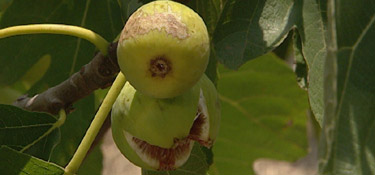
Jesus’ parable about the fig tree is often misunderstood. An emphasis on keeping the ten commandments and doing good works has led to the conclusion that if the fig tree will only be spared if it produces fruit, that we will only be spared if we can manage to build up a folio of good works that can be measured on the day of judgement. However, in this instance, as in most cases in the New Testament, fruit represents much more than external deeds or measurable goodness. As the parable implies, the fig’s bearing fruit is dependent on its receiving enough fertilizer – that is, on its internal health. Fruit trees in general are very reliant on nourishment, they cannot bear fruit unless they have been properly fed and watered. (The first and only time that my parent’s persimmon bore fruit was the year after the ’74 flood had deposited a substantial amount of fertile silt on their garden.)

Many fruit trees need to reach maturity before they bear fruit. Figs generally take two or three years to be well enough established to produce figs and then they will produce best only if they have been given a good start in life – planted in the right situation and fed and watered well. Without help, a fruit tree will probably attain a reasonable height and appear to be growing well, but without the required fertiliser, no amount of growth will produce fruit.

It is possible that Luke combined the sayings about repentance with the parable of the fig tree because he understood that a change of heart (repentance) was required before growth (maturity) could occur. Conversely, repentance alone is not enough, but is a pre-requisite for future development. A change of heart – repentance – creates the sort of internal environment that allows fruit (the external evidence of change and growth) to be produced. That being the case, it becomes clear that Jesus is speaking of fruit (behaviour) which is driven by a relationship with God that is strong and healthy and which is nurtured and developed by the presence of the Holy Spirit. Seen in this light, fruit refers much less to good deeds and much more to the characteristics that result from such a change of heart.

Paul understood this when he wrote of the fruit of the spirit. When he lists the fruit he doesn’t refer to keeping the commandments or doing good deeds but to the external signs of a person at peace with God, with themselves and with the world. Love, joy, peace, long-suffering, gentleness, patience and self-control are the fruit that we are to bear. These are the characteristics that will be a sign of our growing spiritual maturity.

Jesus’ challenge to the disciples that they are not to make the mistake of believing that their turning to him (repentance) is some simplistic, easy fix that will ensure their salvation. Turning to Jesus is only the first step in a process of development that will continue for the rest of their lives and that development, as the parable indicates, will need to be encouraged, fed and nurtured.

Richard Rohr considers spiritual development in his book Falling Upward – a spirituality for the two halves of life[1]. He argues that many people never develop beyond the superficial declaration of faith. Having come to faith, they fail to feed and nurture the depths of their being such that they bear meaningful fruit as a result of their faith. Because they do not pay enough attention to what is going on internally, their external lives never really change. They cannot bear fruit because they have not developed a healthy spirituality that can drive their behaviour.

Rohr suggests that this internal growth is at the core of all religious practice and that it is essential not only for the individual but for the world as a whole. This he claims is because: “God gives us our soul, our deepest identity, our True Self, our unique blueprint at our own ‘immaculate conception’. We are given a span of years to discover it, to choose it and to live our destiny to the full. Our True Self will never be offered again”. The unique person that is ourself has this life only to be the unique person God intends us to be, to achieve the unique goals God has in mind for us and to contribute to the world the unique gifts with which God has endowed us. Our one essential task in this life is to discover and to be that True Self, that unique part of God’s creation. Rohr believes that this task is absolutely imperative for all of us. Heaven and earth, all that is, depend upon our trying to become the person God intended us to be.

Because the implications of this task are so vast, its importance cannot be underestimated. In fact, Rohr suggests, it is because so much is dependent on our spiritual health that the discussion surrounding it is accompanied by such emotionally charged words as “heaven” and “hell”. It is why the vineyard owner threatens to uproot the tree when it is not fulfilling its purpose, why the call to repentance is set in the context of such shocking stories as the slaying of the Galileans and the fall of the Tower of Siloam. The consequence of not nurturing our souls is not something to be taken lightly – it has ramifications for the future of the whole world.

If we allow ourselves grow into our souls, to become the unique being envisaged by God at our creation, God’s purpose not only for us but for the world will be achieved. If we do not grow into our own unique being we hinder God’s purpose, we fail to make our own unique contribution and we refuse the invitation to take part in bringing about the coming of God’s Kingdom.

The purpose of the fig is to bear figs. Without fruit it is taking up space, that could be used to grow something else. It is not fulfilling the purpose for which it was created. Our purpose is to grow into our full identity, that unique self that God has given us and by doing so to share with God in bringing about the kingdom, the salvation of the world.


[1] Rohr, Richard. Falling Upward – a spirituality for the two halves of life. San Francisco: Jossey-Bass, 2011, ix. Note: I acknowledge that I have used Rohr as my starting point, but I am aware that  he may not agree with my use of his premise.