Posts Tagged ‘selflessness’

Being truly whole so that we are wholly free to love.

April 23, 2016

Easter 5 – 2015

John 13:31-35

Marian Free


In the name of God whose love is as strong as death, passion as fierce as the grave[1]. Amen.

She loves you

She loves you

I can remember, as clearly as if it were yesterday, the Christmas that I received my first ever record. It was the year that the Beatles had come to Brisbane and I was nine years old. Even though I didn’t listen to the radio and my parents did not own a TV I was caught up in the hype that surrounded their visit. One of my classmates had even taken the day off school to line the street to the airport and welcome them to the city. Another friend used to sing the song: “Close your eyes and I’ll kiss you”, the song with which a popular TV show of the day concluded. My nine-year-old self knew that she had to be a part of this phenomenon. So when I was asked what I would like for Christmas, there was no hesitation: “I would like a Beatles record.”

My mother and I went into the city to a record shop. In those days the counters were about four-foot tall so I had to stretch to see. “I’d like a Beatles record please,” said my mother. “Which one?” the assistant replied. Mum looked at me, I looked at her. I had no idea that there would be a choice. Helpfully I replied: “One with ‘Yeah, Yeah, Yeah’ on it.” So that is how I came to own this – an EP with ‘She loves you’ on one side and ‘I’ll get you’ on the other. I’d have to say that the lyrics of these and many of the early Beatles songs are not particularly edifying. ‘She loves you yeah, yeah, yeah, she loves you, yeah, yeah, yeah’, and, ‘Love, love me do, you know I love you, so please, love me do’ and yet another, ‘Love is you need, love is you need, love is all you need.’

Love was in the air in the 1960’s and 70’s. Flower children preached it, bumper stickers proclaimed it and popular music extolled it. The problem was that the atmosphere of the day made love sound all too attainable and all too easyms – the answer to all the world’s problems.  Love was not enough to stop the Vietnam war or to bring an end to apartheid and global poverty.

In today’s gospel Jesus enjoins his disciples to love one another in the context of his farewell speech. This includes instructions and warnings, the promise of the Holy Spirit and prayers for the disciples.  The tone for a future without Jesus is set right at the beginning: “I give you a new commandment, that you love one another. Just as I have loved you, you also should love one another.”

As I have loved you. If love was all that we needed, why do so many relationships end acrimoniously and why are so many families torn apart by disputes? The answer is that while there are good reasons for marriages to end – domestic violence being one – many people have a simple and idealistic notion of love.  Some expect love to fill deep needs of their own, others confuse love with control and its opposite subservience and there are those who expect that the simple fact of being love will ensure that their story will be happily ever after.

Jesus apparently has no such illusions, which is why he adds the rider: “Just as I have loved you.” As I have loved you. This is very different from the commandment that asks us to love our neighbours as ourselves. Jesus’ command forces us to consider his life and example and to model ourselves on him.  I quote: “Christ commands us to love as he did, putting neither reputation, nor wealth, not anything whatever before love of our brothers and sisters.” (Cyril of Alexandria)  In a culture in which honour meant everything, Jesus mixed with the disreputable and the outsider, chose poverty over wealth and acted as a servant to his disciples. Though he was divine, Jesus allowed himself to endure all the indignities of being human. In other words, Jesus’ love was a love that thought not of himself, but only of others.

The love that Jesus insists that we show to others is the sort of selfless love that enables us to give up all thoughts of our own needs and desires – for recognition, comfort, satisfaction and instead to ensure the well-being of our brothers and sisters in Christ.

What this entails in practice is being at peace with ourselves and God, being so sure of our place in the cosmos that we do not need to compete with others in order to feel good about ourselves, recognising that we do not need the world’s approval in order to know our own worth, that we do not need to measure ourselves and our worth according the standards of those around us, but  to only according to the standards that Jesus modelled and that Jesus encouraged. For some of us, this means first of all letting go of our own baggage, seeking wholeness and healing for the hurts we carry and the insecurities that drive our behaviour. In some instances it may mean that we take advantage of professional help to lay aside fear, resentment and anxiety or to let go of our sense of inadequacy because ultimately, we are only able to love selflessly from a position of confidence and strength, from a place in which we are completely free of restraint and in which don’t need others to affirm us so we are free to affirm them.

Only when we are absolutely confident in our own worth can we affirm the worth of others. Only when we are completely sure that we are loved and love

able can we selflessly offer love to others. Only when we are truly whole can we wholly give ourselves away.

“Love one another as I have loved you” – it makes the rest of the commandments look like a walk in the park. First of all we have to do everything in our power to accept Jesus’ love and then we have to do all that we can to give that love away.


[1] Song of Songs 8:6

Resurrection – the refusal to give evil the last word

March 26, 2016

Easter Day – 2016

Marian Free


Christ is risen! He is risen today! Alleluia!

Jesus Christ is risen today! The strife is o’er the battle done!

Throughout Western Christendom today, songs of triumph will ring out as believers gather to celebrate the resurrection of Jesus. In the light of recent events such triumphalism seems like a slap in the face for all those who are grieving the victims of the Brussels attacks; for those who face weeks, if not years of surgery and therapy as a result of their injuries and for those who are left wondering “who or what next?”

How is it possible to make sense of the resurrection in the light of the attacks in Brussels, the Royal Commission into child abuse, the coroner’s investigation into the Sydney siege and the pictures of the millions of refugees who would rather face a dangerous sea voyage or wait desperately at border crossings than live with war or poverty? How can we speak of victory in the face of the suffering in Syria, Yemen, Nigeria and countless other places where people just like you and I face the daily horrors of war, the gnawing pangs of hunger and that constant knowledge that it is beyond their power to do anything to protect their children?

There are days when it is difficult not to despair, to wonder if the resurrection of Jesus is an ancient fairy tale or an empty gesture. There are times when we can be forgiven for asking whether Jesus’ death and resurrection made any difference at all. It is clear to anyone who looks that the world that Jesus came to save has not changed. Everywhere we look we see poverty, oppression, injustice, discrimination, warfare and terror. Sometimes it seems as though the signs of life are overwhelmed by the ever-present evidence of death.

And yet, in the midst of horror and despair there is often evidence of life – a refusal to give in to fear and to hate, a determination to hold on and a commitment to live more fully than ever before – to demonstrate that darkness cannot extinguish the light.

It is interesting to note, that in the increasingly secular world, it is Christian symbols, symbols of the resurrection to which people turn when tragedy strikes – the light of a candle, the image of the cross, the placing of flowers, the utterance of prayers, the gathering in memory. The world may not have changed, but the resurrection is deeply embedded in our collective memory. Whether they believe in Jesus or not, at times of despair, people turn to images of the resurrection – images of hope for the future, images that remind us that life can be wrought from death. They seek comfort and support in communal ritual action and in the words of Christian hymns and prayers and they lay flowers in remembrance. Unconsciously, even those who claim not to believe will at times of trauma, turn to the story that provides the world with hope.

On Easter Eve, the Paschal Candle is lit from the new fire. In the darkness of the night the flickering flame is a reminder than when death and terror have done their worst, there is still hope, it is a sign that ultimately the darkness cannot overwhelm the light, nor evil triumph over good. The resurrection is at the centre of our faith – the extraordinary truth that God raised Jesus from the dead, so that all might live. As if that were not enough, the resurrection is also a daily reminder, that it is possible to rise above the ugliness and baseness of human nature, that human beings can and do perform extraordinary acts of selflessness, that in the midst of horror we find courage, strength and compassion and that in the presence of evil we refuse to be cowed or to live our lives in fear[1].

In a world that is far from transformed, the resurrection of Jesus gives us confidence that good will triumph over evil, that love will conquer hate and that life will prove to be stronger than death. Jesus’ resurrection is a sign of hope, a light in the darkness, a reason to hold on when all seems to be lost.

This is why, even in the midst of despair, we can say with absolute confidence “Christ is risen. He is risen indeed! Alleluia!”


[1] Within hours of the explosions in Brussels, locals had arrived at the airport volunteering to drive travelers to other cities. When the earthquake struck Christchurch, people mobilized to get food and water to those who were cut off. When the traffic was stuck because of a major accident, a woman bought bottles of water and distributed them. Simple actions, reminders of the goodness of human nature, the willingness to make sacrifices – small or big and of the determination not to let evil or tragedy have the last word.

No easy answers

March 26, 2016

Go back

Your message has been sent

Warning
Warning
Warning
Warning

Warning.

Today we meet, not only in the shadow of an act of terror over two thousand years ago, but also in the shadow of events in our own day. We draw comfort from the knowledge that God in Jesus shares our suffering. We know too that in Jesus God wrought victory from defeat, joy from sorrow and life from death and we believe that good will triumph over evil and that love will conquer hate.


Service of the Passion

and

Recognition of the Cross
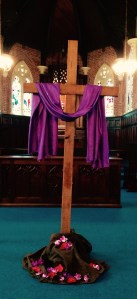
 

The contradiction of the cross

The contradiction of    the cross


(On this most solemn of days we would invite you to enter
and leave the church in silence.)


Procession with cross:

Hymn: 349 in the cross of Christ

Greeting:

The Lord be with you.

And also with you.


Let us pray:

God of contradiction,

give to us wisdom and understanding,

patience and humility,

and the courage to live with uncertainty,

so that we may hope for the right things

and arrive at what we do not know[1].

We ask this through your Son our Saviour Jesus Christ. Amen.


Poem: T. S. Eliot – from The Four Quartets


I said to my soul, be still, and wait without hope

For hope would be hope for the wrong thing; wait without love

For love would be love of the wrong thing; there is yet faith

But the faith and the love and the hope are all in the waiting.

Wait without thought, for you are not ready for thought:

So the darkness shall be the light, and the stillness the dancing.

Whisper of running streams, and winter lightning.

The wild thyme unseen and the wild strawberry,

The laughter in the garden, echoed ecstasy

Not lost, but requiring, pointing to the agony

Of death and birth.


You say I am repeating

Something I have said before. I shall say it again,

Shall I say it again? In order to arrive there,

To arrive where you are, to get from where you are not,

You must go by a way wherein there is no ecstasy.

In order to arrive at what you do not know

You must go by a way which is the way of ignorance.

In order to possess what you do not possess

You must go by the way of dispossession.

In order to arrive at what you are not

You must go through the way in which you are not.

And what you do not know is the only thing you know

And what you own is what you do not own

And where you are is where you are not.


In the name of God who suffers for us and with us, and who longs for us to turn and be made whole. Amen.

“And what you do not know is the only thing that you know.”

Shortly after five pm on Tuesday the world was shocked by the news of yet another act of terror – this time in Brussels. At least thirty people were dead and more than two hundred wounded many seriously. For those of us in Australia this news followed a grueling day in which, through the inquest into the police response, we revisited the final moments of the Lindt Café siege and the deaths of two hostages. At times like this, it is difficult not to ask: “Why?” “Why now?” “Why them?” As the story of the Brussels explosions unfolded, we learnt that a simple decision such as not buying a coffee made the difference between life and death, between being in the line of fire and being a safe distance away from the explosions.

Times like these remind us that there is a fine line between life and death, and that sometimes there is no rhyme or reason as to why one person lives and another dies, why some people live lives seemingly unfettered by grief or disaster and others live lives of quiet desperation, burdened by pain, sorrow or misfortune.

This side of the grave there are no easy answers. Life as we know it is vulnerable and fragile – susceptible to disease and constantly exposed to hazards and dangers – known and unknown. At the same time, humans are complex beings – capable of acts of great selflessness but also of unfathomable depravity, capable of great love, but also of immense hatred. We live in a world in which the good do die young, and the bad sometimes escape unpunished, in which only chance determines the country of our birth or the quality of our parenting, whether we stop for coffee or go straight to the departure gate. In this life, nothing is certain. We cannot predict what joys or heartache lie ahead.

There are two possible responses to this awful uncertainty – we can resist with all our might, refuse to take risks and try to force the world to conform to our expectations. This road will lead to frustration and disappointment, anger and bitterness. Our lives will be narrow and constrained and there will be no guarantee that we will be spared the pain of suffering and loss.

Alternately, we can willingly surrender. We can accept that life is filled with risk and uncertainty and choose to live boldly, courageously and confidently – no matter in what circumstances we find ourselves. This road will not be free of pain, but it will leave us open to joy and laughter, to adventure and hope. We will be able to ride out the bad times because we know that they will come to an end and that it is the good and the bad together that make life worth living.

Jesus chose the latter course. He willingly gave in to the future that was his. He surrendered himself completely to what life had in store. He submitted himself to the humiliation of a kangaroo court, the indignity of a flogging and the certainty of death of the cross. He did not ask: “Why?” or “Why me?” He simply walked the path that was his to walk, believing that somehow, in some way, God would give him both courage and strength in the present and that in the future, it would all begin to make sense. Jesus faced the cross not knowing what lay on the other side. As a consequence he learnt that through death comes life, that joy can be wrought from sorrow and victory from defeat.

Life is filled with uncertainty. The best that we can do is to place ourselves entirely in God’s hands and trust that in this life God will give us courage to face whatever it is that life throws at us and that in death, God will raise us to life eternal.

Reflection:

An abandoned God;

a dying God

confronts our sense of decency

and at the same time opens us to new possibilities –

to new ways of understanding God and ourselves.


Collect:


Holy God,

who teaches us that this day

which is so bad, is good.

Help us to live with incongruity

to know how much we do not know,

that understanding our limitations,

we may be open to the wisdom that comes from you alone. Amen.


Ministry of the Word

Isaiah 52:13 – 53:12

Hear the word of the Lord,

Thanks be to God.

Psalm 22

My God, my God, why have you forsaken me:

            why are you so far from helping me

            and from the words of my groaning?

My God, I cry to you by day, but you do not answer:

            and by night also I take no rest.

But you continue holy;

            you that are the praise of Israel.

In you our forebears trusted:

            they trusted and you delivered them.

To you they cried and they were saved:

            they put their trust in you and were not confounded.

But as for me, I am a worm and no man:

            the scorn of all and despised by the people.

Those that see me laugh me to scorn:

            they shoot out their lips at me

            and wag their heads, saying,

“He trusted in the Lord – let him deliver him:

            let him deliver him, if he delights in him.”

But you are he that took me out of the womb:

            that brought me to lie at peace on my mother’s breast.

On you have I been cast since my birth:

            you are my God, even from my mother’s womb.

O go not from me, for trouble is hard at hand:

            and there is none to help.

Many oxen surround me:

            fat bulls of Bashan close me in on every side.

They gape wide their mouths at me:

            like lions that roar and rend.

I am poured out like water,

and all my bones are out of joint:

            my heart within my breast is like melting wax.

My mouth is dried up like a potsherd:

            and my tongue clings to my gums.


My hands and my feet are withered:

            and you lay me in the dust of death.

For many dogs are come about me:

            and a band of evildoers hem me in.

I can count all my bones:

            they stand staring and gazing upon me.

They part my garments among them:

            and cast lots for my clothing.

O Lord, do not stand far off:

            you are my helper, hasten to my aid.

Deliver my body from the sword:

            my life from the power of the dogs;

O save me from the lion’s mouth:

            and my afflicted soul from the horns of the wild oxen.

I will tell of your name to my companions:

            in the midst of the congregation will I praise you.

O praise the Lord, all you that fear him:

            hold him in honour, O seed of Jacob,

            and let the seed of Israel stand in awe of him.

For he has not despised nor abhorred

the poor man in his misery:

            nor did he hide his face from him,

            but heard him when he cried.

The meek shall eat of the sacrifice and be satisfied:

            and those who seek the Lord shall praise him –

            may their hearts rejoice forever!

Let all the ends of the earth remember

and turn to the Lord:

            and let all the families of the nations worship before him.

For the kingdom is the Lord’s:

            and he shall be ruler over the nations.

How can those who sleep in the earth do him homage:

            or those that descend to the dust bow down before him?

But he has saved my life for himself:

            and my posterity shall serve him.

This shall be told of my Lord to a future generation:

         and his righteousness declared to a people yet unborn,

         that he has done it.

1 Corinthians 1:18-31

Hear the word of the Lord,

Thanks be to God.


Hymn: 339 O sacred head sore wounded


The Gospel of our Lord Jesus Christ according to John Chapter 18 beginning
at verse 1.

Glory to you Lord Jesus Christ.

For the Gospel of the Lord.

Praise to you Lord Jesus Christ.


Hymn: 341 My Song is love unknown.

(During the hymn a collection will be taken up for the Anglican Diocese of Jerusalem)


Intercessions:

Living, loving God, help us to relinquish our confidence in ourselves and our desire to go it alone;

to accept the vagaries of life and to let go of our need to be in control;

to recognise that we do not and cannot have all the answers and to understand that our knowledge is only partial and our insights limited by our humanity.

God when our hearts are aching,

Help us to find you in and among the suffering of the world.

Give us grace to acknowledge that life consists of the good and the bad and that our lives are enriched as a result;

to admit that hatred and fear only limit and bind and that love frees us to be fully alive

and to learn that it is only in your that true peace and joy are to be found.

God when our hearts are aching,

Help us to find you in and among the suffering of the world.


Be with all those whose lives are marred by violence, terror and war,

and with those who perpetrate acts of cruelty against others.

God when our hearts are aching,
Help us to find you in and among the suffering of the world

Support and encourage those whose lives are restricted by poverty, ill-health and disability,

and challenge those who have the means to help but do not.

God when our hearts are aching,
Help us to find you in and among the suffering of the world

Be a friend to those who are overlooked and discounted

and open our eyes to the suffering of those around us.

God when our hearts are aching,
Help us to find you in and among the suffering of the world.

Help us all to reevaluate our lives in the light of the cross and take our place among those who live life to the full and who make a difference in the lives of others.

God when our hearts are aching,
Help us to find you in and among the suffering of the world.


Lord’s Prayer: Accept our prayers through Jesus Christ our Lord,

who taught us to pray.

            Our Father in heaven,

                        hallowed be your name,

                        your kingdom come,

                        your will be done,

                        on earth as in heaven.

            Give us today our daily bread.

            Forgive us our sins

                        as we forgive those who sin against us.

            Save us from the time of trial

                        and deliver us from evil,

            for the kingdom, the power, and the glory are yours

                        now and forever. Amen.

Confession:

Our God whose love knows no bounds

comes to you – naked, weak and bleeding,

holding out holey hands, holy hands and asking only for your love in return.


Let us offer our hearts to God, confessing our sins – the barriers that separate us from each other and from God.

Suffering God,

who gave everything for us

forgive us our arrogance and presumption,

our greed and self absorption,

our neglect of the vulnerable,

our carelessness with the world’s resources,

our unwillingness to trust in you

and our failure to accept and to share your love and compassion. Amen


Absolution:

God whose love knows no bounds

forgives you and sets you free

to love God and to love one another.

Forgive others,

Forgive yourself. Amen.

Recognition of the cross:

730 Jesus remember me when you come into your kingdom.

(Recognition of the cross – you may like to place a flower at the foot of the cross, as a reminder that today is a day of contradiction, a reminder that God continually overturns our expectations so that we might rely on God and not ourselves. Alternately you are welcome to sit or stand in quiet reflection.)

Blessing: May the God who died for you, inspire you to live for God,

and the blessing of God almighty, Creator, Redeemer and Sanctifier be with you now and always. Amen.


Hymn: 262 When pain and terror


Please leave the church in silence


Copyright: Marian Free , 2014 (revised, 2016)


ANZAC DAY

There will be a service to commemorate Anzac Day

Monday 25th April – 8:00am


(If there is anyone for whom you would like us to pray,

Please add their name to the list at the back of the church.)


Rector:          The Rev’d Marian Free: m) 0402 985 593

  1. e) staugust@bigpond.com


Curate:                 The Rev’d Professor Rodney Wolff,

  1. e) staugust@gmail.com, 0426 287 283


Parish Office:       3268 3935 / Fax 3268 4245

Office Hours:       Monday, Thursday & Jumble Wednesdays

                               9.30am – 12.30pm


staugust@bigpond.com

www.staugustineshamilton.com.au


Sermons:            If you would like to read the weekly sermon,

                                 go to the home page and click on sermon.


            St Augustines Anglican Church


@StAugustines


Music Director:      Lesley de Voil: 0418 561 663 or

                                         lesleymdv@gmail.com


Service Times:      Sunday 7:30am & 9:30am

                               Tuesday & Thursday 7:00am

Wednesday 10:00am


Columbarium:      Robin Loan: 0417 799 400 or

                                 r.loan@optusnet.com.au

Columbarium Service: First Saturday of the month 7:30am


[1] “For hope would be hope for the wrong thing.” “In order to arrive at what you do not know you must go by a way which is the way of ignorance.” T.S. Elliot from “East Coker, The Four Quartets”

Our life to live

April 25, 2015

Easter 4 – 2015

John 10:(1-10) 11-18

Marian Free


In the name of God, Shepherd, protector, liberator. Amen.

Most of us would, I think, agree that the Internet is a marvelous tool. That said, we cannot ignore the darker side of this form of mass communication. Just week I heard about a social media site on which Year 8 girls can post pictures of themselves wearing bikinis. Innocent enough you might think until you learn that the photo only stays on the site if enough other girls vote for it to stay. It makes you wonder what sort of arrogance would lead to someone setting up the site and what sort of insecurities would lead to twelve and thirteen year old girls exposing themselves to the sort of large-scale rejection that might follow. That, of course is only one of many sites. There is, in the United States at least, a site called “Revenge”. Men, who have persuaded girlfriends to send photos of themselves in various stages of undress, upload those photos on to the site when the relationship goes sour. The young women discover that they are recognised wherever they go and are mortified to realise that they whole world has seen them naked. Then there are those who use the internet to prey on young people with promises of love, but whose real intention is to use and abuse them.

The Internet is wonderful, but it can be a minefield for the vulnerable, the inexperienced and the naive. It offers fame and fortune but can be sordid and soul-destroying. It can provide a sense of belonging yet also be the source of the most awful social exclusion. People, like sheep, are not always discerning about whom they follow whether it be fellow teens, an over-bearing boyfriend, an employer who plays fast and loose with the law, a Hitler, or an Idi Amin. The human need for affirmation and approval is sufficiently strong that it is possible for some to ignore the small twinges of disquiet that alert them to the fact that all is not well – that they are being used, bullied or taken advantage of. When people are desperate to fit in, they do not always notice the warning signs. They take risks that may have disastrous consequences and they place their trust in those who are only interested in exploiting or taking advantage of them, of using them for their own gain or gratification. They follow people who in the end are not interested in the personal, emotional or social needs of those whom they ensnare but come – as do the thieves in today’s gospel, to steal, kill and destroy.

Sadly, some people are so deafened by the din of the world around them and so anxious to belong to that world that they are either unable or unwilling to listen to their own hearts. Instead of being true to themselves they follow those who offer false hopes and a false sense security. Instead of finding freedom and wholeness they discover that they are constrained and they remain unsatisfied, unfulfilled.

It is in contrast to the thieves, and robbers, (the hired hands, those who exploit), that Jesus describes himself as the “good shepherd.’ The good shepherd does not seek followers to use for his own nefarious means and he does not want to exploit those who follow him in order to achieve his own purposes. The good shepherd has no regard for his own needs, In fact, rather than demand anything of those who choose to follow, the good shepherd wants only what is the best for the sheep to the extent that the shepherd would lay down his life to ensure the well-being of the sheep. In the context of the verse that precedes today’s passage, the good shepherd has come so that the sheep may have life and have it abundantly. This is not a half-life in the shadow of the shepherd, but a life that is rich and full, in which every opportunity is provided for the sheep to achieve their own potential. In other words, the good shepherd does not entrap or limit, but liberates and encourages those who follow to be confident in themselves and to live their own lives.

The good shepherd is selfless – the sheep always come first. The good shepherd is also inclusive. No one has to behave or dress in a certain way to belong. To be part of this flock does not require compromise or a willingness to bend the rules in order to fit in. In fact, so far from being selective, the good shepherd is clear that there are other sheep who do not yet belong – those who live in fear, those who are lost and defenseless, those who are trapped in unhealthy ways of perceiving themselves, those who are enslaved to fads and fashions, those who are struggling to fit in and in so doing become what they are not. The good shepherd wants to bring these into the flock so that they too might “have life and have it abundantly”.

Hearing and responding to Jesus’ voice does not mean being bound by rigid rules or being forced to behave in particular ways. It does mean means hearing the shepherd above the cacophony and demands of the world, it means understanding that we can rise above the need or desire to conform to trends and fashions and it means having the courage to be our own selves knowing that we are so precious, that Jesus would rather give up his life than see us put upon or used,or be what we are not.

The good shepherd wants us to hear his voice, to draw us into his fold, not because he wants us to conform to certain ways of behaving, not because he wants full churches, not because he afraid that we will be condemned at the judgement, but purely and simply because he loves us. Jesus loves us unreservedly and unconditionally and longs for us to make decisions that will lead to our wholeness. Jesus wants all people to know that there is no need to conform to external, worldly measures. It doesn’t matter whether a person is beautiful or plain, clever or not so clever in the eyes of the world, in Jesus’ eyes they are unique and valued.

Thirteen year olds who know that they are precious and loved will not need to expose themselves to rejection, young women will know that their bodies are their own will not be coerced to share them in ways that make them uncomfortable, young men will not need to boast of their conquests in order to impress their mates. Those who follow the good shepherd will discover that the world and it values will lose its hold on them and they will know that their life is their own to live. They will know as Jesus knew that their life is theirs to give and to take up and that no one can take it from them.