Posts Tagged ‘surrender’

Complete surrender

October 9, 2021

Pentecost 20 – 2021
Mark 10:17-31
Marian Free

May I speak in the name of God – Earth-maker, Pain-bearer and Life-giver. Amen.

It has been a long time since I have had to do a comprehension test. So long that I’m not sure that I can accurately remember what they entailed. I do know that they were a component of my early primary school years and I imagine that they were an important aspect of my German lessons. From memory, a comprehension test involved reading a text (or having it read to me) and then being asked a number of questions to determine how well I had understood the passage.

How well would you do, do you think if I gave you a test on today’s gospel? To begin with, you might have to divide what is quite a complex text into its component parts – Jesus’ conversation with the man, Jesus’ teaching his disciples and Jesus’ response to Peter’s question. With regard to the first six verses, I might ask: What Jesus was doing? How did the man approach Jesus? What do we know about the man and what did he want from Jesus? How did Jesus respond and how did the meeting end?

There are a number of points of interest in this text. In the first instance Jesus was “setting out”. He was continuing on his journey when a man ran up and knelt before him? Kneeling is a strange thing to do as the man is not asking Jesus from Jesus. What is the reason for his urgency and why does he kneel, especially when he seems so confident in his own goodness and piety? Interestingly, Jesus rejects the expression “good” Teacher, reminding the man that only God is good. Then instead of listing the ten commandments Jesus mentions only six and does not include love of God or love of neighbour.

I find this one of the more poignant encounters in the gospels. We have to assume that the man’s question and his sense of urgency were genuine, but his confidence in himself could have been seen as arrogance. Was he simply hoping that Jesus would affirm his goodness and his piety? We don’t know. What we do know is that Jesus doesn’t censure the man for the interruption or for his lack of humility. Instead, he looks at him and loves him. Then he drops a bombshell: “you lack one thing, go, sell what you own and come follow me.”
According to Mark the man is shocked (or even appalled) by Jesus’ words. Jesus’ answer was certainly not what he was expecting. He believed, as did his contemporaries, that wealth signified God’s favour. The man presumably saw his possessions as an affirmation that he was keeping the commandments to God’s satisfaction. How could Jesus possibly ask him to give up the very thing that proved his worth in God’s eyes? It was a step too far but even so he went away grieving. He had not found what he sought.

There has been much debate as to whether or not discipleship entails giving up one’s possessions or not, but the central point of this passage is not wealth, rather it is our willingness to depend on and to trust in God. It is about whether we believe that our place in the Kingdom of God and our certainty of inheriting heaven depends on earthly values – wealth and status or on heavenly values. It is about whether we rely our own efforts to achieve the Kingdom or whether we graciously accept that Jesus has done all that needs to be done.

Ever since Jesus announced his death and resurrection he has had to correct misunderstandings about the nature of discipleship. Now he finds that he has to adjust expectations as to what is required to enter the kingdom of God. The two, of course are related. Jesus has been at pains to make it clear that discipleship involves sacrifice not exaltation, service not power, collaboration, not competition. Discipleship does not confer status or make one distinctive – just the opposite. In the same way the Kingdom of God is not characterised by social climbing, rivalry or competition. There is no hierarchy in heaven. We will not be spending eternity comparing ourselves to others so why would we believe that it is OK to do that in the present.

God does not have a hierarchy. We are not measured by how well we compare (or do not compare) with others but by how well we have learnt Jesus’ lesson of complete surrender. We are judged not by what we have, but by what we have been willing to forgo, not by what we have done, but by what we have graciously allowed God to do for us.

Status and wealth might define us in the present but, as Jesus has been at pains to point out over the past few weeks, they are irrelevant in the Kingdom of God. As the saying goes: you can’t take it with you – not wealth, not status – not anything that we cling to that we beleive gives our lives meaning and which distinguish us from those around us. Jesus is trying to make it clear by his teaching and by his example that, if we want to be part of the Kingdom – in the present, or for eternity, then we need to begin to live the kingdom values now. Not only will that prepare us for eternity, but it will radically change the present.

The man who approached Jesus was defined by his possessions – physical, earthly evidence of his worth and his goodness. He refused to believe that his life had value without them. He was unable to accept that there are no distinctions in heaven. He was so concerned for the present that he was unable to prepare himself for the future.

What about us? Are we preparing ourselves for eternity or allowing ourselves to be defined by earthly symbols, earthly values? If we cannot relinquish our symbols of worth in the present, what makes us think that we will be ready to relinquish them in order to enter heaven?

What do you cling to and can you begin to let it go?

The true victory is the cross

April 11, 2020

Easter Day – 2020 (Locked down due to Covid 19)

Matthew 28:1-11

Marian Free

In the name of God, Earth-Maker, Pain-Bearer, Life-Giver. Amen.

“Those who want only God’s will want nothing for themselves, except to carry out God’s will for themselves and for others. But those who operate through their own wills leave no space for God”.[1]

In The Christian Century this week Richard Lischer wrote: “What Jesus offers this Holy Week is not an escape from loss but a better way of losing.” “Not an escape from loss, but a better way of losing.”[2] In other years and in other settings, we have approached Easter with a sense of joy and triumph. We have made it through Lent, spent time in solemn reflection on Maundy Thursday and especially on Good Friday. On Easter Day then we feel free to reflect not on the lessons of Lent or on the sufferings of Jesus but on the wonderful act of God in raising Jesus from the death.

It is difficult in times of relative comfort to really grasp the significance of loss and suffering that lie at the heart of the Christian faith, to forget that the Saviour of the World gave up absolutely everything in order to faithfully answer the call of God, that the resurrected Christ was only possible because of the crucified Christ.

This Easter, when we are facing the loss of social contact, the loss of being present at our Easter services, the loss of freedom and, for many, the loss of jobs, income and businesses, it is timely to reflect that at the heart of the Christian faith is not victory but surrender, not triumphalism but deep humility, not even of resurrection but of the dying that enables resurrection.

All of this is evident in Jesus’ life, who from the moment of his baptism began to let go of his own ambitions and desires and to place himself wholly at God’s disposal. Instead of relying on himself and his own resources, Jesus emptied himself thereby allowing God to work in and through him. In fact, as John’s gospel makes clear, Jesus’ true divinity is revealed on the cross, the place of Jesus’ greatest suffering is the place of his triumph. It is on the cross that Jesus fully realises his destiny, his complete submission to God. The resurrection is a confirmation of Jesus’ victory, it is not the victory itself.

This time of isolation and deprivation is not of our choosing, but it does provide an opportunity to explore our own willingness (or lack thereof), to follow Jesus’ example, to let go of our need to be in control, our desire to achieve something or to be someone. Instead of seeing the closure of our churches as a deprivation, we can see this moment as an occasion to let go of the props on which we rely and to allow ourselves to trust completely in the presence of God.

It is precisely circumstances such as these that – at their best – throw us on the mercy of God and force us to learn that it is when we give up everything that we gain more than we could ever imagine and that when we surrender our lives to God that God can truly work in and through us.

Have a Happy and Holy Easter and instead of being sad about what we do not have let us rejoice in the lessons that this Easter has to teach us.

Every Sunday is a celebration of the resurrection. We will gather once more and how much will we have to celebrate!


[1] Marguerite Porete, in The Flowering of the Soul: A Book of Prayers by Women, Ed Lucinda Vardey, Australia: Random House, 1999, 300.

[2] https://www.christiancentury.org/article/2012-03/stripped-bare

You have been warned!

September 7, 2019

Pentecost 13 – 2019

Luke 14:25-35

Marian Free

In the name of God who ask nothing less than all we have to give. Amen.

Earlier this year a father and son went missing on Cradle Mountain. Grave fears were held for their safety as the weather had closed in and there had been a heavy snow fall. If you stay in a youth hostel anywhere in Tasmania you will be confronted by posters that warn you that the weather in that state is variable and can turn bleak without warning. It would be unwise, the warnings suggest, to set our on a walk unless you are adequately prepared. Even on a sunny, summer day there is no guarantee that it will not turn bitterly cold or even snow, or that visibility will not be seriously reduced. A wise tramper, even if only planning a day trip, will at the very least take a sleeping bag and more food and drink than needed. Better still, that hiker will also pack a tent so that if they are caught out, they will at least have shelter and warmth until the clouds lift or the snow stops falling. Fortunately the father and son duo were no novices. When they realised that conditions had changed they simply set up camp instead of taking the risk of trying to make it to the next shelter. They were found unscathed because they had been prepared for all eventualities.

Today’s gospel acts as a warning for those who set out believing that following Jesus is like a walk in the park. Like the posters in Tasmanian youth hostels, the gospel warns would-be disciples that the journey is not one to be undertaken lightly and should only be entered into if one understands the terrain and is prepared, not only for the journey, but for its possible end.

Jesus has ‘set his face towards Jerusalem’. The turn of phrase suggests a steely determination and an awareness of what awaits him there. The large crowds who follow him have no idea what lies ahead. They have presumably been attracted to Jesus by his healing miracles, his compassion or his teaching. Whatever their reason for following, Jesus needs to warn them that being a disciple is much more than basking in his reflected glory, taking comfort in his compassionate nature, reveling in his revolutionary teaching or rejoicing at his humiliation of the religious leaders.

From the moment that he ‘sets his face towards Jerusalem’, Jesus has made it absolutely clear to any who seek to follow him clear that becoming a disciple involves a radical re-orientation of their life. It is not something to be undertaken lightly because discipleship means giving up everything that matters – family, possessions and even life itself. Discipleship, Jesus insists, means putting God at the centre of their life and seeing everything else from that perspective.

This is not the first time that Luke’s Jesus has insisted that a follower give up their family, or at least make them second to him and it is not the first (and it will not be the last) time that he encourages the disciples to make life-changing decisions about their possessions. Not only must Jesus’ followers be prepared to relinquish everything that they hold dear, but, Jesus insists, that they should not even bother starting out on the journey if they are uncertain as to whether or not they can go the distance. There is no point in starting, he claims, if they are going to fall by the wayside or need rescuing simply because they have started out ill-prepared, unaware of the conditions or of the nature of the path that lies ahead. Once again, this is not a new theme for Jesus. When he first set out on this journey, Jesus demanded that “the dead bury the dead” and that one should not “turn back having their hand to the plough” and warned future disciples that he ‘had nowhere to lay his head.’

Indeed, throughout the gospel, Jesus tells his would-be followers that being a disciple is no guarantee that the path will be smooth or that they will be protected from hardship and grief. In fact, he suggests that the reality of discipleship may well be just the opposite. Being a disciple is as likely to lead to degradation and humiliation as it is to recognition, to apparent failure as it is to lead to success. Those who follow Jesus must be prepared to share Jesus’ fate. They must bear the consequences of following to the point of being willing to ‘take up their cross’ should that be their fate.

It is quite clear that the only way to truly follow Jesus is to relinquish our dependence on everything else – our identity, our self-interest, our need for self-preservation, our ambition, our pretense, our false conception of the world and our need for control. Most of us, I believe, make a faltering start on our journey. Despite Jesus’ demands and the warnings the gospels have preserved for us, few of us surrender everything all at once. Our lifetimes are a process of gradually letting go of all that stands between ourselves and God – possessions, friendships and family, achievements and so on.

We do know know the road ahead, but we cannot say that we haven’t been warned. Let it never be said that we did not know what we were getting into or what is required of us and let us hope that at the end we will not be found to be holding on to anything but will have given ourselves (heart, souls and body) entirely into the hands of God.

Placing our life into the hand of God

April 13, 2017

Good Friday – 2017

Marian Free

I said to my soul, be still, and wait without hope

For hope would be hope for the wrong thing; wait without love

For love would be love of the wrong thing; there is yet faith

But the faith and the love and the hope are all in the waiting.

Wait without thought, for you are not ready for thought:

So the darkness shall be the light, and the stillness the dancing.

Whisper of running streams, and winter lightning.

The wild thyme unseen and the wild strawberry,

The laughter in the garden, echoed ecstasy

Not lost, but requiring, pointing to the agony

Of death and birth.


You say I am repeating

Something I have said before. I shall say it again,

Shall I say it again? In order to arrive there,

To arrive where you are, to get from where you are not,

You must go by a way wherein there is no ecstasy.

In order to arrive at what you do not know

You must go by a way which is the way of ignorance.

In order to possess what you do not possess

You must go by the way of dispossession.

In order to arrive at what you are not

You must go through the way in which you are not.

And what you do not know is the only thing you know

And what you own is what you do not own

And where you are is where you are not.

T.S. Eliot, East Coker

Good Friday – 2017

Marian Free

In the name of God who is our all in all. Amen.

“Wait without hope for hope would be hope for the wrong thing.”

At first glance, Elliot’s poem expresses a view of life that is bleak, desperate and hopeless. “Hope is hope for the wrong thing, love is love for the wrong thing. You must go by the way wherein there is no ecstasy, by the way of ignorance, the way of dispossession.” The poem expresses sentiments that are completely at odds with message of the culture of today. In popular culture, in our magazines and on our televisions we are bombarded by stories of people who insist that anyone can achieve anything as long as they set their minds to it. Popular culture gives the impression that a person’s future is entirely in their own hands – they just have to have a positive attitude, believe in themselves or work hard enough.

Elliot, a Christian, knows that the reality is very different. The poem expresses an understanding that ultimately we have very little power to determine the course of the future. All of us, rich and poor, powerful and vulnerable are subject to the instability of the planet, the frailty of our bodies, the ever-present threat of disease, the carelessness of others, the cynicism of politicians and the greed of those who seek to enrich themselves at the expense of others. In reality each of us has very little control over every aspect of our lives. The only certainly, the only still point in a world that is beyond our ability to direct is God. God alone knows how the future will turn out, God alone can see us through whatever this temporary, unpredictable life has to offer.

Ironically, the only way to achieve anything meaningful and eternal is to surrender control, to cede all power to God, to allow God to determine and direct our path, to trust that God will bring us through to wherever it is that we are meant to be. Only by surrendering ourselves completely to God will we discover the direction in which we are intended to travel. Only when we give ourselves completely to God will we be sure that we are hoping for the right thing, loving the right thing. Only a life totally aligned with God can be a life that is truly godly.

These are the truths that Jesus’ life reveals. As the Son of God, Jesus could have done anything, been anyone. Jesus could have ruled the world, sought glory, riches and power. Instead Jesus chose to surrender himself completely to God, to do only those things that he believed were of God. So completely did Jesus trust in God’s direction that he endured the shame of arrest and trial, the indignity of flogging, the torment and pain of the cross, the emptiness of death and the uncertainty of where it would all end.

Only complete and total surrender “to the way wherein there is no ecstasy”, brought Jesus to where he was truly meant to be. Jesus’ surrender of himself led to his victory over death – not only for himself but for each one of us. The horror of the cross was transformed to the joy and triumph of the resurrection.

We cannot know what lies ahead. We do know that we can trust God.

Let us, with Jesus, surrender control, step into the unknown and place our lives completely and utterly into the hand of God.


Intercessions

God whose Son surrendered himself entirely into your hands, open the eyes of all who “hope for the wrong thing” – those whose desire for power and control, for wealth and security disempowers and impoverishes others. Help us and all humankind to surrender ourselves entirely to your will so that the world might become a place in which all people live in freedom and peace and in which all have an opportunity to reach their full potential.

God in whom we trust. Hear our prayer.

God who turns despair to hope, defeat to victory, death to life, give to your church such confidence in you that it will not fear for its future or seek to protect its position in the world, but to understand “that the faith and the love and the hope are in the waiting”. May we surrender our desire for certainty to the knowledge that all things are in your hands.

God in whom we trust. Hear our prayer.

God whose love for us knows no bounds, give us the skills we need to be bearers of that love to others – especially to those who betray and abandon us, who hurt us and let us down. May the dispossessed and powerless experience the life-giving power of your love.

God in whom we trust. Hear our prayer.

Jesus who became vulnerable even to death, support and uphold all whose lives are beset by illness and strife, give courage to the dying and hope and confidence to the living.

God in whom we trust. Hear our prayer.

Jesus who took “the way in which there is no ecstasy”, give us the courage and confidence to surrender ourselves wholly to you, that we with you might pass from death to life eternal.

Accept our prayers through Jesus Christ our Lord who taught us to pray:

Our Father in heaven, hallowed be your name…

Surrendering our need to know

July 9, 2016

                                                                                           Pentecost 8 – 2016

                                                                                                 Luke 10:25-37

Marian Free

In the name of God who stretches, challenges and inspires. Amen.

There is a wonderful movie out of Kenya called ‘The First Grader’. It recounts the true story of an old man who, on learning that the government is offering ‘free education for all’ presents himself at the local school. The first day he is refused admission by one of the teachers on the basis of his age. Undeterred, he returns the next day, only to be told that he requires a uniform. On the third day he arrives in cut off trousers, long socks and sandals only to be told that there are simply not enough desks and that he must go home. However, his determination pays off when the head teacher allows him to join the class. Conditions are basic. The classes are large and at least one child has to sit on the floor to accommodate Maruge. The teacher is enthusiastic and passionate which is some compensation for the lack of space and equipment.

Two scenes stand out. One is that of a small boy who is asked to come to the front of the class and draw the number five on the blackboard. He does so, but writes it backwards and the other children laugh at him. The other is that of Maruge who, refusing to believe that the boy is stupid, makes a ‘story’ about the number five having a fat belly and a hat. Because the information was presented to the child in a different way by someone whose starting point was that he could learn, the boy was able to imprint the information on his memory.

All of us learn in different ways and have different ways of receiving and processing information. At its best education harnesses those abilities, develops and enhances inquisitiveness and creates a desire to continue to learn. At their best our educational institutions create not individuals who know everything but people who realise how much there is still to know. At their worst they create individuals who are locked into only one way of knowing and who believe that what they have been taught is not only all that they need to know, but that what they know remains true forever.

A similar argument could be made for spiritual education – that is, ideally it creates an openness, an humility, a sense of awe and above all the realisation that there is so much more to know. Sadly this is not the reality for many. Instead of having their minds and spirits expanded through a growing awareness of the utterly other, they are taught rules and regulations, ‘facts’ about God. They are given the impression that faith is about what God expects of us and what we can expect of God. In those instances becomes a closed and limited phenomenon rather than an experience that is unbounded and endlessly open.

It is this latter form of spiritual education that results in fundamentalism and in the sort of arrogance that asserts that there is only way of believing and living and that this way should be imposed on both the willing and unwilling alike. It leads to judgementalism and narrowness and a belief that it is possible to determine who is good and who is bad by the degree to which people conform to established modes of conduct. The end result of such an approach is the opposite of its intent – it leads not to a healthy relationship with the divine, but to a life in which God is no longer required to provide direction or guidance.

Over and over again the Christian scriptures challenge the view that it is possible to know everything there is to know and certainly that it is impossible to know even a fraction of all a there is to know about God. Perhaps the finest example of this is God’s response in the Book of Job. God is taunting Job, challenging him to prove his wisdom and understanding in comparison with that of God. Paul confronts the arrogance of the Roman community when he reminds them that the foolishness of God is wiser than the wisdom of humans and Jesus consistently points out the limited understanding of those who would challenge him in debate.

Today’s gospel is one such example. The lawyer asks a question, not because he wants to know the answer, but because a he wants to test Jesus. Jesus turns the question back on the enquirer, who responds with another question. Jesus’ response is to tell a parable which, with its shock conclusion, exposes the self-satisfaction of the lawyer and his narrow view of God. The lawyer, like so many of those who opposed Jesus, appears to have a fixed and legalistic view of God and of faith. They seem to believe that they know exactly what is expected of them and of others. As a result they believe that they are in a position to judge and that they can determine who is in and who is out. Their faith has been reduced to a number of pre-determined precepts and they do not have the flexibility to see beyond what they believe they know to understand what it is that they do not know.

Today’s parable is one that many of us have learned in Sunday School. It is so familiar to us that we no longer appreciate the challenge it presents and are happy to accept the conventional view that it is about doing good deeds or helping others. If we listen/read carefully, we will see that Jesus does not answer the lawyer’s question. Instead of describing a person to whom one should be neighbour, Jesus challenges the lawyer to consider neighbourliness from a surprising and unexpected quarter – the reviled and despised Samaritan. Being a neighbour, accepting neighbourliness is not something that can be confined to definition, but is a concept that continually expands as we learn more about the world and about God’s inclusive love.

In this and other ways, Jesus was constantly stretching and expanding the established view, pushing people beyond conventional ways of understanding and insisting that they rely on God and the movement of the Spirit and not on their own limited understanding.

Contrary to popular understanding, faith is not something that is fixed and delimited for all time. It is a journey from certainty to uncertainty, from independence to dependence and from self-confidence to confidence in God. It is not a matter of having or needing to have all the answers but of surrendering ourselves to the infinite wisdom of God and of finding peace in not knowing and not needing to know.

The lawyer wanted to secure faith and knowledge in a concise, limited and defined format. Jesus challenges him, and therefore us, to understand that it is only possible to be truly secure when we throw ourselves on the mercy of God and trust in God to reveal all that we need to know.

No easy answers

March 26, 2016

Go back

Your message has been sent

Warning
Warning
Warning
Warning

Warning.

Today we meet, not only in the shadow of an act of terror over two thousand years ago, but also in the shadow of events in our own day. We draw comfort from the knowledge that God in Jesus shares our suffering. We know too that in Jesus God wrought victory from defeat, joy from sorrow and life from death and we believe that good will triumph over evil and that love will conquer hate.


Service of the Passion

and

Recognition of the Cross
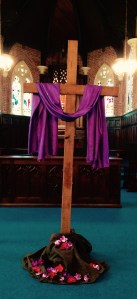
 

The contradiction of the cross

The contradiction of    the cross


(On this most solemn of days we would invite you to enter
and leave the church in silence.)


Procession with cross:

Hymn: 349 in the cross of Christ

Greeting:

The Lord be with you.

And also with you.


Let us pray:

God of contradiction,

give to us wisdom and understanding,

patience and humility,

and the courage to live with uncertainty,

so that we may hope for the right things

and arrive at what we do not know[1].

We ask this through your Son our Saviour Jesus Christ. Amen.


Poem: T. S. Eliot – from The Four Quartets


I said to my soul, be still, and wait without hope

For hope would be hope for the wrong thing; wait without love

For love would be love of the wrong thing; there is yet faith

But the faith and the love and the hope are all in the waiting.

Wait without thought, for you are not ready for thought:

So the darkness shall be the light, and the stillness the dancing.

Whisper of running streams, and winter lightning.

The wild thyme unseen and the wild strawberry,

The laughter in the garden, echoed ecstasy

Not lost, but requiring, pointing to the agony

Of death and birth.


You say I am repeating

Something I have said before. I shall say it again,

Shall I say it again? In order to arrive there,

To arrive where you are, to get from where you are not,

You must go by a way wherein there is no ecstasy.

In order to arrive at what you do not know

You must go by a way which is the way of ignorance.

In order to possess what you do not possess

You must go by the way of dispossession.

In order to arrive at what you are not

You must go through the way in which you are not.

And what you do not know is the only thing you know

And what you own is what you do not own

And where you are is where you are not.


In the name of God who suffers for us and with us, and who longs for us to turn and be made whole. Amen.

“And what you do not know is the only thing that you know.”

Shortly after five pm on Tuesday the world was shocked by the news of yet another act of terror – this time in Brussels. At least thirty people were dead and more than two hundred wounded many seriously. For those of us in Australia this news followed a grueling day in which, through the inquest into the police response, we revisited the final moments of the Lindt Café siege and the deaths of two hostages. At times like this, it is difficult not to ask: “Why?” “Why now?” “Why them?” As the story of the Brussels explosions unfolded, we learnt that a simple decision such as not buying a coffee made the difference between life and death, between being in the line of fire and being a safe distance away from the explosions.

Times like these remind us that there is a fine line between life and death, and that sometimes there is no rhyme or reason as to why one person lives and another dies, why some people live lives seemingly unfettered by grief or disaster and others live lives of quiet desperation, burdened by pain, sorrow or misfortune.

This side of the grave there are no easy answers. Life as we know it is vulnerable and fragile – susceptible to disease and constantly exposed to hazards and dangers – known and unknown. At the same time, humans are complex beings – capable of acts of great selflessness but also of unfathomable depravity, capable of great love, but also of immense hatred. We live in a world in which the good do die young, and the bad sometimes escape unpunished, in which only chance determines the country of our birth or the quality of our parenting, whether we stop for coffee or go straight to the departure gate. In this life, nothing is certain. We cannot predict what joys or heartache lie ahead.

There are two possible responses to this awful uncertainty – we can resist with all our might, refuse to take risks and try to force the world to conform to our expectations. This road will lead to frustration and disappointment, anger and bitterness. Our lives will be narrow and constrained and there will be no guarantee that we will be spared the pain of suffering and loss.

Alternately, we can willingly surrender. We can accept that life is filled with risk and uncertainty and choose to live boldly, courageously and confidently – no matter in what circumstances we find ourselves. This road will not be free of pain, but it will leave us open to joy and laughter, to adventure and hope. We will be able to ride out the bad times because we know that they will come to an end and that it is the good and the bad together that make life worth living.

Jesus chose the latter course. He willingly gave in to the future that was his. He surrendered himself completely to what life had in store. He submitted himself to the humiliation of a kangaroo court, the indignity of a flogging and the certainty of death of the cross. He did not ask: “Why?” or “Why me?” He simply walked the path that was his to walk, believing that somehow, in some way, God would give him both courage and strength in the present and that in the future, it would all begin to make sense. Jesus faced the cross not knowing what lay on the other side. As a consequence he learnt that through death comes life, that joy can be wrought from sorrow and victory from defeat.

Life is filled with uncertainty. The best that we can do is to place ourselves entirely in God’s hands and trust that in this life God will give us courage to face whatever it is that life throws at us and that in death, God will raise us to life eternal.

Reflection:

An abandoned God;

a dying God

confronts our sense of decency

and at the same time opens us to new possibilities –

to new ways of understanding God and ourselves.


Collect:


Holy God,

who teaches us that this day

which is so bad, is good.

Help us to live with incongruity

to know how much we do not know,

that understanding our limitations,

we may be open to the wisdom that comes from you alone. Amen.


Ministry of the Word

Isaiah 52:13 – 53:12

Hear the word of the Lord,

Thanks be to God.

Psalm 22

My God, my God, why have you forsaken me:

            why are you so far from helping me

            and from the words of my groaning?

My God, I cry to you by day, but you do not answer:

            and by night also I take no rest.

But you continue holy;

            you that are the praise of Israel.

In you our forebears trusted:

            they trusted and you delivered them.

To you they cried and they were saved:

            they put their trust in you and were not confounded.

But as for me, I am a worm and no man:

            the scorn of all and despised by the people.

Those that see me laugh me to scorn:

            they shoot out their lips at me

            and wag their heads, saying,

“He trusted in the Lord – let him deliver him:

            let him deliver him, if he delights in him.”

But you are he that took me out of the womb:

            that brought me to lie at peace on my mother’s breast.

On you have I been cast since my birth:

            you are my God, even from my mother’s womb.

O go not from me, for trouble is hard at hand:

            and there is none to help.

Many oxen surround me:

            fat bulls of Bashan close me in on every side.

They gape wide their mouths at me:

            like lions that roar and rend.

I am poured out like water,

and all my bones are out of joint:

            my heart within my breast is like melting wax.

My mouth is dried up like a potsherd:

            and my tongue clings to my gums.


My hands and my feet are withered:

            and you lay me in the dust of death.

For many dogs are come about me:

            and a band of evildoers hem me in.

I can count all my bones:

            they stand staring and gazing upon me.

They part my garments among them:

            and cast lots for my clothing.

O Lord, do not stand far off:

            you are my helper, hasten to my aid.

Deliver my body from the sword:

            my life from the power of the dogs;

O save me from the lion’s mouth:

            and my afflicted soul from the horns of the wild oxen.

I will tell of your name to my companions:

            in the midst of the congregation will I praise you.

O praise the Lord, all you that fear him:

            hold him in honour, O seed of Jacob,

            and let the seed of Israel stand in awe of him.

For he has not despised nor abhorred

the poor man in his misery:

            nor did he hide his face from him,

            but heard him when he cried.

The meek shall eat of the sacrifice and be satisfied:

            and those who seek the Lord shall praise him –

            may their hearts rejoice forever!

Let all the ends of the earth remember

and turn to the Lord:

            and let all the families of the nations worship before him.

For the kingdom is the Lord’s:

            and he shall be ruler over the nations.

How can those who sleep in the earth do him homage:

            or those that descend to the dust bow down before him?

But he has saved my life for himself:

            and my posterity shall serve him.

This shall be told of my Lord to a future generation:

         and his righteousness declared to a people yet unborn,

         that he has done it.

1 Corinthians 1:18-31

Hear the word of the Lord,

Thanks be to God.


Hymn: 339 O sacred head sore wounded


The Gospel of our Lord Jesus Christ according to John Chapter 18 beginning
at verse 1.

Glory to you Lord Jesus Christ.

For the Gospel of the Lord.

Praise to you Lord Jesus Christ.


Hymn: 341 My Song is love unknown.

(During the hymn a collection will be taken up for the Anglican Diocese of Jerusalem)


Intercessions:

Living, loving God, help us to relinquish our confidence in ourselves and our desire to go it alone;

to accept the vagaries of life and to let go of our need to be in control;

to recognise that we do not and cannot have all the answers and to understand that our knowledge is only partial and our insights limited by our humanity.

God when our hearts are aching,

Help us to find you in and among the suffering of the world.

Give us grace to acknowledge that life consists of the good and the bad and that our lives are enriched as a result;

to admit that hatred and fear only limit and bind and that love frees us to be fully alive

and to learn that it is only in your that true peace and joy are to be found.

God when our hearts are aching,

Help us to find you in and among the suffering of the world.


Be with all those whose lives are marred by violence, terror and war,

and with those who perpetrate acts of cruelty against others.

God when our hearts are aching,
Help us to find you in and among the suffering of the world

Support and encourage those whose lives are restricted by poverty, ill-health and disability,

and challenge those who have the means to help but do not.

God when our hearts are aching,
Help us to find you in and among the suffering of the world

Be a friend to those who are overlooked and discounted

and open our eyes to the suffering of those around us.

God when our hearts are aching,
Help us to find you in and among the suffering of the world.

Help us all to reevaluate our lives in the light of the cross and take our place among those who live life to the full and who make a difference in the lives of others.

God when our hearts are aching,
Help us to find you in and among the suffering of the world.


Lord’s Prayer: Accept our prayers through Jesus Christ our Lord,

who taught us to pray.

            Our Father in heaven,

                        hallowed be your name,

                        your kingdom come,

                        your will be done,

                        on earth as in heaven.

            Give us today our daily bread.

            Forgive us our sins

                        as we forgive those who sin against us.

            Save us from the time of trial

                        and deliver us from evil,

            for the kingdom, the power, and the glory are yours

                        now and forever. Amen.

Confession:

Our God whose love knows no bounds

comes to you – naked, weak and bleeding,

holding out holey hands, holy hands and asking only for your love in return.


Let us offer our hearts to God, confessing our sins – the barriers that separate us from each other and from God.

Suffering God,

who gave everything for us

forgive us our arrogance and presumption,

our greed and self absorption,

our neglect of the vulnerable,

our carelessness with the world’s resources,

our unwillingness to trust in you

and our failure to accept and to share your love and compassion. Amen


Absolution:

God whose love knows no bounds

forgives you and sets you free

to love God and to love one another.

Forgive others,

Forgive yourself. Amen.

Recognition of the cross:

730 Jesus remember me when you come into your kingdom.

(Recognition of the cross – you may like to place a flower at the foot of the cross, as a reminder that today is a day of contradiction, a reminder that God continually overturns our expectations so that we might rely on God and not ourselves. Alternately you are welcome to sit or stand in quiet reflection.)

Blessing: May the God who died for you, inspire you to live for God,

and the blessing of God almighty, Creator, Redeemer and Sanctifier be with you now and always. Amen.


Hymn: 262 When pain and terror


Please leave the church in silence


Copyright: Marian Free , 2014 (revised, 2016)


ANZAC DAY

There will be a service to commemorate Anzac Day

Monday 25th April – 8:00am


(If there is anyone for whom you would like us to pray,

Please add their name to the list at the back of the church.)


Rector:          The Rev’d Marian Free: m) 0402 985 593

  1. e) staugust@bigpond.com


Curate:                 The Rev’d Professor Rodney Wolff,

  1. e) staugust@gmail.com, 0426 287 283


Parish Office:       3268 3935 / Fax 3268 4245

Office Hours:       Monday, Thursday & Jumble Wednesdays

                               9.30am – 12.30pm


staugust@bigpond.com

www.staugustineshamilton.com.au


Sermons:            If you would like to read the weekly sermon,

                                 go to the home page and click on sermon.


            St Augustines Anglican Church


@StAugustines


Music Director:      Lesley de Voil: 0418 561 663 or

                                         lesleymdv@gmail.com


Service Times:      Sunday 7:30am & 9:30am

                               Tuesday & Thursday 7:00am

Wednesday 10:00am


Columbarium:      Robin Loan: 0417 799 400 or

                                 r.loan@optusnet.com.au

Columbarium Service: First Saturday of the month 7:30am


[1] “For hope would be hope for the wrong thing.” “In order to arrive at what you do not know you must go by a way which is the way of ignorance.” T.S. Elliot from “East Coker, The Four Quartets”
A matter of love

March 19, 2016

Palm Sunday – 2016

Luke 22: -23:

Marian Free


A matter of love

May God whose love for us knows no bounds, free us from all those things that prevent us from accepting that love. Amen.

Love is an extraordinary motivator. It can enable people to go to extraordinary lengths to make a difference for those whom they love. Parents of children with severe handicaps invest hours of their time and all their financial resources to not only ensure that their child has the best quality of life that is possible, but also to defy the medical staff who have advised them that the child has no future. Siblings of cancer sufferers cycle around Australia or complete other such feats to raise awareness of the disease and raise funds for research. Husbands or wives refuse to turn off life support machines, believing that the one whom they love has a future.

The love and determination of a spouse means not only the difference between life and death, but also the difference between simply being alive and having some quality of life.  Only last week I read the account of a young woman Danielle. At just 23[1] Danielle had married the love of her life. Only months later her husband, Matt he seriously injured in a cycling accident. As well as numerous fractures, he had sustained a serious traumatic brain injury. A team of doctors advised Danielle to turn off his life support.

Danielle trusted the doctors and thought she would agree to end Matt’s life. After a sleepless night she thought: “Matt is my husband. If he stays in a coma, of if he needs looking after for the rest of his life, I will be the one taking care of him.” Instead of conceding that the doctor’s were right, Danielle knew if a flash that she could do it. She felt that God was telling her to take a chance, that this was her path in life. Danielle was not going to let Matt die. That was 2011. What followed was a battle to bring Matt out of the coma, battles with the medical staff who wanted to put him into a nursing home and twenty four hour care, once she got him to her mother’s home. Caring for Matt meant changing nappies, checking feeding tubes, giving sponge baths, administering up to 20 different medications, turning Matt every two hours and single handedly doing all the physical therapy that was required.

Danielle’s journey is a long way from over and Matt may never be the same, but he sings to Danielle and writes her poems and tells her every day that he loves her.

As is the case with Danielle, the cost of love is often enormous – emotionally, financially and in terms of the time that is involved. Yet the lover (parent, sibling, friend) thinks nothing of that, only of ensuring that their beloved is loved and cared for, has the best life that is possible in the circumstances and that they know that they have not been abandoned.

This Lent, it has seemed to me that the readings have focused on love – God’s boundless, unconditional love for all of humanity. We have seen that God reaches out for us in love, refusing to give up on us no matter how much we disappoint, frustrate and even enrage God.  God does not/cannot stop loving even when we blindly go our own way, when we put up barriers between ourselves and God’s love or when we behave in ways that are damaging to ourselves or to others. God’s love for us is a love that never gives up, no matter how broken or beyond repair we might be and it is a love that never counts the cost.

Today and throughout this week, we will witness God’s love played out in Jesus’ journey to the cross. We cannot know what was going through Jesus’ head when he set out for Jerusalem or when he incurred the wrath of the Jewish leaders by entering the city as a King, by challenging their views and by being high-handed in the Temple. What we do know is that at any point Jesus could have turned back. At any point, Jesus could have decided that it was all too hard and simply given up. At any point, Jesus could have chosen to do what was right for him, rather than what might be right for others.

But as relentlessly as the forces of evil lined up against him, Jesus doggedly continued on the path that was before him, the path that would ensure death for him and life for the world.

This is the ultimate demonstration of God’s love for us – God, in Jesus entering our world and pouring out love and compassion on an ungrateful world. God demonstrates God’s love for us in Jesus’ giving himself completely to and for us – doing whatever it would take to enable us to live our lives as fully as we possibly can.

God cannot and will not stop loving us. It remains for us to accept that we are loved and to discover that it is only by surrendering to God’s love that we will find fulfillment, freedom and peace. It remains for us to abandon ourselves to God and to thereby see that it is only in God we have all that we want or need.

[1] Reported in the latest Marie Claire Australia magazine (April 16, 2016, p104-106).

It doesn’t depend on us

May 2, 2015

                                                                                      Easter 5 – 2015

                                                                              John 15:1-8; Acts 8:26-40

                                                                                                                                                                         Marian Free

In the name of God in w  is the source of our being and of all our doing. Amen.

Abiding, discipleship and bearing fruit are among the themes of this short passage from John’s gospel. John’s gospel is both incredibly simply and amazingly complex. Interlocking themes weave their way through a variety of scenarios and images in a way that makes the text repetitive, but also difficult to untangle. This in turn makes the gospel easy to understand (because the ideas are repeated over and over again) and impossible to explain (because so many ideas are included in a very few verses). 

Take today’s gospel for example. It follows on from the discussion on the good shepherd and Jesus’ statement that he has other sheep to bring into the fold. A new image – that of the vine appears to be refer to this new community – one that includes both the original flock and the other sheep whom Jesus has brought in. This new community is described as the branches of the vine, Jesus, who is the source of their life and fruitfulness. By virtue of their decision to ‘abide’ in Jesus these branches have been ‘pruned’ or ‘made clean’ so that they will bear even more fruit. 

In contrast, those who have not responded to Jesus have lost their connection with the source. As a consequence they wither and die – not because they do not bear fruit, but because they do not abide in Jesus nor he in them. Abiding in Jesus, being connected to the vine allows the branches to bear fruit. Bearing fruit in this instance is not related to good works or what a person does or does not do. ‘Bearing fruit’ describes a person’s relationship to the vine – their connectedness or not. The reason for this, is that it is not the branch itself that produces fruit. On its own, the branch can do nothing. It requires the life giving nutrients that flow through the sap that comes from the vine. A grape vine can only produce grapes. A passion vine can only produce passion fruit. The source of life determines what is produced. 

It is this notion that is at the heart of the metaphor of the vine. Followers of Jesus, those who abide in Jesus and he in them, are so intimately connected to Jesus that their lives are not only empowered by him, but  they are, to all intents and purposes, him. What they ask for will be given to them, not because Jesus wants to indulge them or to reward them for their faithfulness, but because they abide in him. If they abide  in Jesus their lives will be so intimately connected with his, that they will want only what Jesus himself would want. 

The connection between Jesus and the disciples is as close as that between Jesus and the Father. By abiding in Jesus (abiding in the vine), the disciples become one with him and therefore one with the Father. Just as Jesus glorifies the Father, so the disciples, by abiding him will in their turn glorify the Father. Fruitfulness then, is not something we do, but something that God (Jesus) does through us. Bearing fruit is for us, as it is for the branch of the vine, something that it passive not active. It involves opening ourselves up to the life-giving power of Jesus so that Jesus can work through us. On our own we do not produce fruit, but if we allow God to work in us and through us, God’s purposes will be achieved through us and that purpose is that God will be glorified.

The story of Philip and the Eunuch is unrelated, but I believe it helps to demonstrate the point that Jesus is making here. Philip is one of the Greeks who has fled Jerusalem following the stoning of Stephen. Philip goes to the road between Jerusalem and Gaza, not to further some purpose of his own, but as a response to the voice of God. Once on the road, Philip again demonstrates his oneness with God. He hears the voice of the Spirit urging him to join the Eunuch who is confused by what he is reading in the book of Isaiah. Led by the Spirit, Philip asks if the Eunuch understands what he is reading. When the Eunuch says that he does not, Philip explains the gospel so convincingly that the Eunuch is brought to faith and seeks baptism. His task done, Philip is ‘snatched by the Spirit’ and finding himself in Azotus where he continues to share the gospel. 

What these two very different texts have in common is the concept that the spread of the  gospel is not dependent on us but on God. The gospel is spread, not by anything that we do, but by what God in us does. This means that more important than anything we do or do not do, is our relationship with God. God can only work in and through us, this is if we are intimately connected to God (the vine) and if our lives are fed and directed by the Spirit within us. In the language of today’s gospel: if we abide in Jesus and Jesus abides in us our lives will be so completely aligned with that of God that what we want will be what God wants and God’s will will be achieved through us and  fruit that we bear will be the spread of the good news.

For decades now we have been anxious  about declining congregation numbers and worried by the increasing secularisation of the world around us. As a result we have tried all kinds of programmes and invested huge amounts of energy in trying to attract people to the faith. In other words, we allow ourselves to think that the future of the gospel depends entirely on  us. Today’s readings remind us that the opposite is the case. It doesn’t depend on us. The gospel always was and always is in God’s hands. The very best that we can do to progress God’s mission in the world is to allow ourselves to be so utterly and completely swept up in God’s ambit that God can and will work in and through us. To further God’s kingdom in the world all that is necessary is for us to surrender ourselves to God’s greater wisdom and open ourselves to God’s life-giving, life-directing presence and leave the rest up to God.

How can we possibly allow ourselves to think that the kingdom of God depends entirely on us? All we need to do is abide in the vine and  leave it to God to do the rest.

Surrender now

November 23, 2013

Christ the King 2013

Luke 23:33-43

Marian Free 

In the name of God who created us in God’s own image. Amen.

Jesus was not the first or the last king to be executed. A great many Kings (or heirs apparent) have been executed or murdered. In the Old Testament, the books 1 & 2 Kings are filled with gruesome accounts of power struggles – particularly among half-brothers. At times whole families are slaughtered in order to ensure that one person’s right to rule is not challenged. The history of the British Monarchy is no less ruthless. Civil wars have been fought by supporters of rival claimants to the throne. In 1483, Richard duke of Gloucester. who had already killed the then Queen’s brother and her eldest son from her first marriage. forcibly locked up her son Edward – the king who had inherited the throne from his father – and shortly after imprisoned the younger son as well. The young princes (aged 13 and 10) were seen from time to time, but then disappeared completely. It is presumed that they were killed so that they would not challenge their uncle’s right to the throne. (In the Art Gallery at the moment a poignant painting of the boys’ Mother bidding them farewell is hung in a prominent place near the entrance.) (The problem with power illegally gained is that is has to be protected from challengers – those who have usurped the throne are only too aware of how easily they might be unseated. All potential threats need to be disposed.)

Some British Monarchs have been publicly executed. At least two of Henry the Eighth’s wives were executed for treason. In our tradition, perhaps the most well-known monarch to have been executed was Charles the 1st who was accused of treason because of his refusal to call a Parliament. Charles was firmly convinced of the divine right of kings and sought to levy taxes without Parliament’s consent. He was tried by 68 judges (there were to have been 135) and beheaded.

What makes Jesus different from this long line of tragic kings, queens and princes is that Jesus never had nor sought power – in fact just the opposite. Jesus did not see himself as someone who was in competition with the priests, scribes and Pharisees. He certainly did not try to usurp power from the rulers of Rome. From our point of view he does not appear (in himself) to pose any real threat to either the leaders of the church or the representatives of the Roman Empire.

He has none of the trappings of royalty – no palace, no fancy clothes, no wealth, no army. Jesus by his own account has nowhere to lay his head and his followers do not appear to be men whom he could easily form into a fighting force. In fact Jesus is the antithesis of all things associated with power and control. As the Son of God, he has all kinds of resources at his command – including angels – yet he chooses not to call on them even when they could save his life. Instead of resisting, Jesus allows himself to be arrested. Instead of mounting a defense he remains silent before his accusers. Instead of calling out an army (of angels) to save him, he allows himself to be nailed to the cross.

Jesus’ approach to death is consistent with his approach to life. From the moment of his baptism, Jesus makes it clear that, though he knows he is God, he is not going to capitalize or take advantage of that knowledge. He could turn stones into bread when he is hungry, jump off the Temple and be unharmed and he could rule the world if he chose to claim power solely for himself. However, despite the knowledge that he has power to just about anything, Jesus never imposes his will or lords it over others – just the opposite. Unlike the dictators of his time (and ours) Jesus knows that imposing his will on others will not secure their confidence or their loyalty. He knows that love that is forced is not love. He knows too, that it is only by forgoing all the trappings of wealth and power, only by giving himself completely to God that God’s purpose (rather than his) will be achieved.

Jesus’ teaching likewise emphasises service over power. Over and over again he teaches his disciples that the first will be last and the last will be first or that the one who serves is greater than the one who lords it over others. By example and instruction, Jesus models the notion that humility is the quality most prized in heaven and that submission to God is more likely to lead to salvation than trying to succeed on one’s own terms.

From beginning to end, Jesus confounds everyone. His life begins in humble circumstances and ends with the shame of the cross. In popular understanding, he does not fit the image of a soldier Messiah, nor does he conform to the expectations of a King of David’s line. Jesus does not exercise his prerogative to judge. All in all, he is a very unlikely and unexpected Saviour.

Jesus’ crucifixion highlights how little he has been understood and the disdain rather than the respect that has come his way. To the very end he held fast to his purpose, which was to demonstrate that true power is demonstrated through service rather than dominance. Interestingly, it is at the end – ironically – that his true divinity is demonstrated. At the very point at which he most identifies with humanity in death, the very point at which he is most human and most vulnerable, he exercises his divine right to both judge and to forgive and in so doing to decide who may or may not enter paradise – something that only God can do.

Jesus is a king who doesn’t conform to the ways of the world. He is a contradictory and confusing king who refuses the identifiers of status wealth and power. Following this king will not lead to power and glory. Sometimes it will lead to persecution and derision. It does not require great exploits and certainly has no career structure. If we choose to follow Jesus, we will learn that we are most empowered when we empower others, that we are most truly ourselves when we are the person whom God created, that true authority comes not from ourselves but from the presence of God within us, that entry into the Kingdom of God is not something that we earn, but something that we receive when we acknowledge Jesus and no other as our King.

Ultimately, we have no power, no glory, no wisdom or strength or goodness that does not come from God. That being the case, we might as well surrender. As Jesus gave himself fully to God so we might as well give ourselves fully to Jesus and discover as Jesus did that it is only when we give everything away that we uncover the wealth, the gifts and the godliness that was already ours.

“Yes” to God

August 17, 2013

Pentecost 13 (Mary, Mother of our Lord)

Luke 2:1-7

Marian Free

May our “yes” to God, be a source of transformation for ourselves and in turn, for the world. Amen.

It must be absolutely amazing to see the desert in bloom after the rain, or Lake Eyre teeming with bird and fish life when the waters from the north fill it to the brim. To watch the dry and barren earth respond to the rain, slowly turn green and then to blossom with flowers of all different shapes, sizes and colours must be truly magical. Our spring is not as spectacular as that of cooler climes, but it is still possible to discern the changes and to observe new shoots, on trees like the frangipani as the bare winter branches respond to warmth and light. In temperate climates of course, the change is more dramatic – trees that are bare and apparently lifeless, spring into leaf, then bud and flower and sometimes even fruit. Snow covered ground parts to allow the spear-like leaves of snowdrops, daffodils and jonquils to push through, dotting the white with green until the flowers of yellow and white provide carpets of colour on a background of green grass. Nature simply opens itself to the changes in light, water and warmth and wonders result.

A pervasive image associated with God’s (positive) relationship with Israel is that of fertility  (even fecundity). The nation without God is described as barren and desolate, but its return to God will be so life-giving, that it will be like the desert blooming. The message that the prophets proclaim in many and varied ways, is that existence without God is dry, bleak and empty, but that with God, life is rich, fruitful and full. God’s love is bountiful, extravagant and limitless, for with God there are no half measures, God gives everything that he has and God gives without restraint. The Old Testament prophets insist that in order to receive that love and the abundance that God offers, Israel needs only to give up its striving for independence and to accept God’s sovereignty instead of going its own way, serving other “gods” and resisting the God of their forebears.

God’s loving goodness, while a powerful force for change, simply cannot break through a wall of resistance and stubbornness. Love needs a welcome before it can make itself at home and effect the transformation promised by the prophets.

And so it is we come to Mary who, at the turn of the eras, opened herself – heart, mind and body – to the presence of God in her life.  Mary who, despite her youth, instinctively knew that no matter the risks and the potential costs, life with God would still be infinitely better and richer than life without God. Mary, whose “yes” to God two thousand years ago, is an exemplar for our own “yes” today. Mary, whose ready submission to God’s will is a model for the surrender of our own lives to God. Mary, whose acceptance of God’s life within her, succeeded in giving God a body in which to be physically present in the world and which in turn succeeded in bringing salvation to every nation.

Beginning with nothing but Mary’s welcoming heart, God burst forth into life, taking the world by surprise and opening up new possibilities for relationship with God. What Mary illustrates and Jesus demonstrates, is that a life completely given over to God is not a life of servitude that is limited and constrained, but rather a life of freedom, fulfillment and satisfaction. What they teach us is that surrendering our all, leads not to the loss of our selves, but rather to the discovery of our true selves, the self made in the image of God, free from the impurities of our frail human existence and enlivened by the Spirit. When we give our wholehearted “yes” to God, God makes a home with us. When we give ourselves fully to God we are not thereby condemned to a life of dry, dull compliance but to a life filled with abundant joy, extravagant love and endless possibility, a life in which we are liberated to reach our full potential.

If we have not yet experienced that fullness of life that results from God’s presence in us, it may be that, unlike Mary, we are still holding something back. If we have not experienced God’s profligate love, it is perhaps because we are insisting on holding on to our independence, resisting giving our all or unwilling just yet to allow God to fully inhabit us.

God asks to come in, but will not force himself on us. It remains our choice to welcome God or not, our choice to align our lives with God, our choice to participate in God’s future hopes for ourselves and for the world.

When Mary offered God a home and opened her heart to God, she risked everything – her relationship with Joseph, her reputation and even her life. At the time, she could have had no real idea of how her life would pan out, no concept of the joy and the pain that would ensue, no inkling of the significance of her action for the future of the entire world, but, confident of God’s goodness and grace, Mary said “yes” and as a result the possibilities for the whole of humanity were expanded and enhanced.

If Mary’s “yes” made such a difference to the history of the world, who knows what our “yes” to God – collective or individual – might mean. If we have the courage to wholeheartedly say “yes” to God, the desert might bloom, injustice cease, poverty come to an end and peace reign on earth. Just one word from us might make all the difference.