Easter 3 – 2018
Luke 24:36b-48
Marian Free
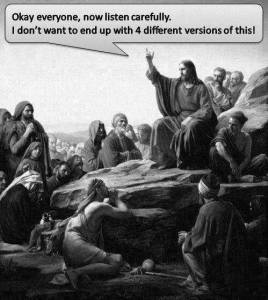
Four not one
In the name of God who, through Jesus, raises us to newness of life and empowers us with the Holy Spirit. Amen.
This Semester I am teaching a subject entitled the Synoptic Gospels. The course entails looking at the first three gospels to try to discern what each author is saying and why they chose to order their material in a particular way. We ask: what was it about the author’s own experience and the needs of his community that led him (we are fairly surely that the gospels were written by men) to construct the story of Jesus in the way that they did. The question of four gospels is one that has led skeptics to deny the validity of the gospels and pious believers to come up with a variety of different explanations for the differences. An explanation that I was given as a teenager was that if four different people witnessed something (a traffic accident for example) they would all report the story somewhat differently. Each eyewitness would have observed the scene from a different point of view and would have come to their own decisions as to what happened.
In reality it is unlikely that any of the evangelists were eyewitnesses to the life of Jesus.[2]We believe that the earliest gospel to be written was the gospel of Mark and that it dates to the late 60’s or early 70’s. Matthew and Luke were probably written in the next decade. Until then the early believers had been happy to use the Old Testament as their scriptures and to rely on oral tradition (and maybe the letters of Paul) as their source for the teachings of Jesus. (In fact there were some like Papias who believed that the oral tradition was more trustworthy than anything that could be written down because it was “first –hand”).
At around the time Mark’s gospel was written there were a number of differing forces that led to a desire to capture the stories of Jesus in a more permanent way. The Christian movement was becoming more and more dislocated from its roots with the destruction of the Temple and the spread of the faith into a Gentile environment. The death of the first generation of believers gave an added urgency to the task of capturing Jesus’ story. It was felt that a record should be made while there was still some connection to Palestine and before the memories became more than second-hand.
For the first forty years after Jesus’ death years, the stories of his life and teaching circulated orally. They would have been told differently by different story-tellers and have been given different emphases depending on the context in which they were told. (It is remarkable that we have only 4 gospels and not 400!)
It is not surprising then that we have several different accounts of the resurrection. Mark’s gospel (as we saw on Easter Day) leaves us up in the air telling us only that the women saw Jesus but were too afraid to tell anyone. According to Matthew the women see Jesus at the tomb and are sent to remind the disciples to return to Galilee where Jesus commissions the disciples to make disciples of all nations. Luke has a number of resurrection stories that allow the author (through Jesus) to use scripture to explain Jesus’ death and resurrection.
Despite these differences there are a number of consistencies. In all three gospels women go to the tomb at dawn on the first day of the week and find it empty. In all three instances a messenger speaks to the women and tells them that Jesus has risen. The messengers also give the women a mission. They are to remind the disciples either to go to Galilee or to remind them of what Jesus said when they were in Galilee. In all three gospels Mary Magdalene is one of the women who was at the tomb on that morning. In other words, at dawn on the first day of the week, two or three women one of whom was Mary Magdalene went to the tomb and found it empty. A heavenly messenger informed them of Jesus’ resurrection and tasked them with taking a message to the men. As a consequence of their experience and possibly of Jesus’ appearances to the disciples Jesus’ followers were convinced that he was alive – so convinced that they began to spread the message far and wide until a small movement begun in an insignificant part of the empire, spread throughout the entire world.
As an academic I am fascinated by the differences between the gospels, It excites me to try discover the motivations of the authors, the needs of the communities, the cultural setting of the first century, the distinct emphasises of each gospel, the particular message that the author is trying to get across and the unique picture of Jesus that they are trying to paint. In the end though, none of that matters. Whether there is one account of the resurrection or several. I’m not particularly concerned to know whether Jesus entered locked rooms, ate broiled fish or walked to Emmaus. What is important to me is that on that first day of the week, something happened that convinced not only the women who saw, but the men whom they told, that Jesus was not dead but alive and that as a result their lives were so dramatically changed that within two decades a movement had formed around the risen Christ and had spread beyond the bounds of Palestine to as far as Rome. What matters to me is that two thousand years later women and men are still convinced that Jesus has risen and they know their lives to be enriched, empowered and transformed as a result of that knowledge.
We don’t need to explain the differences or similarities in the stories told by the gospel writers, nor to we have to justify to others the fact that there is not one, but that there are four accounts Jesus’ life and teaching. We all have our own resurrection stories to tell. Let’s tell our story with such passion and conviction that what happened on that first day of the week will continue to inform and transform the world.
Christ is risen! He is risen indeed! Alleluia!
[1]This cartoon was sent to me via email, so unfortunately I can’t acknowledge the source.
[2]Only about 25% of the population lived beyond their mid-twenties.


 Swallowsrest