Posts Tagged ‘Temple’

God is in the here and now

November 15, 2025

Pentecost 22 – 2025

Luke 21:5-19

Marian Free

In the name of God in whose hands are all things. Amen.

We live in particularly unsettled times. It is impossible to be unaware of the fragility of social structures, of national borders and of infrastructure. In some places democracy appears to be under threat; wars in the Ukraine, the Sudan and elsewhere threaten to change the shape of the world and typhoons, hurricanes and earthquakes reveal the vulnerability of our built structures.

For those of us who have lived through at time of relative of security, peace and prosperity  the current state of the world can feel destabilizing and disturbing. We just don’t know how to plan ahead.

Jesus’ disciples knew what it was to live in uncertain times. Most of them lived a hand to mouth existence. Except for a brief period under the Maccabees their country had been under foreign domination for centuries. At this point in the first century Galilee was ruled by a cruel and capricious Herod and the marginally more benign Pilate ruled in Judah. Everything that could be taxed was taxed and punishment for unrest was swift and violent. Their ability to make plans for the future was severely limited.

One point of stability and confidence was the Temple. The Temple, built as it was on the Temple Mount was a magnificent and imposing building. Constructed in 516 BCE to replace the original that had been destroyed by the Babylonians, the Temple had been significantly enhanced by Herod the Great (the father of the current Herod) and was known as Herod’s Temple. For Herod it was a symbol of power and might and control and for the Jews it was a symbol of God’s presence in their midst, a holy place in which the ancient rituals of sacrifice and atonement could be carried out, a place of prayer, a meeting place and a place in which even the Gentiles could worship the God of the Jews. Above all, it was a reminder of the universal nature of God, a sign of solidity, strength and endurance.

The Temple dominated the city of Jerusalem, it would have been almost impossible to imagine that it could be razed to the ground.  

Yet, on overhearing people marvel at the Temple Jesus warns that: “the days will come when not one stone will be left upon another; all will be thrown down.” And in response to the disciples’ question: “When will this be?” Jesus doesn’t answer their questions but continues with a number of seemingly unrelated warnings – about false teachers, wars, insurrections, earthquakes, famines and plagues,  betrayals and persecution.

This section of the gospel is usually referred to as the “little apocalypse”, a litany of what might be expected at the end of time. It is possible that is reflecting  a commonly held view that things are so bad that God will surely intervene and bring the world as it is to an end. If so, he is helping his disciples to make sense of the chaos that they see around them and assuring them that a) they will survive if they hold fast and b) that God will ultimately have the upper hand.

Equally possible is that Jesus, recognising the anxiety of his disciples, is warning them that the future is unpredictable and that God doesn’t work to a time line. Jesus is encouraging the disciples not to waste time by focusing on what might or might not happen but instead to live in the present and to take things as they come, knowing that God will equip them to cope with whatever comes their way – be it political upheaval, natural disaster or persecution. Jesus is reminding the disciples  that they cannot and should not try to second guess God, that they should try to trust that God has things in hand and that the future will unfold in God’s own time.

Jesus is reminding his disciples that life is precarious and the world is unpredictable and that they shouldn’t allow themselves to be caught up wondering what will happen and when. Rather they should concentrate on what they can and cannot do in the present. They should learn to place their trust only in God, because God is the only constant  – not political systems, not buildings and certainly not the natural environment.  Living in the present and leaving the future to God is the only way to cope with uncertainty. Trying to take control is futile. Worrying about the future and trying to create systems and structures that will cushion us from the visiccitudes of existence, keeps us in stasis and prevents us from experiencing life with its joys as well as its sorrows. Obsessing about how one might face a situation (a situation that may not arise) prevents us from seeing and grasping how God is acting right here right now.

Jesus advice is as relevant now as it was two thousand years ago. In uncertain times, he says, we must avoid the temptation to trust in those who make false promises that all will be well. When we are are tempted to read the signs of the times, we must remember that there will always be wars, insurrections and natural disasters and that they are not accurate indications that the end is near, but simply a reflection of the nature of humanity and of the instability of the planet. If we are tempted to see the hand of God behind the awful events in our lives and in the world Jesus reminds us of our limited understanding and asks that we leave the ordering of events to God.

The disciples want Jesus to tell them what the future will hold. Jesus’ response is to tell them not to waste time worrying about the future, not to build up barriers the hope that they can protect themselves from hurt and from harm, but rather to embrace the present with all it difficulties and complexities and to trust in God to give them the confidence to accept what is, the courage to persevere and the words to say.

No one knows what the future will hold so let us trust God in the present rather than placing our hope in an unknown future and being paralyzed by unnecessary fear.
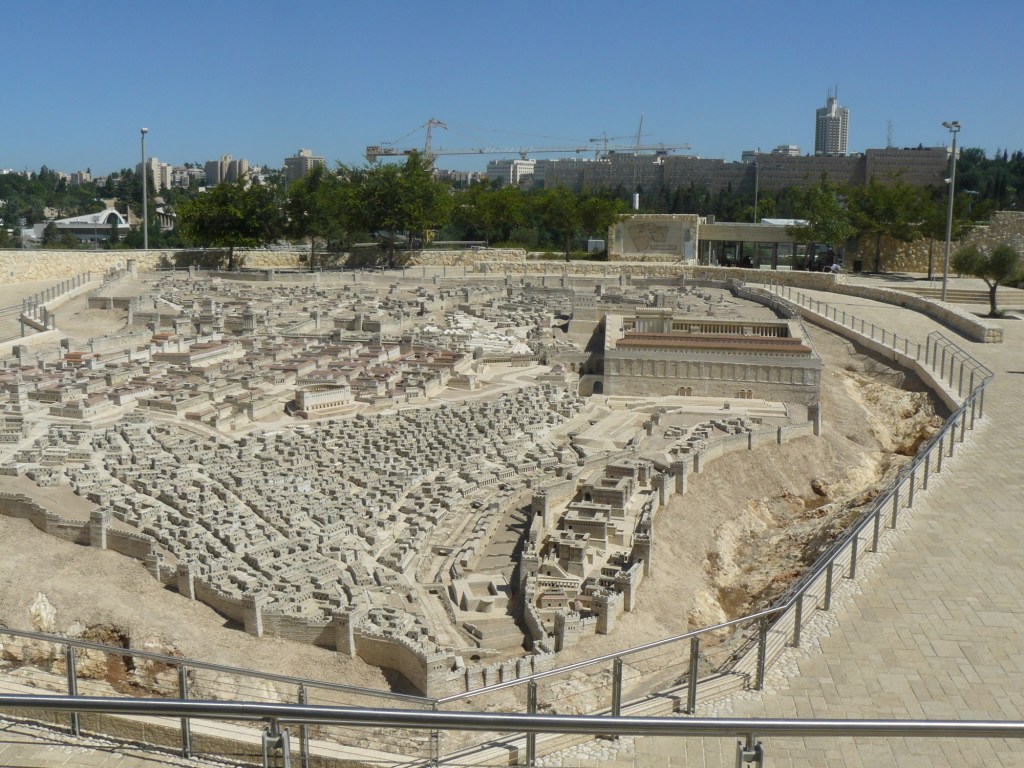


Model of first century Jerusalem

See what large stones! Trusting in the temple or trusting in God.

November 16, 2024

Pentecost 26 – 2024

Mark. 13:1-8

Marian Free

In the name of God in whom we trust. Amen.

One only has to read/watch the news to see the catastrophic state of the world: the unimaginable devastation and loss of life from the floods in Valencia and the wars in the Middle East, Ukraine and elsewhere, the disorder and civil unrest in Haiti, the drug-fuelled violence in Mexico, the displacement of people in the Sudan, Burma and elsewhere, the increasing polarisation between people of the same nation and background and between people who confess the same faith, and the exaggerated rhetoric and personal attacks around differing political views and cultural values – even in countries like our own. 

It is difficult at times not to fall into despair. It is tempting to look at the state of the world, to ask “what is going on?”, to wonder what the future might hold and to ponder where God might be in all this upheaval. Are all these disturbances a sign of more to come (as the changes in climate seem to threaten)? Are we witnessing the end of life as we have known it OR is this really the beginning of the end of the world?

It is human nature to want to make sense of calamity[1]. Collectively, we want to give meaning to the death of a child, the destruction of our home, a life-threatening illness – to any unexpected tragedy or calamity. So great is our need to give meaning to something that has no meaning that we fall into the trap of making up trite, often pious explanations for such events. We are anxious find explanations that cover up our feelings of inadequacy, our inability to find the right words to say, or which to help us to avoid facing the trauma of the inexplicable. 

I’m sure that you know what I mean. You may even have used phrases yourself. “God wanted another angel”, “They are in a better place,” “This will make you stronger” and so on. There are any number of such sayings that have entered our vocabulary to be trotted out when we have nothing better to say.  Sadly, by failing to honestly acknowledge someone’s pain, by not facing the trauma head on, we often increase a person’s sense of isolation and grief. Instead of providing comfort, we reveal our own failure to understand and our unwillingness to engage.  When say these things to ourselves, we withhold permission from ourselves to express our heartache, to sit with our grief until such time as the healing process can begin.

Today’s gospel forms the beginning of what is known as the “Little Apocalypse”, the description of things to come. Very often these are taken to be sign of the end – in fact that language implies that that is what Jesus is saying.

I want to suggest that Jesus’ meaning is much broader and much more related to the present (at whatever time in history that present might be). 

Scholars believe that Mark’s gospel was written to and for a community under threat. It written to reassure believers that their experience is not out of the ordinary, that in fact it was to be expected as a consequence of following Jesus. The gospel is a reminder that 

following Jesus is not a protection against the world’s ills. Faith in Jesus is not some or of amulet that will protect believers from harm. Believers will face the same travails and encounter the same losses as anyone who does not believe.

In our reading this morning the disciples look at the Temple which appears to have been built to withstand any threat. It was by all accounts a magnificent structure, built of huge stones, some of which were fifty feet long and eight foot high and thousands of tonnes in weight. To the disciples – Galileans all – the Temple must have seemed indestructible[2]. At the same time, despite all that Jesus has tried to teach them – about his suffering, about their taking up the cross – they still seem to hold the belief that Jesus has come to Jerusalem to confront the Romans, to restore Temple worship by removing the corrupt priests.

It is possible that for most if not all of the disciples are visiting Jerusalem for the first time. As followers of Jesus, they experienced his triumphal entry into the city and now they can sit and admire the Temple – the meeting place between YHWH and God’s people. “Look, Teacher, what large stones and what large buildings!” 

Jesus’ response would have been entirely unexpected. instead of joining in their wonder, Jesus announces the destruction of the Temple. “Do you see these great buildings? Not one stone will be left here upon another; all will be thrown down.” The Temple is not as indestructible as they think. Like everything else on earth, it is ephemeral and temporary, subject to destruction and decay.

This is too much for them to comprehend. The disciples need details, they need to make meaning out of what Jesus has said, they want to be able to prepare for such a catastrophic event. So they ask: “Tell us, when will this be, and what will be the sign that all these things are about to be accomplished?” It is then that Jesus begins to tell them of all the things that might happen. These, as I have suggested, are not so much signs of the end as Jesus providing a corrective – don’t look for signs even the angels in heaven do not know the time (13:32). Understand (Jesus seems to be saying) that worldly existence is precarious, humans are susceptible to variations in the weather, human bodies are vulnerable to disease and deterioration, and human nature tends towards competitiveness and selfishness. Peace and prosperity, health and fitness are not a given, but a privilege enjoyed by a few.  There are no simple, trite answers to trauma.

Our faith does not protect us from wars, earthquakes, famines, from hardship, poor health, or frailty. What faith does at its best is determine how we react to setbacks, traumas, and loss. What matters is not so much that we are able to interpret the times, but how we respond to what is going on around us. 

As people of faith, we cannot cut ourselves from the realities of human existence, but we can learn to live in the present, accepting what is rather than looking back to an idealized past or striving for an unrealistic future.[3] As people of faith, we are to learn to  place ourselves, our loved ones and the world in entirely in the hands of God, believing – sometimes against all evidence to the contrary, that all things will work for good. In this way, and this way alone, we will be ready for whatever is to come because we will already have placed our trust in things eternal, things that will last.

 Jesus’ comments about the destruction of the Temple are less about the timing of the end, and more a corrective of the disciples’ belief that Jesus has come to overthrow the leaders of Rome and of the Temple. They are a reminder not to look back to an idealised past or forward to an unrealistic future, but to live fully in the present, with all the good and bad that comes with that and to trust that God is with us through it all. 


[1] When my parent’s home was completely covered by flood waters in 1974, my father wandered round in a daze half-jokingly asking why God had asked him to build an ark!

[2] All that remains today are the Temple steps (see photo)

[3] It is important to note that non- resistance does not equal passive acceptance. If we can change things, if by the way we live and the way we act we can make a difference in our lives and in the lives of others, then we should do so.

Authority that emanates from within

September 26, 2020

Pentecost 17 – 2020

Matthew 21:21-32

Marian Free

May I speak in name of God who is and was and is to come. Amen.

In the distant past when I was studying undergraduate subjects in biblical studies, I had an amazing lecturer. I can no longer remember which subject we were studying but I do remember his innovative way of teaching. At the beginning of Semester, he presented us with a copy of the lectures that were sent to external students. The idea was that we should read the lectures and come to class with our questions. This was so novel that I was particularly diligent and, though I don’t remember what spurred the question, I clearly remember asking what it was that made Jesus different. Why, in other words, did the early church so readily identify Jesus with God? Apparently the answer was simple and clear – it was Jesus’ authority. The lecturer did not point to Jesus’ miracles, his power over nature or his teaching, but to his authority – not authority given or assumed, but authority that was innate, that was an integral part of who and what Jesus was. He did not need to have anyone or anything authorize his actions or his words, he was sufficient I and of himself.

The Greek root ‘auto/autos’ means “self” or “directed from within” and the Greek ‘autos’ can be translated as self or same. We use it in a great many words – automobile, autonomy automatic, autograph. It is also the root of the word authority. Jesus had authority in that he relied on himself and not on his role, his job description or his superiors. He did not defer to others or call on his position to justify himself, nor did he need to. He did not need to claim an external support in order for demons to obey him, for the winds to cease or for people to believe him. His authority – derived from his very being – was evident to the natural world, the supernatural world and to humankind.

Today’s gospel is about authority – who has it and from what does that authority derive?

As is so often the case, the setting of this encounter is important. The lectionary takes us from chapter 20:1-16 to 21:23-32. As a consequence, unless we are studiously reading Matthew’s gospel in its entirety, we see Jesus’ argument with the chief priests and elders as an isolated event rather than in its context. To fill you in – Jesus has come into Jerusalem amid much fanfare and adulation. He has entered the Temple and overturned the tables of the moneychangers and he had further enraged the elders and chief priests by healing the blind and the lame who in turn identified Jesus as the Son of David. On the next day, as Jesus returned to Jerusalem, from Bethany, he cursed a fig tree that had no fruit and the tree withered at once. His authority – over nature, over illness and over the people – is obvious. No wonder then, that the chief priests and the elders were questioning the source of his authority. Jesus’ very presence challenges their authority – in the Temple and as leaders of the people. If they are to regain their position of authority (an authority bestowed by role or by wealth) they will need to reassert themselves. They attempt to do this by taking Jesus on, hoping that their question will stump him and will thereby bring him into disrepute with the people. If they succeed Jesus will be put to shame and the people will turn from him and submit to them.

What happens is just the opposite.

Today’s battle for authority is just the beginning of a series of challenges that the various leaders put to Jesus.  Once the chief priests and elders have been defeated (and been exposed in a series of parables), the Pharisees attempt to entrap Jesus (sending in their place their disciples and the Herodians). Next a group of Sadducees try to expose him. Lastly, a lawyer puts a question to Jesus. When all these attempts to trap Jesus fail, Jesus turns the tables on the church leaders who “from then on do not dare to ask him any questions.” This effectively puts an end to the debate but, but not to their rage as Jesus has inflamed rather than dampened their sensibilities.

Today’s gospel describes the first of the challenges. The chief priests and elders approach  Jesus and ask him to justify himself. They ask two questions which are only slightly different. “By what authority (or what kind of authority) are you doing these things (i.e., casting the money changers out of the Temple and healing the blind and the lame )?” and “Who gave you this authority?” ‘The first question is about the nature of Jesus’ authority, the second about its source. (see also Matthew 9:34, 12:24).[i]‘  Jesus answers a question with a question. What, he wonders, do they mean by authority? Can they tell the people, for example, where John’s baptism came from – ‘from heaven or from man’? Of course they can’t. Jesus has them over a barrel. If they say from heaven, the crowd will ask why they themselves have not been baptized. On the other hand, if they say from man, they will antagonise the very crowds whose loyalty they are trying to regain.

In this first challenge, Jesus has maintained the upper hand. The chief priests and elders are forced to acknowledge that they don’t know from where John’s baptism comes. Jesus presses home his advantage by telling parables directed at them. Their authority is baseless. It is entirely dependent on their ability to influence and control the crowds and very little to do with an authority which should be derived from their service to God. The crowds are already resentful of an elite that depends on Rome for validation. On the other hand, they recognise that Jesus’ authority emanates from himself. He needs no external validation and it is this that draws the crowds to him.

We don’t have to understand the Nicene Creed or the complex theological arguments as to why Jesus might be both God and man. Jesus’ own authority affirms his divinity. The crowds needed nothing more – neither should we.


[i] Direct quote from Stanley Saunders, Working Preacher for today.

Seeing what is in front of us

February 1, 2020

Feast of the Presentation – 2020

Luke 2:22-40

Marian Free

May I speak in the name of God, Earth-maker, Pain-bearer, Life-giver. Amen.

Sacramental worship in first century Palestine was a very different proposition from that in Brisbane today. Whereas we are used to celebrating Holy Communion every week in our Parish Churches, the Hebrews might, if they were able, attend the Temple for major feast days or to observe specific rituals that could only be carried out in the Temple. Passover seems to have been a must for most Israelites, but it is possible that not everyone was able to make these pilgrimages on a yearly basis.

It is difficult to know how many towns or villages had synagogues, but from the biblical evidence that Jesus taught in their synagogues and that the early believers came together every week, we can assume that it was the practice (of the men at least) to gather weekly to read from scripture, say or sing the Psalms and to expound on the biblical text. But as there was only one Temple, anything that required the services of a priest took place there, in Jerusalem.

In setting the scene for his gospel, the author of Luke is careful to establish Jesus’ Jewish credentials. This seems strange for a person who was writing for a Gentile audience, but the Roman Empire was suspicious of anything novel, in particular of different belief systems which they regarded as superstitions and as a threat to the Empire. Judaism was accepted and even respected by the Romans because of its long, established history. By making it clear that Jesus was a member of this ancient faith Luke establishes the credibility (and the heritage) of what, to many, appeared to be a new religion.

Luke builds up the picture of Jesus’ Jewish credentials in a number of ways. The parents of John the Baptist (Jesus’ cousin) are described as coming from ancient priestly families and Zechariah is in the Temple offering the sacrifice when an angel announces John’s conception. Mary and Joseph fulfil the obligation under the law to circumcise Jesus on the eighth day. Forty days after Jesus’ birth they make the long journey to Jerusalem to offer a sacrifice to redeem their first-born son and to undergo the rite of purification. Later, when Jesus is twelve years old, the family will return to Jerusalem for the Passover Festival. Five times in today’s the author refers to the law, the basis of the relationship between God and God’s people and Luke’s gospel both begins and ends in the Temple – the centre of the Jewish faith. In other words, the Gentile readers of this account of Jesus’ life (in particular Theophilus) are left in no doubt that this emerging faith has its roots firmly based in Judaism and is in fact nothing new but a continuation of that ancient religion.

In describing the presentation of Jesus in the Temple Luke moves the story forward. He suggests that the time of the prophets has ended. What God has promised to Israel has come to pass. Led by the Spirit, Simeon recognises the child as the Lord’s anointed – the one who will be the instrument of God’s salvation – a light to the Gentiles and the glory of God’s people Israel. Without labouring the point, Luke establishes that God has acted in the world and that going forward, Gentiles as well as Jews will be included in God’s acts of salvation.

Luke has established that this apparently ‘new’ faith has an age-old history. Now he makes it clear that, with the birth of Jesus, the faith is moving from one era into another. It is a continuation of the old while at the same time it is leaving the past behind and forging a new path. John the Baptist provided the bridge between the past and the present. From now on the focus will be on Jesus and God’s actions in the world through him. All this, the reader is led to believe, is completely in accord with God’s plan.

Luke moves the story forward in another way as well. Simeon’s words to Mary give us a foretaste of what it to come. Jesus’ presence will not be welcomed by all. His teachings and actions will be a source of division. People’s reaction to him will reveal where they stand in relation to what God is doing in the world and a once unified faith will be divided to the point of separation.

When I read this account, what strikes me is the wisdom, openness and spirituality of Simeon and Anna and their very different responses to Jesus. Both are near the end of their lives and seem to have led lives of prayer such that their connection to God is strong and their awareness of God’s presence in their lives is real and powerful. Mary and Joseph would have been little different from other parents visiting the Temple that day, that week or that year. They were poor (as is indicated by the sacrifice of a dove not a lamb) and had travelled from an insignificant village in the Gentile region of Galilee.  Yet Simeon, guided by the Spirit, comes into the Temple at the very moment that they do and recognises in Jesus the child whom God had promised he would see. Simeon’s reaction is to take the child and give thanks. Anna appears to be already in the Temple and has presumably seen or heard something. She wastes no time with the child and his parents but exuberantly praises God and announces the presence of the child to everyone who is ‘looking for the redemption of Jerusalem’.

As their lives come to a close, Anna and Simeon demonstrate a depth of faith that enables them to sense what God is up to and to recognise God’s presence in the world. They display an openness to the possibility that God might do the unexpected and they reveal their confidence that God will do what God has promised. May we too live such lives of faith and faithfulness that our relationship with God will make us aware of God’s presence in our lives and in the lives of others and may we live in expectation that God will act in the world.

Pecking order

September 29, 2017

Pentecost 17 – 2017

Matthew 21:23-32 (some thoughts)

Marian Free

In the name of God who is ultimately beyond our understanding. Amen.

 It wasn’t until I became the proud owner of chickens that I really understood the concept of “pecking order”. Of course I knew what it meant, but to see it in practice among my fowls was an eye opener. I inherited my chickens and it was clear at the time to see that Tracey was the dominant one and that poor foolish Lacey was at the bottom. When new chickens were introduced they took the lowest place in the order. Over time as the original chickens were replaced I have observed that the pecking order can change even when the chicken population remains stable. So for example, when one chicken goes off the lay, another steps into her place and one that appears to be on the outer can, for reasons unknown to me, suddenly become one of the crowd again. I’m sure that a little bit of research would enlighten me as to the behavioural codes that determine the way in which the pecking order is arranged, but today I just want to make the point that there are certain codes that determine a chicken’s place in the world.

Humans are very different from chickens of course, but we are still very interested in our place in the world. This was particularly true in the culture of the first century Mediterranean. Concepts of honour and shame were at the centre of social life and Maintaining one’s place in society depended on observing a complex code of interaction. There is not the space here to go into detail. A person (man) had to behave in such a way as to avoid coming into dishonour and to some extent to prevent causing dishonour to another by, for example, putting them in his debt. A person’s honour could be enhanced if they were able to put down or dishonour another. Honour was in limited supply and if one gained honour, he did so at the expense of someone else

This is the social context in which we have to view today’s gospel. The literary context of the exchange between Jesus and the chief priests and elders is that of an extended series of controversy stories that start at the beginning of chapter 21 and go all the way through to the end of chapter 22.

Jesus’ entry into Jerusalem and his “cleansing” of the Temple have caused great consternation among the leaders of the Jews. The reaction of the crowd and Jesus’ own behaviour threaten to undermine the authority of the leaders. Having spent the night at Bethany, Jesus has returned and now he appears to be establishing himself in their Temple – their place of authority and power. In order to reestablish their own position the chief priests and elders need to bring Jesus into disrepute, to expose him as a fraud and to undermine his authority. They issue five challenges in total (Matthew 21:23-32, 22:15-22, 22:23-33, 22:34-40, and 22:41-46) but they unable to discredit Jesus and the section concludes: “No one was able to give him an answer, nor from that day did anyone dare to ask him any more questions.” Jesus has not only held his ground, but as a consequence has further undermined the authority of the leaders and as a consequence their status and their honour has been diminished. It is no wonder that they seek to put Jesus to death – they have been utterly humiliated and, being unable to best Jesus in argument, there appears to be no other way in which they can regain lost ground

In today’s gospel first of the challenges, is about authority – the priests are sure that their authority comes from God, but from where does Jesus’ authority come? Jesus doesn’t answer, but instead turns the tables on them by asking a question of his own. It is evident that John has drawn many people to him, to repent and to be baptised, including members of the establishment. How do the chief priests explain his authority? The question, as we see, places the chief priests and the elders in a double-bind, whatever answer they give will have negative consequences. They will either be accused of failing to believe someone sent from God, or they will risk the displeasure of the crowds by claiming John to be merely human – either way they lose. They are forced to admit that they don’t know, thereby losing face in the presence of the crowds.

Many of us, at some point in our lives, make the mistake of thinking that we know better than God that if we ran the universe things would be different. The controversy stories remind us that while we can challenge and argue with God, in the end, God cannot be bested.

Breaking down the barriers

March 7, 2015

Lent 3 -2015
John 2:13-21
Marian Free

In the name of God, whom we access through Jesus – not through buildings or rituals. Amen.

John 2:13 The Passover of the Jews was near, and Jesus went up to Jerusalem. In the temple he found people selling cattle, sheep, and doves, and the money changers seated at their tables. Making a whip of cords, he drove all of them out of the temple, both the sheep and the cattle. He also poured out the coins of the money changers and overturned their tables. He told those who were selling the doves, “Take these things out of here! Stop making my Father’s house a marketplace!” His disciples remembered that it was written, “Zeal for your house will consume me.” The Jews then said to him, “What sign can you show us for doing this?” Jesus answered them, “Destroy this temple, and in three days I will raise it up.” The Jews then said, “This temple has been under construction for forty-six years, and will you raise it up in three days?” But he was speaking of the temple of his body.

I wonder what, if anything, surprised you in today’s gospel? For myself, three things are immediately obvious. The first is that Jesus’ cleansing of the Temple occurs at the beginning of his ministry; the second is that Jesus compares the Temple precincts to a marketplace and not to a “den of thieves” and the third is the reference to Jesus’ body as a temple. These stand out because they are not found in the other accounts of the same event. If you were to put John’s account of the cleansing of the Temple side by side with the accounts found in the other three gospels you would notice other significant differences in the retelling. These include Jesus making a whip of cords, pouring out the coins of the money-changers, the disciples’ remembering the Psalm (“zeal for your house”) and suggesting that if the Temple were destroyed, he Jesus, could raise it up in three days.

These distinctions are significant and important if we are to understand John’s gospel and the differences between John’s gospel and Matthew, Mark and Luke. Among other things, the Synoptic Gospels place the majority of Jesus’ ministry in Galilee. Jesus makes only one visit to Jerusalem and that is for less than a week – the week in which he dies. The author of John’s gospel suggests that there were three occasions on which Jesus visited Jerusalem and that his first visit – this one, occurred immediately after the wedding at Cana (which is in Galilee). Jesus performs the first of his signs – changing water into wine – and immediately makes the long trip to Jerusalem for the Passover.

According to John, Jesus goes to Jerusalem on several occasions during his ministry and he appears to spend a great deal of time there – more time there than in Galilee. The Synoptic gospels tell the story quite differently, Jesus visits only once and that just before his death. The differences in the accounts means that it is difficult to tell just how long Jesus’ public ministry was. Was it only one year as implied by the Synoptics, or was it three as implied in John’s account?

Of course each author retells the story in a different way according to the point they want to make. In the case of John’s gospel, one of the author’s intentions is to demonstrate that in his person, Jesus replaces the Temple, its festivals and its rituals. Through Jesus, in other words, John claims that believers have a direct access to God. There is no longer any need for an intermediary – whether that be the priests or the rituals associated with the Temple. In Jesus is all that a believer needs for healing, rest, and life-giving sustenance. This is most evident in what we know as the “I am” statements some of which occur specifically in the context of the Jewish festivals. When Jesus says: “I am the light of the world”, “I am the living water”, “I am the bread of life”, he is implying that in his person he represents the symbols of the cult. As the light of the world, Jesus makes Hanukkah redundant, as the bread of life he implies that he replaces the Passover festival and as the water of life, he becomes the primary symbol associated with the Feast of the Tabernacles.

All of this goes to explain why the author of John’s gospel places Jesus’ clearing of the Temple at the very beginning of Jesus ministry. It sets the scene for what is to come. In other words, John is using this event in Jesus’ life to introduce the idea that Jesus replaces the Temple and all that it represents. This theme is not unique to John, but is found, albeit in a very different way in the Book of Hebrews, which is much more explicit about Jesus’ replacement of the Temple, the priesthood and the sanctuary as the primary means by which believers access or enter into relationship with God.

To us this all seems self-evident – it is a theme with which we have lived our whole lives. It is important to remember that John is writing in a completely different context – one in which the Temple had played a role for centuries and in which there were temples were central to the worship of the vast array of Greek and Roman gods. Worshipping a god without a Temple was almost inconceivable if for no other resaon than that there needed to be somewhere to offer sacrifices.

John is writing at the end of the first century. At the time Jerusalem (and therefore the Temple) had been destroyed – the focus of the Jewish cult no longer existed. Even had it survived, those who believed in Jesus would not have been welcome because they had not supported the Jews in the uprising against Rome If the Temple no longer existed, it would have raised the questions: Where and how might the cult be practiced if there is no longer a Temple, no longer a Holy of Holies? If there was no longer a Temple how and where would believers express their relationship with God? Without the Temple how could the people communicate with God.

John’s gospel provides the answer – all these things are possible in and through Jesus. The Temple is no longer necessary. Through Jesus believers have direct access to God. They do not need cult or ritual to express their relationship with or to communicate with God. Everything that the Temple cult had provided – reconciliation with God, purity rituals, opportunities to give thanks to God and so on – is now to be found in and expressed through the person of Jesus. This is the point that John is making in his retelling of the “cleansing of the Temple”. Jesus claims that should the Temple itself be destroyed, he could raise it up – not in the 46 years it had taken Herod to bring it to its current state, but in just three days. This is an extraordinary claim. It would be impossible to rebuild the bricks and mortar of the building, but as John explains for the benefits of his readers, Jesus is not referring to the physical Temple, but to himself. Through his death and resurrection, Jesus will become the means of communication with God. All that the Temple has been, all the functions that the Temple has served, will be available through faith in Jesus. If there is a need for a Temple, Jesus is that Temple.

It is important to understand that the Church is not a substitute for the Temple, that the clergy are not intermediaries between the faithful and God, that our rites and rituals might express our faith but they do not stand between God and us. Thanks to Jesus, the relationship between each individual and God is direct and immediate. Those who believe in Jesus don’t need someone else to pray for on their behalf, to ask forgiveness on their behalf or to offer sacrifices on their behalf. No one needs another person to act as God’s interpreter because God is accessible to each and every one of us.

God has broken all the barriers, between himself and humankind. Such barriers as there are of our own making and our own design.

Will God indeed dwell on earth?

June 1, 2013

Pentecost 2 2013

1 Kings 8

Marian Free

 In the name of God who is always with us and yet always just beyond our reach. Amen.

“But will God indeed dwell on earth with us?” These words spoken by Solomon at the dedication of the Temple never cease to amaze me.  The most extravagant Temple has just been completed and as Solomon begins the prayer of dedication, he admits that it will not be a place that will be able to hold God.

When Israel journeyed through the wilderness the Tablets of the Law were kept in an ark, which in turn was kept in the Tent of Meeting. Every time the people broke camp, the Tent would be dismantled and whenever they stopped it would be erected. Even when the Israelites finally settled in the promised land, the Tent remained the place in which they worshipped. It was not until David became King that anyone thought to do anything different.

Having finally settled in Jerusalem, David built himself a magnificent palace. However, it was only when his own home was completed that David realises that while he has furnished himself with somewhere splendid to live, God still (figuratively at least) lives in a tent. He determines to rectify the situation and build a Temple for God.  Initially the prophet Nathan encourages David in that plan, but that same night the prophet is given a message for the King. “Are you the one to build me a house to live in? I have not lived in a house since the day I brought up the people of Israel. Have I ever asked: “why have you not built me a house of cedar?” (2 Samuel 7:7).  God, it appears, does not require a house.

That would seem to be the end of the story, however, according to the Book of Kings, David was prevented from building a Temple not only because God rejected the idea, but also because he was constantly engaged in conflict and not settled enough to carry out a building project. So it was that when Solomon was established as king and the nation was at was peace, Solomon began the process of building the Temple of his father’s dream. Apparently the building was a huge undertaking. Solomon is said to have conscripted 30,000 men to work on the building in shifts of 10,000 a month. On top of that there were 70,000 labourers, 80,0000 stonecutters and 3,3000 supervisors, not to mention the various artisans who carved the timber and cast the bronze.

It is hard to imagine the wealth and extravagance of the building. According to the Book of Kings, both the interior and exterior were overlaid with gold including the floor. The pillars were bronze every surface appears to have been covered in carvings. All the vessels were bronze or gold as were the candlesticks, snuffers, basins and so on.

At last the Temple is complete and the day of dedication arrives. All of Israel is gathered to witness the ark being brought up into the Temple and Solomon begins to address the people: “The Lord has said that he would dwell in thick darkness. I have built an exalted house, a place for you to dwell in forever.”

The King continues by explaining why he has built the Temple and praising God for the covenant that God has made with David to establish David’s house forever. It is then that the King appears to be pulled up short. The God of Israel is unlike any other God, there is no God like him in the heaven above or on earth below. It seems that as Solomon utters those words he is reminded that no Temple, no matter how splendid or lavish it is sufficient to contain God. The God whom he addresses simply cannot be confined by four walls. All the effort and all the expense that has been poured into the Temple will not be able to keep God in one place or to make God answerable to the people.

That said, the exercise of building the Temple has not been a waste of time. God may not be able to be contained, but that does not mean that the Temple has no purpose. Solomon sees that it can provide a place in which the people can strengthen their relationship with and dependence on God. It can be a place in which they address their concerns to God, seek forgiveness or ask for God’s help. Solomon’s prayer turns in this direction as he asks that God’s eyes be “open day and night toward this house” and asks that God will respond to the prayer of the people, hear their cry and forgive them when they ask.

Throughout the ages, those who believe have built places of great beauty in which they can worship God. Whether they be Cathedrals or Parish churches, built by Kings or by the people, they represent  – not an attempt to restrict God – but a desire to demonstrate through the construction of a place of worship, love of, faith in and gratitude towards God. God cannot be contained even by the highest heaven – let alone the grandest structures that we can erect. God cannot be manipulated or cajoled, or bound to us by anything other than God’s love for us. We cannot force God’s hand through strength or weakness.

We can however continue to trust in God’s love and God’s presence with us and reach out in prayer and worship, in penitence and gratitude, in our churches and in our day-to-day lives confident that God will hear and respond. We can continue to offer God our very best – not to ensure that God is obligated to us, but to demonstrate through such offerings our thanksgiving and praise.

The teenage years – the adolescent Jesus

December 29, 2012

Christmas 1

Luke 2:41-52

Marian Free


In the name of God, who nurtures and encourages us, and who sets us free to make our own way in the world. Amen.

We all know that a parent bird literally forces a fledgling out of the nest so that it learns how to fly. If it is not pushed, it may never stretch its wings and become independent. It will be unable to survive unless the parent birds plan to lay no more eggs and feed the baby bird forever.

One of the things that I learnt as a parent was this – that good parenting, or at least reasonably good parenting, involves the costly task of letting go. That is, if we do the task of parenting well, what we are doing is preparing our children not to be parented. We engage in the task of ensuring that our children do not need us. The role into which we put so much energy and love is one that if done well inevitably leads to hurt, loss and separation. Our task, difficult as it may seem, is to prepare our children for independence – to love them so much that instead of holding on to them we set them free.

There are at least four stages of separation before our children actually leave the nest.

Each of these stages can create pain, stress and disharmony within the family as the relationships between parent and child are forced to change and adapt to the shifting situations. At least in recent history, it appears that unlike birds, we do not have an in-built trait which is automatically triggered when our children reach a particular stage of development. Our instinct is often to maintain control rather than to let go. Wehave to struggle with the process of our offspring’s growing maturity. Most of us find it difficult to be totally gracious about our children’s growing independence – or at least about the unsettling way in which their quest to separate themselves disrupts what has been a comfortable family life.

All separation is painful. Not only is the process of birth agonizing in a physical sense, but a mother also has to accept that the child, which was an integral part of her, can now exist – at least breathe and eat – independently. She is still needed, but she has to adapt to being needed in a different way. After two years, a child begins to exert pressure to be further identified as an independent individual. The so-called “terrible twos” are simply part of the process as a child makes the journey from dependence to independence. For many families this is a difficult time as parents try to find the balance between giving the child an opportunity to express themselves and at the same time creating boundaries so that the child learns the limits and gains a sense of security.

If this stage is negotiated successfully there may be a time of relative tranquility until the child reaches adolescence. Then, once again, the child will test the limits, make demands for independence and disrupt the pattern of relationships which have been developed and which have allowed the family unit to operate smoothly. Unlike the terrible twos, this is a stage which may extend over a number of years and which may force the final stage to come sooner rather than later. Teenagers often have no understanding of and certainly no sympathy for their parent’s concerns. They know that they will be safe at their friend’s party. They are sure that no harm will come to them if they go out with their friends and so on. On the other hand, parents often do not readily accept that their child is responsible or that their child is capable of making sensible decisions and looking after themselves. Parents know what can happen and take some time to accept that their child is ready for the world.

Finally, the young person is ready to step out on their own, to make their way. Tears at weddings reflect pride, but also a recognition that the person into whom so much was poured can now go it alone. All the love, all the nurture that the parent has provided have led to their child going off on their own.

Today’s gospel has many parts, of which one is Jesus’ adolescence. In this episode the twelve year old Jesus is demonstrating his growing awareness of who he is, he is asserting his independence, separating from his birth family and shifting his allegiance to another cause. In other words he is being a typical adolescent. Jesus has been brought by his parents to Jerusalem – as he has been for the past eleven years. As a twelve year old he has presumably been given some independence which he uses to make up his own mind that he does not need to leave at the same time as the rest of the family. His parents, who have trusted him to be responsible are, not surprisingly, filled with anxiety when they realize he is not with the return party and they begin an anxious search for him.

When they finally discover him, Jesus behaves like a normal adolescent. He cannot understand why they should have been so worried. He knew that he was perfectly safe and capable of looking after himself! Jesus’ response to his mother’s question is one of surprise: “Why were you looking for me?” He dismisses his parent’s anxiety, and as other adolescents have done since, accuses them of ignorance: “Didn’t you know?” This is a typical twelve year old who believes that he is all grown up and who thinks that his parents (who are stupid) should have caught up with that fact.

It is very easy to read the story of Jesus in the Temple in a pious way, but it is just as valid to see this account as further evidence of Jesus’ humanity.

Certainly, the author of Luke uses the account to make a transition from the story of Jesus’ birth to the beginning of Jesus’ public ministry. He is also making the Temple a central character as he does at both the beginning and end of the Gospel, he is introducing the reader to Jesus’ superior wisdom, suggesting Jesus’ strong ties to God the Father, making links with the birth narrative (Mary treasured all these things in her heart) and with Simeon’s prediction (a sword will pierce your own heart). None of these must be allowed to paper over the picture of Jesus’ behaving as any other teenage boy asserting his independence, trying to break free of the parental shackles and seeking to be treated as an adult.

It is clear that “in the memory of the Lukan community, Jesus appeared not only as the son of the divine Father, but also in complete humanity, as a maturing boy[1].”

God as Jesus fully identified with our human situation in order that God might redeem our humanity and restore our divinity. In our own quest for divinity, we need not reject our humanity, but embrace it and, with God’s help make what we can of it.


[1] Bovon, Francois. (Trans Christine M. Thomas). Luke 1. Minneapolis: Fortress Press, 2002, 113.

Building a house for God

August 25, 2012


Pentecost 13

1 Kings 8

Marian Free


In the name of God whose majesty, might and power we cannot comprehend and cannot begin to contain. Amen.

‘Yahweh had been tamed and domesticated. He had been put in his house and told to expect visitors, he was to be available as required. but could you do that to Abraham’s God who always travelled ahead of his people? Could you do that to the terrifying God of Exodus and Sinai, the God who was no one’s puppet? In the years to come there were to be many questions about the Temple. For all its exquisite beauty, for all then hopes and longings of the pilgrims who wound their way up to Jerusalem, there were many who saw the Temple as a danger to the true worship of the Lord. Could a God who had always been on the move be made to stand still?’

One only has to see the footage of the crowds at the ‘wailing wall’ in Jerusalem or to reflect on the tensions that surround the Temple Mount or the Dome of the Rock in Jerusalem to understand the place of the Temple in the Jewish imagination. The history of the Temple is filled with drama. It was dreamt of by David, built by Solomon, destroyed by the Babylonians, re-built by the Jews, extended by Herod and finally and to this date, irrevocably, destroyed by the Romans. Until its destruction by Rome, the Temple was the centre and the unifying element for the Jewish people. Up until the time of Jesus thousands flocked to Jerusalem for the major religious festivals. Week by week the priests made burnt offerings of behalf of the people.

The Temple was not like our Parish churches, or even our modern Cathedrals. Weekly services of worship were not held in its precincts. Synagogues were the places for meeting and teaching. The Temple was for worship and sacrifice. The worship of our Cathedrals is replicated in our Parish churches which are modeled on their design. In the time of Solomon there were no synagogues and when, after the return from exile, synagogues were established in towns and villages, their purpose was far removed from that of the temple. Nothing and nowhere could achieve the purpose and significance of the Temple.

The original Temple was quite small by our standards. It was not so much a place of worship, but a place in which offerings could be made.  As we can see from the description of the dedication of the Temple, worshippers may have gathered around its walls during the great festivals, but they were not expected to enter in large numbers. The holiest of holies – the place in which the burnt offerings were made – could only be entered by an allotted priest.

Visits to the Vatican and other European cathedrals reveal the sort of generosity that believers pour out to express their devotion to God. By all accounts Solomon’s Temple, despite its size, would surpass them all in extravagance. From the time of the Exodus to the time of David, Yahweh had been worshipped in the tent of meeting which could be packed up and re-erected as the Israelites travelled to the promised land. When David succeeded Saul as King, he built himself a splendid palace. It was only when his home was complete that he was struck by the fact that while he lived in a palace, God was only provided with a tent. This was not a problem for God of course, who forbade David from building a Temple. The fact that this task was then given to Solomon indicates that this was not a permanent ban.

Planning for the Temple began while David was still alive, but building only started in earnest when Solomon acceded to the throne and peace with neighboring countries had been established. According to the first book of Kings the building of the Temple was quite an undertaking. The timber alone took 30,000 men to cut it in shifts of 10,000 at a time. At the quarry there 70,000 labourers, 80,000 stonecutters and 3,300 supervisors. The interior of the building was completely covered with the timber much of which was elaborately carved. All of the interior and its decoration was completely covered in pure gold. On top of this were all the various furnishings and vessels which were likewise made of gold or other precious metals. It must have been completely overwhelming – a house fit for God who was no longer housed in conditions below that of the king.

After all that expenditure and all that effort why Solomon’s moment of doubt? At the very moment at which the Temple is to be dedicated Solomon is struck by one thing – God cannot be contained. There is no human structure that is able to hold and house God, not even something of such splendour and beauty. In the midst of his prayer he exclaims: “But will God indeed dwell on the earth? Even heaven and the highest heaven cannot contain you, much less this house that I have built!” The nature of his prayer changes as a result of his insight. As he acknowledges that God cannot be forced to stay still he prays that God will respond to those who pray in the Temple, that God will hear the prayers of those who turn towards the Temple and respond to those who so for forgiveness. Solomon asks not only for the people of Israel, but for anyone who would turn to Israel’s God in prayer.

The quote with which I began captures Solomon’s dilemma. God who had spoken to Moses in the burning bush, God who had led the people out of Egypt in a cloud by day and a pillar of fire by night, God who had thundered from Mt Sinai when the law was given was not to be bound but to be acknowledged, worshipped and adored. The Temple was and only ever could be a sign of the people’s loyalty, recognition of and obedience to that God.

It is wonderful to have beautiful places in which to offer prayer and praise to God. It is natural to want to offer to God our very best – in buildings, in furnishings and in sacred vessels. However it is important to recognize – as did Solomon – that these are simply expressions of our love. However lavish and beautiful they are, they cannot trap God into remaining still, they cannot be used to insist that God has an obligation to us. God is greater and more magnificent than anything that we can build and cannot be limited by time or space.

We will continue to build places of beauty and awe, but nothing will ever be as awesome as the real thing. We should not be blinded by human edifices – whether our buildings, our institutions or anything else we have created to help us express our faith – but should constantly and fearfully open ourselves to the presence of God wherever we are and wherever we may be.