Posts Tagged ‘Trust’

God is in the here and now

November 15, 2025

Pentecost 22 – 2025

Luke 21:5-19

Marian Free

In the name of God in whose hands are all things. Amen.

We live in particularly unsettled times. It is impossible to be unaware of the fragility of social structures, of national borders and of infrastructure. In some places democracy appears to be under threat; wars in the Ukraine, the Sudan and elsewhere threaten to change the shape of the world and typhoons, hurricanes and earthquakes reveal the vulnerability of our built structures.

For those of us who have lived through at time of relative of security, peace and prosperity  the current state of the world can feel destabilizing and disturbing. We just don’t know how to plan ahead.

Jesus’ disciples knew what it was to live in uncertain times. Most of them lived a hand to mouth existence. Except for a brief period under the Maccabees their country had been under foreign domination for centuries. At this point in the first century Galilee was ruled by a cruel and capricious Herod and the marginally more benign Pilate ruled in Judah. Everything that could be taxed was taxed and punishment for unrest was swift and violent. Their ability to make plans for the future was severely limited.

One point of stability and confidence was the Temple. The Temple, built as it was on the Temple Mount was a magnificent and imposing building. Constructed in 516 BCE to replace the original that had been destroyed by the Babylonians, the Temple had been significantly enhanced by Herod the Great (the father of the current Herod) and was known as Herod’s Temple. For Herod it was a symbol of power and might and control and for the Jews it was a symbol of God’s presence in their midst, a holy place in which the ancient rituals of sacrifice and atonement could be carried out, a place of prayer, a meeting place and a place in which even the Gentiles could worship the God of the Jews. Above all, it was a reminder of the universal nature of God, a sign of solidity, strength and endurance.

The Temple dominated the city of Jerusalem, it would have been almost impossible to imagine that it could be razed to the ground.  

Yet, on overhearing people marvel at the Temple Jesus warns that: “the days will come when not one stone will be left upon another; all will be thrown down.” And in response to the disciples’ question: “When will this be?” Jesus doesn’t answer their questions but continues with a number of seemingly unrelated warnings – about false teachers, wars, insurrections, earthquakes, famines and plagues,  betrayals and persecution.

This section of the gospel is usually referred to as the “little apocalypse”, a litany of what might be expected at the end of time. It is possible that is reflecting  a commonly held view that things are so bad that God will surely intervene and bring the world as it is to an end. If so, he is helping his disciples to make sense of the chaos that they see around them and assuring them that a) they will survive if they hold fast and b) that God will ultimately have the upper hand.

Equally possible is that Jesus, recognising the anxiety of his disciples, is warning them that the future is unpredictable and that God doesn’t work to a time line. Jesus is encouraging the disciples not to waste time by focusing on what might or might not happen but instead to live in the present and to take things as they come, knowing that God will equip them to cope with whatever comes their way – be it political upheaval, natural disaster or persecution. Jesus is reminding the disciples  that they cannot and should not try to second guess God, that they should try to trust that God has things in hand and that the future will unfold in God’s own time.

Jesus is reminding his disciples that life is precarious and the world is unpredictable and that they shouldn’t allow themselves to be caught up wondering what will happen and when. Rather they should concentrate on what they can and cannot do in the present. They should learn to place their trust only in God, because God is the only constant  – not political systems, not buildings and certainly not the natural environment.  Living in the present and leaving the future to God is the only way to cope with uncertainty. Trying to take control is futile. Worrying about the future and trying to create systems and structures that will cushion us from the visiccitudes of existence, keeps us in stasis and prevents us from experiencing life with its joys as well as its sorrows. Obsessing about how one might face a situation (a situation that may not arise) prevents us from seeing and grasping how God is acting right here right now.

Jesus advice is as relevant now as it was two thousand years ago. In uncertain times, he says, we must avoid the temptation to trust in those who make false promises that all will be well. When we are are tempted to read the signs of the times, we must remember that there will always be wars, insurrections and natural disasters and that they are not accurate indications that the end is near, but simply a reflection of the nature of humanity and of the instability of the planet. If we are tempted to see the hand of God behind the awful events in our lives and in the world Jesus reminds us of our limited understanding and asks that we leave the ordering of events to God.

The disciples want Jesus to tell them what the future will hold. Jesus’ response is to tell them not to waste time worrying about the future, not to build up barriers the hope that they can protect themselves from hurt and from harm, but rather to embrace the present with all it difficulties and complexities and to trust in God to give them the confidence to accept what is, the courage to persevere and the words to say.

No one knows what the future will hold so let us trust God in the present rather than placing our hope in an unknown future and being paralyzed by unnecessary fear.
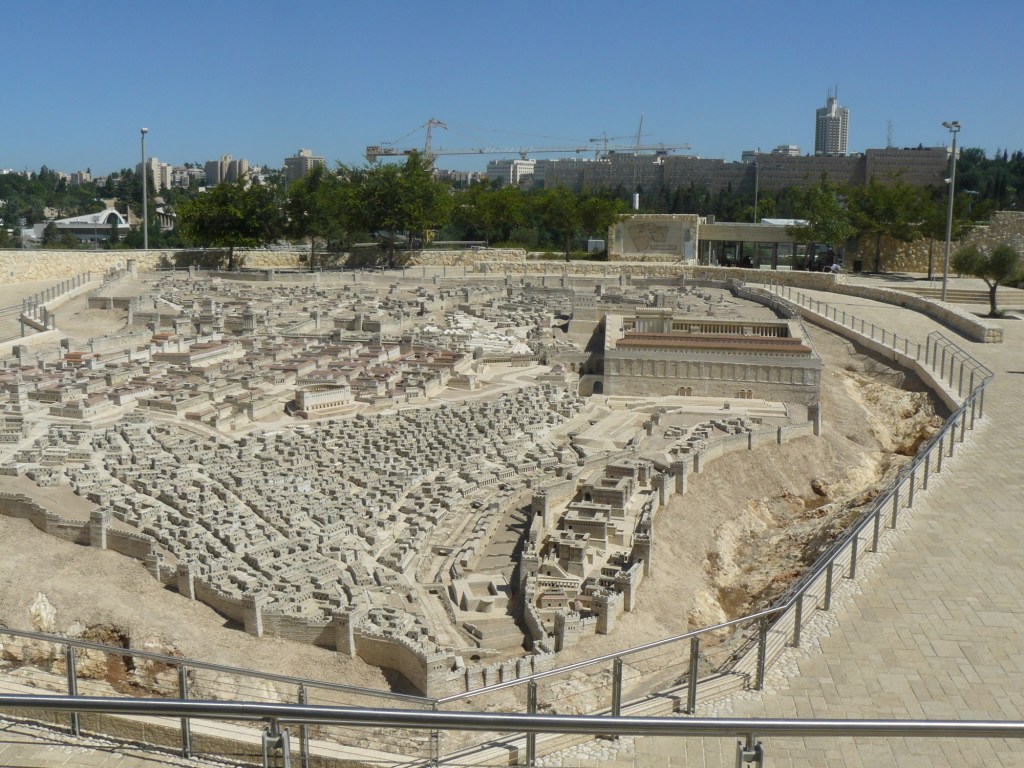


Model of first century Jerusalem

See what large stones! Trusting in the temple or trusting in God.

November 16, 2024

Pentecost 26 – 2024

Mark. 13:1-8

Marian Free

In the name of God in whom we trust. Amen.

One only has to read/watch the news to see the catastrophic state of the world: the unimaginable devastation and loss of life from the floods in Valencia and the wars in the Middle East, Ukraine and elsewhere, the disorder and civil unrest in Haiti, the drug-fuelled violence in Mexico, the displacement of people in the Sudan, Burma and elsewhere, the increasing polarisation between people of the same nation and background and between people who confess the same faith, and the exaggerated rhetoric and personal attacks around differing political views and cultural values – even in countries like our own. 

It is difficult at times not to fall into despair. It is tempting to look at the state of the world, to ask “what is going on?”, to wonder what the future might hold and to ponder where God might be in all this upheaval. Are all these disturbances a sign of more to come (as the changes in climate seem to threaten)? Are we witnessing the end of life as we have known it OR is this really the beginning of the end of the world?

It is human nature to want to make sense of calamity[1]. Collectively, we want to give meaning to the death of a child, the destruction of our home, a life-threatening illness – to any unexpected tragedy or calamity. So great is our need to give meaning to something that has no meaning that we fall into the trap of making up trite, often pious explanations for such events. We are anxious find explanations that cover up our feelings of inadequacy, our inability to find the right words to say, or which to help us to avoid facing the trauma of the inexplicable. 

I’m sure that you know what I mean. You may even have used phrases yourself. “God wanted another angel”, “They are in a better place,” “This will make you stronger” and so on. There are any number of such sayings that have entered our vocabulary to be trotted out when we have nothing better to say.  Sadly, by failing to honestly acknowledge someone’s pain, by not facing the trauma head on, we often increase a person’s sense of isolation and grief. Instead of providing comfort, we reveal our own failure to understand and our unwillingness to engage.  When say these things to ourselves, we withhold permission from ourselves to express our heartache, to sit with our grief until such time as the healing process can begin.

Today’s gospel forms the beginning of what is known as the “Little Apocalypse”, the description of things to come. Very often these are taken to be sign of the end – in fact that language implies that that is what Jesus is saying.

I want to suggest that Jesus’ meaning is much broader and much more related to the present (at whatever time in history that present might be). 

Scholars believe that Mark’s gospel was written to and for a community under threat. It written to reassure believers that their experience is not out of the ordinary, that in fact it was to be expected as a consequence of following Jesus. The gospel is a reminder that 

following Jesus is not a protection against the world’s ills. Faith in Jesus is not some or of amulet that will protect believers from harm. Believers will face the same travails and encounter the same losses as anyone who does not believe.

In our reading this morning the disciples look at the Temple which appears to have been built to withstand any threat. It was by all accounts a magnificent structure, built of huge stones, some of which were fifty feet long and eight foot high and thousands of tonnes in weight. To the disciples – Galileans all – the Temple must have seemed indestructible[2]. At the same time, despite all that Jesus has tried to teach them – about his suffering, about their taking up the cross – they still seem to hold the belief that Jesus has come to Jerusalem to confront the Romans, to restore Temple worship by removing the corrupt priests.

It is possible that for most if not all of the disciples are visiting Jerusalem for the first time. As followers of Jesus, they experienced his triumphal entry into the city and now they can sit and admire the Temple – the meeting place between YHWH and God’s people. “Look, Teacher, what large stones and what large buildings!” 

Jesus’ response would have been entirely unexpected. instead of joining in their wonder, Jesus announces the destruction of the Temple. “Do you see these great buildings? Not one stone will be left here upon another; all will be thrown down.” The Temple is not as indestructible as they think. Like everything else on earth, it is ephemeral and temporary, subject to destruction and decay.

This is too much for them to comprehend. The disciples need details, they need to make meaning out of what Jesus has said, they want to be able to prepare for such a catastrophic event. So they ask: “Tell us, when will this be, and what will be the sign that all these things are about to be accomplished?” It is then that Jesus begins to tell them of all the things that might happen. These, as I have suggested, are not so much signs of the end as Jesus providing a corrective – don’t look for signs even the angels in heaven do not know the time (13:32). Understand (Jesus seems to be saying) that worldly existence is precarious, humans are susceptible to variations in the weather, human bodies are vulnerable to disease and deterioration, and human nature tends towards competitiveness and selfishness. Peace and prosperity, health and fitness are not a given, but a privilege enjoyed by a few.  There are no simple, trite answers to trauma.

Our faith does not protect us from wars, earthquakes, famines, from hardship, poor health, or frailty. What faith does at its best is determine how we react to setbacks, traumas, and loss. What matters is not so much that we are able to interpret the times, but how we respond to what is going on around us. 

As people of faith, we cannot cut ourselves from the realities of human existence, but we can learn to live in the present, accepting what is rather than looking back to an idealized past or striving for an unrealistic future.[3] As people of faith, we are to learn to  place ourselves, our loved ones and the world in entirely in the hands of God, believing – sometimes against all evidence to the contrary, that all things will work for good. In this way, and this way alone, we will be ready for whatever is to come because we will already have placed our trust in things eternal, things that will last.

 Jesus’ comments about the destruction of the Temple are less about the timing of the end, and more a corrective of the disciples’ belief that Jesus has come to overthrow the leaders of Rome and of the Temple. They are a reminder not to look back to an idealised past or forward to an unrealistic future, but to live fully in the present, with all the good and bad that comes with that and to trust that God is with us through it all. 


[1] When my parent’s home was completely covered by flood waters in 1974, my father wandered round in a daze half-jokingly asking why God had asked him to build an ark!

[2] All that remains today are the Temple steps (see photo)

[3] It is important to note that non- resistance does not equal passive acceptance. If we can change things, if by the way we live and the way we act we can make a difference in our lives and in the lives of others, then we should do so.

God is not ours to control

June 24, 2023

Pentecost 4 – 2023
Matthew 10:24-39
Marian Free

In the name of God whose ways are not our ways, whose timing is not our timing. Amen.

How you might wonder does a preacher know what to preach – especially when confronted by such diverse and complex readings as we have before us this morning? It is difficult to pass over the pettiness of Sarah and of Abraham’s willingness to collude with her mean spiritednesses. How can one possibly declare (as we did) that this is the word of God? Paul’ letter to the Romans is rich and complex but again, for the sake of time, this too has to be passed over. My habit, as is the Anglican tradition, has been to focus on the gospel, but today’s gospel – as last week’s – consists of several parts. To give the passage the attention it deserves would warrant longer than we have. So to answer my question – in the first instance I read the set texts (hoping that some idea or theme will leap out). Second, I read what other people have to say – what have they made of these diverse readings? If this fails to produce inspiration I will repeat the process until an idea begins to form. Throughout the process I place myself in God’s hands through prayer and reflection, trusting that the Holy Spirit will and does guide me.

Sometimes I am as surprised as you might be as to where I land.

This week for instance, I was convinced that the gospel provided good material for a sermon on persecution – what it is, and why some who claim to be persecuted are not. A re-reading, however, convinced me that, just as this week’s gospel concluded that begin last week, so the theme of prayer could be addressed through Jesus words to his listeners. (That is to say I saw the gospel in a new light – a light I trust given through the Spirit).

Last week I wondered whether we thought that God had a magic wand with which (if we prayed hard enough, or in the right way) God could answer our prayers. Today’s gospel makes it clear that this is not how God acts. In fact, today’s gospel is shocking and confronting to any of us who have a simplistic, naïve faith. If we believe in a God who is benign at best and a frustrated parent at worst, then Jesus’ words today fill us with disquiet – “Do not think that I have come to bring peace to the earth; I have not come to bring peace, but a sword. For I have come to set a man against his father,and a daughter against her mother.” These words (and indeed those that precede them don’t conform to a picture of a Jesus who is warm, loving and protective. This angry, challenging Jesus makes us want to look the other way, to disassociate ourselves (surely he can’t mean what he is saying!)

Throughout history we have simplified and domesticated our faith. We have smoothed off the rough edges, seen conformity to the norms of society as an indication of our goodness and our moral standing. We associate ‘rocking the boat’ with non-conformist radicals, nothing to do with good upstanding Christian citizens.

We are ill-equipped to hear what Jesus is saying. But Jesus is saying something really important. His confronting language serves as a corrective to all of us who think that we know what God should do and how God should do it. Jesus reminds us that God is not ours to control (through prayer or any other means). He defies our desire that he will bring peace, restore order or conform to our expectations that faith is not costly or that as a consequence of his coming all differences between us will be dissolved. He makes it clear that he cannot change the world without first changing us.

Contrary to what we want to believe, Jesus warns us that faith can be, and often is divisive – because it calls us to stand for justice, to love the unlovable, to welcome the rejected. Our faith might bring us comfort- but Jesus warns that it is just as likely to make us uncomfortable. While he wants to shake us out of our complacency, to remind us that no amount of prayer will force God’s hand, Jesus is also keen to reassure us. We need not be afraid. Even if strife is raging around us and our prayers seem to fall on deaf ears. God knows each one of us – down to the hairs on our head and, even in the midst of our troubles God is with us, supporting and sustaining us.

In the final analysis instead of expecting God to do what we want, we have to trust God. We do not try to bend God to our will or, expect God to do what we think God should do. Through prayer we place ourselves in God’s hands, seek God’s will and rely on God’s strength to face the chaos in which we find ourselves.

Where your treasure is

August 6, 2022

Pentecost 9 – 2022
Luke 12:32-34
Marian Free

In the name of God, Earth-maker, Pain-bearer, Life-giver. Amen.

I have read Herbert and Harry by Pamela Allan so often that I almost know it by heart. It is a tale of two brothers who lived together, farmed together, and fished together until one day when fishing they pulled up a chest full of treasure. “It’s mine,” said Herbert, “I pulled it up.” “It’s mine,” said Harry, “I cast the net here”. Then Herbert pushed Harry and Harry fell – into the sea. Harry who was a strong swimmer, made it safely to shore while Henry rowed as hard as he could and as far as he could until he reached a lonely piece of shore. Then he started to walk. Herbert wanted to get as far away from Harry as he could. Finally, he lay down to sleep but even though it was dark, and he was very tired, he could not sleep. “What if Harry came and stole the treasure while he slept?” So, he pushed the treasure under the roots of a tree, but he still could not sleep: “What if someone had seen him put it there?”

So, Herbert decided to go far away to the highest mountain in the land and hide the treasure under some rocks, but still, he could not sleep. “What if someone had followed him?” So, he dug a hole deep into the mountain, pushed the treasure in and rolled a huge stone across the entrance. But still, he could not sleep. “What if someone forced him to tell where the treasure was?” He needed guns, lots of guns, but guns were not enough, he began to build a fort. All this took many, many years.

Now, Herbert and Harry are very old men. Herbert still guards his treasure on the top of the highest mountain in the land, but still, he cannot sleep. While Harry, who had no treasure has always been able to sleep.

“Where your treasure is there your heart will be also.”

We are all a bit like Herbert – anxious to hold on to what we have, worried that someone might take it from us, concerned that we will not get by without it. We try to separate ourselves from those who might have designs on our possessions. In places like Cape Town or Port Morseby those who have something to protect build high walls around their homes and top them with barbed wire. They employ armed guards to ensure that no one can get in and steal. Even in Australia where the threat is not so great, people are busy installing security lights, cameras, and alarms to deter anyone from coming in. Gated communities keep the right people in and the wrong people out.
As the story illustrates, alarms, guns and walls are only temporary solutions. Ultimately they exaggerate, rather than diminish our anxiety. Walls and security guards are constant reminders of our what we have to lose, they are a visible symptom of our fear and insecurity. At the same time, they are an indication of how dependent we are on our belongings for our sense of security and well-being – they reassure us that we will have enough for tomorrow, they give us a means by which we can measure ourselves against others and sometimes they are a sign of how far we have come.

And to what end? – possessions can end up possessing us and walls designed to keep us safe hem us in. What is more, our physical treasures are finite and they are vulnerable to loss and decay. As recent events have reminded us, it does not matter what measures we put in place to protect what we own, nothing will keep them safe from fire or flood or other natural disaster. However high our barriers, however extensive our security – those who really want to breach our defences can find ways to do so. However long our life, it will come to an end and no matter how much we have amassed we cannot take it with us.

Thankfully there are treasures that cannot be measured, treasures that are free for the asking and which do not need walls to contain them, because they cannot be contained. Intangible treasures like love, joy, faith, generosity, selfless and hope are imperishable and are designed to endure for eternity. These treasures do not need walls. Indeed, walls would be wasted, because these treasures have no boundaries. They are limitless and they flow outward from those who possess them without being diminished no matter how widely they are shared.

“Where your treasure is, there your heart will be also.”

In her children’s book, Pamela Allan, highlights Herbert’s wasted life. In his desire to protect his treasure he locks himself away, forgoing relationships and experiences which might have enriched his life. Harry, on the other hand, grows old on his farm with wife, children, and grandchildren. In the end, it is Harry – the one without the treasure – who is the richer of the two.

It is possible to spend an entire lifetime amassing wealth and possessions and in building bigger and “safer” fortresses to protect them but in so doing we become so focussed on ourselves and what we have and so anxious about losing it, that we miss out on the enjoyment we might have had from spreading our good fortune with others.

Immediately prior to today’s gospel Jesus has told his disciples: “do not worry about your life, what you will eat, or about your body, what you will wear. For life is more than food, and the body more than clothing. And do not keep striving for what you are to eat and what you are to drink, and do not keep worrying. For it is the nations of the world that strive after all these things, and your Father knows that you need them. Instead, strive for his kingdom, and these things will be given to you as well.”

Walls that keep others out also keep out God. Relying on our possessions prevents us from learning that we can place our trust in God. Prioritising our earthly treasures prevents us benefiting from heavenly treasures which are already ours for the asking and which nothing and no one can take from us.

Where your treasure is, there your heart will be also.

God loves you and that’s all. you need to know

March 19, 2022

Lent 3 – 2022
Luke 13:1-9
Marian Free

In the name of God who has no favourites. Amen.

Last year, a number of Social Media platforms made the decision to allow users to choose whether or not to publicise the number of ‘likes’ that their post received. Prior to that action there had been a significant public outcry about the competitive nature of social media and the mental health problems that ensued. It seems that some users were not only comparing the number of followers that they had against other users, but that they were also competing with others as the number of people who ‘liked’ their posts. In some cases, this was leading to extreme behaviours in order to increase the number of people who viewed the posts – riding on the roofs of moving trains or taking photographs in other very dangerous situations or expressing controversial opinions whether they believed in them or not. In other instances, the competitive aspect of the media was leading some people to feel undervalued if their posts did not receive as much attention as those of their friends. If a person’s posts included ‘selfies’, the result of receiving less attention than others led to a poor body image and to the reduction a person’s self-confidence -sometimes to the point that a person experienced depression or worse, led to suicide.

It is easy to blame social media for this situation, but really social media has simply exaggerated and brought to the fore a behaviour that is integral to human nature. Competition between individuals, groups and nations is not new and, as the current situation in Ukraine illustrates, it can have catastrophic effects. Indeed, in the natural environment competition is essential to the survival of the species – male -male competition ensures that the stronger/smarter males mate with more females which in turn assures the continuation of the species.

Contrary to our ideals, the natural world is not benign and we – often to our detriment – are part of that world.

In today’s rather gory and obscure gospel, Jesus confronts this competitive way of thinking and living – particularly the sort of competition that vies for God’s attention and affection or which assumes that God plays favourites with those who behave in particular ways. It is difficult to say why Luke breaks into his gospel with this conversation between Jesus and ‘those present’. There is nothing to suggest that those who report the actions of Pilate are engaging in a game of ‘one-upmanship’, but Jesus’ response makes it clear that he thinks that they are telling him the story about the blood being mixed with sacrifices in order to reassure themselves that they will not suffer the same fate. They assume that the Galileans must have done something truly awful for God to punish them in this way.

Jesus’ answer makes it clear that God had nothing to do with the fate of the Galileans. He is clear that God does not measure us against one another. God doesn’t favour the ‘good’ over the ‘bad’. God does not have a scale against which to determine who is more (or less) deserving of reward (or punishment). In fact, Jesus knows that God has no expectation that any flawed human being will achieve perfection.

This apparent interruption to the flow of Luke’s account provides an important message for ourselves on this third Sunday of Lent. For in two thousand years little has changed. We are no different from those in Jesus’ audience. Like them, we (at least on occasion) fall into the practice of comparing ourselves with others, reassuring ourselves that however bad we are ‘at least we are not as bad as them’.

Jesus wants his listeners to come to their own conclusion, so he asks: ‘Do you think that these Galileans were worse sinners than all other Galileans?’ or that those on whom the tower fell, ‘were worse offenders than all the others living in Jerusalem?’ Speaking to everyone who is present, Jesus continues: ‘Unless you repent, you will all perish just as they did.’ In other words, Jesus makes clear (as he does elsewhere) that when it comes to sin, we are equals, no one is more (or less) deserving than anyone else. God does not care whether our sins are great or small, heinous or careless, what does matter is that we recognise that we are all sinners, and that we all fall short of the glory of God (Rom 3:23). In other words, instead of comparing ourselves (favourably) against others, Jesus encourages us to be honest about our own faults and determine to turn (repent) from the ways of the world and our self-absorption and to trust in God’s love and care for everyone.

The apparently unrelated parable of the fig tree illustrates just this point. Worldly, competitive values (represented by the landowner) dictate that results – productivity, justifying one’s existence, being better than those around you – are more important than relationships. Kingdom, non-competitive values (represented by the gardener) teach us that – nurture, patience, understanding individual capabilities and needs – are of more importance than individualism and competition.

God knows and loves each one of us – just as we are – and, when we don’t live up to our potential, God patiently and lovingly gives us a little more care – hoping, believing that we will (however good or bad we may be) come good in the end.

We are all (sinner and saint) equal in the eyes of God, equally valued, equally treasured and God will (as God already has) do everything to ensure that we enter God’s kingdom.

It is not God who excludes us, but we through our mistaken belief that God has standards that we fail to meet, who exclude ourselves.

How long will it take for us to trust in God’s love for us? How long before we understand that we are already laid bare and cannot hide our true selves from God? How long before instead of living in fear of judgement, we live in joyful anticipation of Jesus’ coming again?

God loves you and that is all that you need to know and if you know that, you will accept that God loves everyone.

FOCUS!

March 12, 2022

Lent 2 – 2022
Luke 13:31-35 (Genesis 15:1-12,17-18)
Marian Free

Loving God, may we so keep our eyes on you that we will not be led from our path no matter the circumstance in which we find ourselves. Amen.

Foxes, chickens, Herod, Jerusalem, threat, lament, warning and determination, references to time and Pharisees worried about Jesus’ fate. There are so many threads in the few verses that make up today’s gospel that it is difficult to know which, if any, of these is useful for our Lenten observance or even if they hold together. On this occasion, the immediate context of our passage doesn’t help us to determine its meaning. Immediately prior to these verses Jesus who, on his way to Jerusalem has been going through villages and towns teaching, responds to a question as to who will be saved. Jesus answers by issuing a warning to the effect that now is the time to accept God’s invitation to enter the kingdom before it is too late, before others – the gentiles – have taken all available places and the door is shut.

Following the Pharisees’ warning and Jesus’ response is an account of Jesus’ observing people at a banquet and his comment that it is better to take a lower place at the table and be invited to move up than to take a place of honour and be demoted. Both reflections conclude with a reminder that kingdom values reverse those of the world: “the first will be last and the last will be first” (13:30) or “those who exalt themselves will be humbled and those who humbled themselves will be exalted” (14:11). These reflections are indeed useful for those of us who are examining our lives this Lent, but they provide little insight into today’s gospel.

Perhaps a more useful starting place for our understanding of today’s passage is to go back to the moment that Jesus left the relative safety of Galilee and began his journey to Jerusalem. In 9:51 (53) Luke tells us that Jesus ‘set his face towards Jerusalem’. As I mentioned a few weeks ago, this is strong language. Jesus’ experience so far has told him that his message and his presence is not welcome among those in positions of leadership in the church. What is more the fate of John the Baptist is evidence that the powers representing Rome will, at the very least, view him with suspicion if not fear (something that the warning of the Pharisees in today’s reaffirms). Jesus is not going to Jerusalem because he is seeking glory or even because wants to see the great city. He has set his face to Jerusalem because he knows that this is where he will face his destiny.

The (unexpected?) warning from the Pharisees provides an occasion for Jesus to reflect on his mission. His response to Herod (“tell that fox”) indicates that nothing – not even the threat of death will deter him or cause him to turn from the path that has been set before him. There is work to be done and he will continue to fulfill his purpose: ‘today and tomorrow and on the third day I finish’. It is easy to see a reference to Easter here, but in colloquial terms ‘today and tomorrow’ relate to what Jesus is doing now and ‘the third day’ means ‘in due course’. Jesus’ listeners (who do not have our benefit of hindsight) will have heard this as an indication of Jesus’ resolve, his determination to complete the task set before him whatever the obstacles. The threat of death is no obstacle. Jesus will not be distracted or deterred. He has a task to fulfill and he will not turn aside until it is completed. “Today and tomorrow and the next day I must be on my way.” (He must stay where he is until he has done all that he is meant to do, but then he must continue to Jerusalem no matter the personal cost.)

In this way Jesus is nothing like his forbear Abraham who, despite being chosen by God and having received God’s promises, needs constant reassurance. Abraham is not willing to face danger and he often takes the easy way out – making up his own mind about the best way forward rather than trusting in God’s purpose for him. He is easily distracted by his desire for an heir and his anxiety that the kingdoms through which he passes will not allow his party to pass through in safety.

Jesus has no such concerns. Whatever the situation, whatever possible obstacles lie ahead, he is utterly focused on God’s will for him. Jesus’ resolve, his commitment, determination and single-mindedness are what stand out in today’s gospel and are what provide an example, an incentive for our own practice this Lent and for our Christian vocation as a whole.

In comparison to Jesus, how do we stack up? In the light of Jesus’ determination to see his mission to its end, we should ourselves how much we are concerned for our own safety, our own comfort, our own goals for our future? How often do we let our own timidity, or our lack of confidence prevent us from placing our trust completely in God? How often and how easily are we distracted from our primary goal of being a disciple of Christ How many of our resolutions have faltered because we did not have strength to follow through?? Indeed how many times have we been sidetracked from the task we set ourselves for this Lent?

I leave you with two prayers from A Prayer Book for Australia, that you might like to pray daily this Lent and which might help to strengthen your resolve to be better disciples of Christ.

Christ, whose insistent call
disturbs our settled lives:
give us discernment to hear your word,
grace to relinquish our tasks,
and courage to follow empty-handed
wherever you may lead. (210)

Loving God,
give us wisdom and understanding
in discerning your will for our lives.
Teach us in all things
to seek first your honour and glory.
May we perceive what is right,
have courage to pursue it
and grace to accomplish it,
through Jesus Christ our Lord. (213, adapted).

May we have grace to relinquish all that stands between God’s will and ourselves and our selfish desires and may we have the courage to pursue whatever it is that God might ask of us.

Complete surrender

October 9, 2021

Pentecost 20 – 2021
Mark 10:17-31
Marian Free

May I speak in the name of God – Earth-maker, Pain-bearer and Life-giver. Amen.

It has been a long time since I have had to do a comprehension test. So long that I’m not sure that I can accurately remember what they entailed. I do know that they were a component of my early primary school years and I imagine that they were an important aspect of my German lessons. From memory, a comprehension test involved reading a text (or having it read to me) and then being asked a number of questions to determine how well I had understood the passage.

How well would you do, do you think if I gave you a test on today’s gospel? To begin with, you might have to divide what is quite a complex text into its component parts – Jesus’ conversation with the man, Jesus’ teaching his disciples and Jesus’ response to Peter’s question. With regard to the first six verses, I might ask: What Jesus was doing? How did the man approach Jesus? What do we know about the man and what did he want from Jesus? How did Jesus respond and how did the meeting end?

There are a number of points of interest in this text. In the first instance Jesus was “setting out”. He was continuing on his journey when a man ran up and knelt before him? Kneeling is a strange thing to do as the man is not asking Jesus from Jesus. What is the reason for his urgency and why does he kneel, especially when he seems so confident in his own goodness and piety? Interestingly, Jesus rejects the expression “good” Teacher, reminding the man that only God is good. Then instead of listing the ten commandments Jesus mentions only six and does not include love of God or love of neighbour.

I find this one of the more poignant encounters in the gospels. We have to assume that the man’s question and his sense of urgency were genuine, but his confidence in himself could have been seen as arrogance. Was he simply hoping that Jesus would affirm his goodness and his piety? We don’t know. What we do know is that Jesus doesn’t censure the man for the interruption or for his lack of humility. Instead, he looks at him and loves him. Then he drops a bombshell: “you lack one thing, go, sell what you own and come follow me.”
According to Mark the man is shocked (or even appalled) by Jesus’ words. Jesus’ answer was certainly not what he was expecting. He believed, as did his contemporaries, that wealth signified God’s favour. The man presumably saw his possessions as an affirmation that he was keeping the commandments to God’s satisfaction. How could Jesus possibly ask him to give up the very thing that proved his worth in God’s eyes? It was a step too far but even so he went away grieving. He had not found what he sought.

There has been much debate as to whether or not discipleship entails giving up one’s possessions or not, but the central point of this passage is not wealth, rather it is our willingness to depend on and to trust in God. It is about whether we believe that our place in the Kingdom of God and our certainty of inheriting heaven depends on earthly values – wealth and status or on heavenly values. It is about whether we rely our own efforts to achieve the Kingdom or whether we graciously accept that Jesus has done all that needs to be done.

Ever since Jesus announced his death and resurrection he has had to correct misunderstandings about the nature of discipleship. Now he finds that he has to adjust expectations as to what is required to enter the kingdom of God. The two, of course are related. Jesus has been at pains to make it clear that discipleship involves sacrifice not exaltation, service not power, collaboration, not competition. Discipleship does not confer status or make one distinctive – just the opposite. In the same way the Kingdom of God is not characterised by social climbing, rivalry or competition. There is no hierarchy in heaven. We will not be spending eternity comparing ourselves to others so why would we believe that it is OK to do that in the present.

God does not have a hierarchy. We are not measured by how well we compare (or do not compare) with others but by how well we have learnt Jesus’ lesson of complete surrender. We are judged not by what we have, but by what we have been willing to forgo, not by what we have done, but by what we have graciously allowed God to do for us.

Status and wealth might define us in the present but, as Jesus has been at pains to point out over the past few weeks, they are irrelevant in the Kingdom of God. As the saying goes: you can’t take it with you – not wealth, not status – not anything that we cling to that we beleive gives our lives meaning and which distinguish us from those around us. Jesus is trying to make it clear by his teaching and by his example that, if we want to be part of the Kingdom – in the present, or for eternity, then we need to begin to live the kingdom values now. Not only will that prepare us for eternity, but it will radically change the present.

The man who approached Jesus was defined by his possessions – physical, earthly evidence of his worth and his goodness. He refused to believe that his life had value without them. He was unable to accept that there are no distinctions in heaven. He was so concerned for the present that he was unable to prepare himself for the future.

What about us? Are we preparing ourselves for eternity or allowing ourselves to be defined by earthly symbols, earthly values? If we cannot relinquish our symbols of worth in the present, what makes us think that we will be ready to relinquish them in order to enter heaven?

What do you cling to and can you begin to let it go?

Getting the relationship right

November 21, 2020

The Reign of Christ

Matthew 25:31-46

Marian Free

May I speak in the name of God who gives us everything that we might give God our all. Amen.

My sister used to work for Family Services. It was a traumatic experience for someone who had just left university. Every Sunday lunch she would regale us awful stories – her way of dealing with the stress. Needless to say a number of her stories have stayed with me.  One relates to a young boy who was placed in a foster home in January. Somehow his foster parents discovered that Santa had never been to his home. His mother has always said that he had been too naughty. His foster parents were so sad to hear his story that, even though Christmas was long gone, they organized the local Rotary to bring Santa to their home just for this child.

Parents use a variety of techniques to discipline or control their children  – corporal punishment, coercion, persuasion, rewards, positive reinforcement, behaviour modification and so on. A certain amount of discipline is necessary. A child who knows what the boundaries are is likely to feel more secure and a child who understand that some things and some situations are dangerous will be better able to keep out of trouble. Whether we like it or not, we are all part of the wider society and we need to understand how to get along with other people and how to respect the law and the rights and needs of others. At its best, discipline encourages a child to be their best self and to get along with others. Few of us make perfect parents, but I am sure that those of us who have had the opportunity to be parents have done our very best to raise happy, confident children.

Unfortunately, there are some for whom discipline too easily slips into control. There are parents who say such things as, “if you don’t do what you are told I won’t love you”, “if you don’t behave I’ll leave you on the street”. A child raised in such circumstances would live in a state of constant anxiety, never knowing what behaviour might lead to the threatened punishment or when their parent’s love might be withheld. Instead of feeling valued and growing into mature and happy people, they would always be insecure, always trying to please their parents in order to earn their love.

Young or old, we all respond much better if we know that we are valued and loved by our parents.

Sometimes the Bible appears to  present God as a demanding and hard to please parent, one who says! “If you don’t behave I won’t love you.”  I have known many people who have not been taught to believe that God loves them unconditionally and live in constant fear that they have done something to displease God. In reality there is no impossibly high standard that we have to reach in order to earn our entrance into heaven. Nor is God watching every detail of our lives in order to catch us out so we can be punished. Instead God is urging us on from the sideline, conscious of our frailty but willing us to be our best selves.

Today’s gospel, indeed the gospels of the last two weeks, could easily be used (indeed have been used) to support the view of a harsh and unforgiving God. If you do not have enough oil the door will be locked, if you haven’t appreciated and used God’s gifts you will be thrown into outer darkness. It seems clear if you don’t reach the bar, God won’t have a bar of you!

I’d like to put the three parables into context. All our gospels were written at least 40-50 years after Jesus’ death. By this time those who knew Jesus would have died and it is possible that the second generation of believers would also have also died. The initial enthusiasm for the faith would have waned and the believing community would no longer be able to rely on the shared excitement of the original believers to shape behaviour and to draw new converts to the faith. At such a time the church would have been looking at new ways to get members and new ways of encouraging members to hold on to the faith.

There is considerable evidence within Matthew’s gospel to suggest that the community, having left behind the first flush of enthusiasm is looking for ways to encourage people to stay and ways to draw others in. What better way to put the ‘fear of God into people than to threaten believers and non-believers alike to an eternity of punishment. Of all the gospel writers none does a better job at this than Matthew. Only Matthew, for example has the parable of the wise and foolish maidens and the sheep and the goats.

Let me make it clear. I do believe that I/we will one day have to answer to God for our lives on earth and let me tell you, that will be close enough to hell for me.

It is easy to think that God is harsh and unforgiving, but the parables of the wise and foolish maidens, the talents and the sheep and the goats may be pointing in another direction. They may be challenging us to ensure that our relationship with God is so strong and secure that we always have something in reserve, have the confidence to use our gifts and the desire to support and encourage others.

If you put your relationship with God first, everything else will fall into place.

Open to God’s abundant love

November 14, 2020

Pentecost 24-2020

Matthew 25:14-30 (notes from Stradbroke Island)

Marian Free

In the name of God whose generous love is poured out on all who would receive it. Amen.

Gallery owner, international art dealer and philanthropist Tim Olsen has this week released his memoir – Son of a Brush. Tim is the son of one of Australia’s most well-known and respected artists John Olsen. As he tells it, Tim had a chaotic and emotionally deprived childhood. The family spent Tim’s early years in Europe before moving to an artist’s commune to the north of Melbourne. Dunmoochin was, Tim writes, ‘a bacchanalian free love cult’. Sexual experimentation was encouraged. Tim witnessed scenes that no seven year old should be exposed to and he was very aware of the distress that his father’s sexual adventures caused his mother. But it was not just life at home that was unsettling. Tim was bullied and abused by the local children. On one occasion a group of eight children, including a young girl, knocked him to the ground and urinated on his face. Tim credits this heinous act as the reason why, throughout his life, he has struggled to trust friendships and intimacy.

His turmoil didn’t end when the family left Dumoochin for Sydney two years later. Tim was sent to boarding school. When he graduated at 18 his parent’s marriage had reached breaking point and his father left his mother for the woman with whom he’d been having an affair. (Tim heard about the subsequent marriage through a friend who had been invited to the wedding – though he had not. When John married his fourth wife, Tim and his sister were banned from visiting.) Tim went on to be a hugely successful art dealer, corporate advisor and consultant, but nothing could fill the deep void inside. His first marriage failed and despite a second marriage and the birth of his son, Tim’s private life spiraled into a self-destructive pattern of over-eating and alcohol abuse. At one point he even considered taking his life.

Tim is on the way onto recovery thanks to his wife and to friends who kept him strong, but his story is a reminder that abuse and neglect leave people traumatized and untrusting, unable to form intimate relationships and often trapped in negative and destructive behaviour which reinforces their belief that they are not good enough or that there is nothing about them that is loveable.

That rather long introduction is an attempt to answer the question as to why the third slave in today’s parable hides the money that is entrusted to him. His experience of life has left him fearful untrusting and lacking in any self-confidence. His primary concern on being given the vast amount of money is to keep it safe. He does what He does what most people did to keep valuables safe from thieves and invaders – he buries it. After all, he has been given no instructions, perhaps it’s a trick x yet another ruse to expose his inadequacies. (‘Better be safe’, he might have thought.)

As I have said before, Matthew’s version of this parable often gets conflated with Luke’s version and both no doubt have been changed in the retelling. At the heart of the parable is generosity. The amounts given to each servant are impossibly large – millions of dollars. Instead of focusing on the punishment of the third servant perhaps our focus should be on the generosity of the giver and our willingness (or inability) to be gracious recipients of that generosity.

If we have not known unconditional love and trust, it can be almost impossible to feel loved and trusted, impossible to love and trust others. Some people (presumably illustrated by the third servant) close in on themselves fearing that if they open themselves to ‘love’ they will only be hurt and abused. Unable to accept that they might be loveable, they cannot even see God as a God who loves without condition. They feel that they must constantly be on the alert for abuse and that they must try to please others (including God). They feel that love, if love is to be had at all, has to be earned and that others (including God) are always on the lookout to find reasons not to love them.

The parable is not so much a parable about a harsh and unforgiving God, but about a God who pours out abundant love, and it tries to explain why not everyone is able to receive that love. It is written for those of us who know God’s love, whose lives have not been barren and filled with disappointment and is a reminder to always trust God and to be open to God’s love. Those who through trauma and fear lock themselves out of God’ love will never know the rewards and blessings of same. I believe though, that the gospels as a whole (think the lost sheep, the prodigal son) tell us that God will leave no one behind and that those who have been traumatized and denigrated and unloved, will one day open their wounds to the ministrations of God’s love and will be made whole. Then they too will see that the gifts of God (the talents) will grow in ways that they can not begin to conceive.

Taking Responsibility

June 13, 2020

Pentecost 2 – 2020

Matthew 9:35-10:8 

Marian Free

In the name of God who calls, equips and sends us into the world. Amen.

A number of you will have received and returned the Parish Survey – thank you. The Wardens wanted to get a sense of your expectations as we prepare to re-open the church for public worship. If you have completed the survey you will know that most of the questions are quite straightforward – where you are most comfortable worshipping, how you have found the isolation, what are you most looking forward to when you return and how you see St Augustine’s (what does it mean to you). I imagine that no one had difficulty with any of these questions and, from the answers we have received so far, it is clear that a majority of people have been reasonably happy with what we have been doing in the past and are keen to resume face-to-face worship in much the same way as it was before.

After answering the more general questions you might have been caught by surprise (as I confess, I was) when it came to the last statement on the survey: My vision for my spiritual future looks like:…. Most of the other questions were somewhat general and impersonal. They allowed us to place responsibility for the life of the Parish elsewhere: on the Parish Council or on the ministry team. But, as I read it, this last statement asked us to take responsibility for ourselves and for our own spiritual journey. “My vision for my spiritual journey.  The statement challenged us to reflect on our own spiritual health, to consider whether or not it will look any different in the future and, if we think it will look different, what we are going to have to do to make that future a reality. 

It is a quite confronting and even demanding statement, especially for traditional Anglicans who are not used to articulating their inner experiences or sharing their spiritual practices with others. It is a reminder too, that in the end it is we as individuals (not the Parish as a whole) who will have to answer to God for the way in which we have responded or not to the presence of God within us. As members of this Parish we may have to justify how we have or have not built the Kingdom of God in this place, but how we do that will depend in part on how we have responded to God’s call in us.

In the end how we move forward as a community depends not on the Ministry Team or the Parish Council, but on each one of us. Together we make up the congregation of St Augustine’s or of the Parishes of which we are a part. Our individual spiritual health contributes to the health of the congregation as a whole. Our commitment to grow in our faith and to develop good spiritual practices will in turn ensure the health of our Parish. The depth of our relationship with God and with each other will be a sign of hope in the wider community which will in turn draw others to faith.

Taking responsibility is at the heart of today’s gospel. Jesus sends the disciples out to do the very things that he has been doing: “preaching the good news, curing the sick, raising the dead, cleansing the lepers and casting out demons”. Jesus “sends them”. He doesn’t go with them to ensure that they get it right. He doesn’t give them explicit instructions as to what to do or what to say. In fact, he sends them out with very little – except their faith in him and his confidence in them. Jesus trusts his relationship with them and theirs with him. His mission and its future depends absolutely on his ability to trust the disciples to take responsibility for the healing, life-giving good news that he himself proclaimed. 

So, Jesus sends them out – on their own. He doesn’t go with the disciples and hold their hands. He doesn’t hand them a script and expect them to follow it word-for-word. He doesn’t give them a check list that they have to tick off. He doesn’t look over their shoulders to ensure that they are getting it right. Jesus simply sends them out believing that they are up to the task while he himself gets on with his own teaching and proclaiming. 

We know that the disciples were a mixed collection of foolish, ambitious, cautious (even cowardly) men yet Jesus has complete confidence that they are up to the task and the disciples, despite their human frailty, trusted Jesus (or the Holy Spirit that Jesus bestowed on them) to empower and lead them to complete the mission they had been given. 

So, it is with us. Jesus gives us the responsibility to trust that the Holy Spirit that each of us received at our baptism will lead, inspire, direct and encourage us to complete our mission – in our life as a community and in our individual spiritual lives. Jesus will not give us a detailed list of instructions or a specific road map of the way ahead. He won’t continually check up on us but will treat us as adults as people who have their own agency and their own free will to respond to his call on our lives and to carry out the mission to which he has assigned them.

It is somewhat unnerving I admit. The future is not clearly spelt out for us, it is not written down step by step. It will simply unfold as we continue to place our trust in Jesus and in Jesus’ trust in us. 

If you found the last statement in our survey confronting or challenging that is not necessarily surprising. Our spiritual future is something of an open book – one that is dependent in part on God’s plan for our lives, but one that will not come to fruition unless we continue to place our trust in God and to place our lives entirely in God’s hands.