Posts Tagged ‘uncertainty’

God is in the here and now

November 15, 2025

Pentecost 22 – 2025

Luke 21:5-19

Marian Free

In the name of God in whose hands are all things. Amen.

We live in particularly unsettled times. It is impossible to be unaware of the fragility of social structures, of national borders and of infrastructure. In some places democracy appears to be under threat; wars in the Ukraine, the Sudan and elsewhere threaten to change the shape of the world and typhoons, hurricanes and earthquakes reveal the vulnerability of our built structures.

For those of us who have lived through at time of relative of security, peace and prosperity  the current state of the world can feel destabilizing and disturbing. We just don’t know how to plan ahead.

Jesus’ disciples knew what it was to live in uncertain times. Most of them lived a hand to mouth existence. Except for a brief period under the Maccabees their country had been under foreign domination for centuries. At this point in the first century Galilee was ruled by a cruel and capricious Herod and the marginally more benign Pilate ruled in Judah. Everything that could be taxed was taxed and punishment for unrest was swift and violent. Their ability to make plans for the future was severely limited.

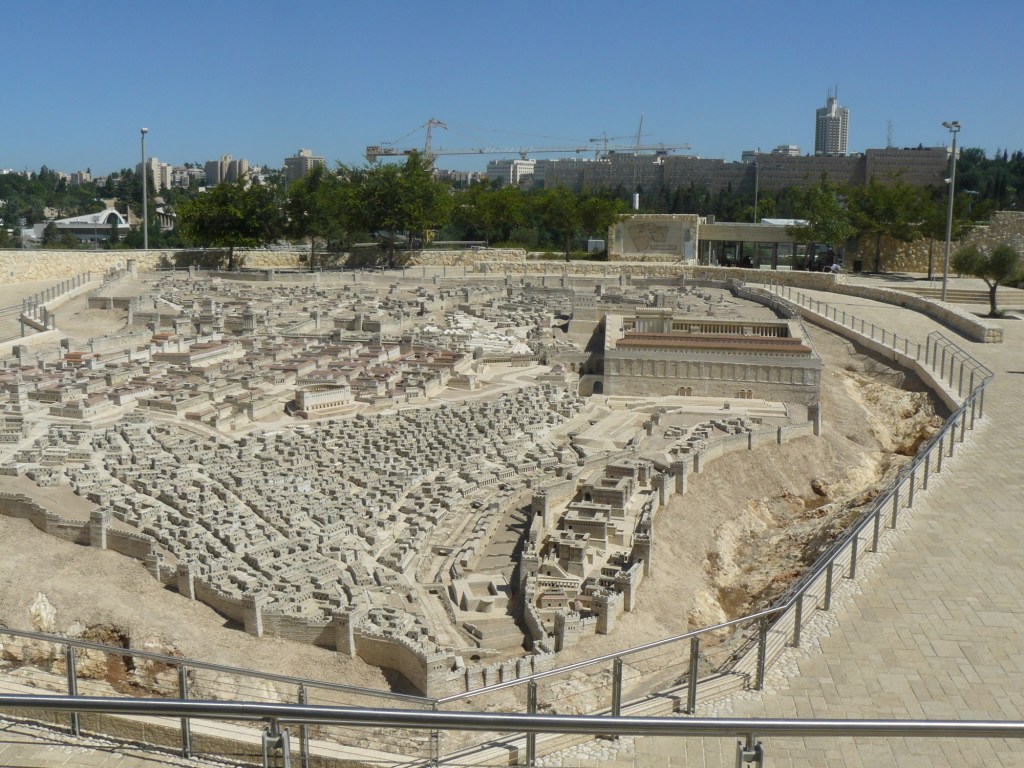
One point of stability and confidence was the Temple. The Temple, built as it was on the Temple Mount was a magnificent and imposing building. Constructed in 516 BCE to replace the original that had been destroyed by the Babylonians, the Temple had been significantly enhanced by Herod the Great (the father of the current Herod) and was known as Herod’s Temple. For Herod it was a symbol of power and might and control and for the Jews it was a symbol of God’s presence in their midst, a holy place in which the ancient rituals of sacrifice and atonement could be carried out, a place of prayer, a meeting place and a place in which even the Gentiles could worship the God of the Jews. Above all, it was a reminder of the universal nature of God, a sign of solidity, strength and endurance.

The Temple dominated the city of Jerusalem, it would have been almost impossible to imagine that it could be razed to the ground.  

Yet, on overhearing people marvel at the Temple Jesus warns that: “the days will come when not one stone will be left upon another; all will be thrown down.” And in response to the disciples’ question: “When will this be?” Jesus doesn’t answer their questions but continues with a number of seemingly unrelated warnings – about false teachers, wars, insurrections, earthquakes, famines and plagues,  betrayals and persecution.

This section of the gospel is usually referred to as the “little apocalypse”, a litany of what might be expected at the end of time. It is possible that is reflecting  a commonly held view that things are so bad that God will surely intervene and bring the world as it is to an end. If so, he is helping his disciples to make sense of the chaos that they see around them and assuring them that a) they will survive if they hold fast and b) that God will ultimately have the upper hand.

Equally possible is that Jesus, recognising the anxiety of his disciples, is warning them that the future is unpredictable and that God doesn’t work to a time line. Jesus is encouraging the disciples not to waste time by focusing on what might or might not happen but instead to live in the present and to take things as they come, knowing that God will equip them to cope with whatever comes their way – be it political upheaval, natural disaster or persecution. Jesus is reminding the disciples  that they cannot and should not try to second guess God, that they should try to trust that God has things in hand and that the future will unfold in God’s own time.

Jesus is reminding his disciples that life is precarious and the world is unpredictable and that they shouldn’t allow themselves to be caught up wondering what will happen and when. Rather they should concentrate on what they can and cannot do in the present. They should learn to place their trust only in God, because God is the only constant  – not political systems, not buildings and certainly not the natural environment.  Living in the present and leaving the future to God is the only way to cope with uncertainty. Trying to take control is futile. Worrying about the future and trying to create systems and structures that will cushion us from the visiccitudes of existence, keeps us in stasis and prevents us from experiencing life with its joys as well as its sorrows. Obsessing about how one might face a situation (a situation that may not arise) prevents us from seeing and grasping how God is acting right here right now.

Jesus advice is as relevant now as it was two thousand years ago. In uncertain times, he says, we must avoid the temptation to trust in those who make false promises that all will be well. When we are are tempted to read the signs of the times, we must remember that there will always be wars, insurrections and natural disasters and that they are not accurate indications that the end is near, but simply a reflection of the nature of humanity and of the instability of the planet. If we are tempted to see the hand of God behind the awful events in our lives and in the world Jesus reminds us of our limited understanding and asks that we leave the ordering of events to God.

The disciples want Jesus to tell them what the future will hold. Jesus’ response is to tell them not to waste time worrying about the future, not to build up barriers the hope that they can protect themselves from hurt and from harm, but rather to embrace the present with all it difficulties and complexities and to trust in God to give them the confidence to accept what is, the courage to persevere and the words to say.

No one knows what the future will hold so let us trust God in the present rather than placing our hope in an unknown future and being paralyzed by unnecessary fear.


Model of first century Jerusalem

Of foxes and hens – Luke 13:31-35

March 15, 2025

Lent 2 -2025

Luke 13:31-35

Marian Free

In the name of God who has “yet more light and truth to break forth from God’s word[1].” Amen.

As part of my Lenten discipline, I am reading Healing Wounds: the 2025 Lent Book by Norwegian Bishop and author Erik Varden. Varden is a Trappist monk, so I should not have been surprised that his approach to the study is that of a Roman Catholic.  While I understand his imagery, I find some of it jarring. That said, the book is providing much food for thought. Varden takes as his starting point an ancient poem authored by one Arnulf of Leuven (1200-48), a Cistercian and an author. The poem is a meditation on the cross, specifically on Christ’s body on the cross – his feet, his knees, his hands. Varden suggests that the poem asks the question: “How do I appropriate the passion narrative with due proportion and without presumption?” or “How do I experience Christ’s wounds as the living source of a remedy by which sin is cured and humanity’s wounds, my wounds are healed?”[2]

It is not only Varden’s theology that is somewhat different from my own, but his use of scripture. In particular, given this week’s gospel, I have found my self pondering his reference to Luke 13:34b. “How often have I desired to gather your children together as a hen gathers her brood under her wings, and you were not willing!” Varden is commenting on the poet’s reflection on Jesus’ hands – “your sacred hands extended”.  The poet continues: “You show yourself broad, ready to receive both good and bad; attracting the indolent, calling the devout, holding them in your embrace, freely open to all.” Influenced by the language of the poet Varden writes: “He (Jesus) desired to gather Jerusalem’s children ‘together as a hen gathers her brood under her wings.’”

I will leave you to ponder what to make of the image. It may be that you, like Arnulf and Varden, see Christ’s outstretched arms on the cross as a welcoming embrace, and that for you too Jesus’ arms nailed to the cross recall to mind Jesus’ words as he contemplates Jerusalem in today’s gospel.

Varden has, it seems to me, used scripture quite creatively, and this is just one example. That said, it is only in the last few hundred years that we have expected scripture to make literal sense. Until quite recently scholars and preachers alike understood that scripture was to be understood allegorically and that it did not have to be entirely logical or linear.

This historical understanding of scripture comes in handy when we examine today’s gospel which, read as a piece, does not seem to be particularly coherent. (In fact, as I am discovering during Morning Prayer, much of Luke’s gospel reads as a list of unrelated sayings or comments.)

In the five verses that comprise this morning’s gospel there appear to be at least four unconnected themes – warnings, determination, concern and prediction – each of which warrant more than the one or two lines allotted.  There are foxes and hens, Pharisees who warn rather than attack Jesus, a city that kills prophets, a Saviour who is also a mother hen, and a saying that could refer to Jesus’ entry into Jerusalem or to his post-resurrection return. 

In these verses we see Jesus at his most discerning, his most assertive and his most maternal.

Trying to construct a sermon on any one of those themes means neglecting the others. There is a temptation, into which I may have fallen, to speak of foxes and hens, even though there is no direct connection between them in the text. 

Sometimes, I believe, it is important not to try to make literal sense of the text but allow it to speak to us in whatever way is appropriate for the time – ours or the world’s. It is important not to force the text into some form of coherence – to make the Pharisees’ warning relate to Jesus’ passionate outburst of love, to conflate Jesus’ discussion with the Pharisees with his reflection on Jerusalem.  Likewise, as familiar and heart-warming as they are, we should not take Jesus’ words about gathering the chicks out of context.

It is important to try to make sense of our scriptures, to place them in their context, and to understand the author’s literary skills and intention.  There are times though when sitting with the complexities and contradictions that we find in scripture, accepting that no amount of research, no amount of manipulation of the text will translate into something that makes absolute sense is just what is needed. 

Sometimes, as I have certainly said before, there seems to be some wisdom, if not intention here – the very incoherence of a text serves a purpose. Texts that seem to make little sense serve as a warning that we are not to rely on an earthly capacity for understanding, or to believe that earthly values are a reflection of heavenly values. Complex, contradictory scriptures force us to accept that we can never truly know the mind of God and that we must let go of our desire for certainty, simply sit with the text, and retain an openness to the movement of the Spirit – in the text, in ourselves and in others.

In the words of the hymn:

We limit not the truth of God

to our poor reach of mind,

by notion of our day and sect,

crude, partial and confined:

no let a new and better hope

within our hearts be stirred:

                  the Lord has yet more truth and life

to break forth from his word

O Father, Son, and Spirit, send

us increase from above;

enlarge expand all living souls

to comprehend your love;

and make us all go on to know

 with nobler power conferred:

                  that you have yet more light and truth

to break forth from your word.[3]

Sometimes all we can do is to let the words wash over us and make such sense as they will.


[1] George Rawson, hymn writer,1807-89.

[2] Varden,  p20. The book is available on Kindle as well as in hard copy.

[3] George Rawson, Togetther in Song, 453.

Getting out of God’s way – John 14:6

May 6, 2023

Easter 5 – 2023
John 14:1-14
Marian Free

In the name of God who is as close as breath and yet always just beyond our reach. Amen.

I often say that Jesus did us a great disservice by not writing down his teachings or his philosophy of religion. Jesus left it open for his followers to develop their own theology and, in the case of the gospel writers, to draw up their own individual version of events. It is possible that Christianity would be more united had Jesus been more definitive or produced something in writing . There would be less confusion as to what he said and did and no need for the early church to make sense of Jesus’ death and resurrection, because Jesus would have spelled out the meaning of everything before he died. In other words, to avoid confusion, misunderstanding and division, Jesus could have made it clear that he was promoting a new religion. He could have produced a fully formed theology of the Christian faith, written a creed and provided outlines of liturgical and ecclesiastical practice so that no one need be in any doubt as to what the church should believe and what it should do.

Having said that, I suspect that Jesus’ creation of uncertainty was actually a deliberate attempt to free humanity from a need to lock God (and faith) into a rigid set of principles and behaviours. Jesus does not set anything in stone, because Jesus wants us to rely less on ourselves and more on God; to grasp that our salvation is dependent not on anything that we can do, but on what God in Jesus has done for us; and to understand that God cannot be bought, bargained with or reduced to human categories.

He wants those who follow him to avoid the trap that the Pharisees seem to have fallen into – the trap of desiring certainty, of believing that they know and understand God, and of thinking that they can stay on the right side of God if only they follow this rule or another. Jesus hopes that those who come after him will follow his example of openness to God and his willingness to trust God blindly rather than to think that we can bind God to our will.

I find the Jesus of John’s gospel is perhaps the most frustrating, obscure, and contradictory. To give just one example, in verse 13:33 Jesus says: “Where I am going, you cannot come”, then only 8 verses later he says: “You know the way to the place where I am going” and “where I am you may be also” (14:4, 3). Both cannot be true, so we are forced to live with the tension of not knowing for sure.

Jesus seems to be deliberately keeping his disciples (and therefore us) deliberately on edge, ensuring that we don’t try to lock God into one way of being or another. He knows our desire for security, but he want us to understand that our relationship with God is less a matter of holding on, but rather a matter of letting go, less a matter of living within rigid and narrow guidelines and more a matter of grasping the expansiveness and openness of God.

As Meister Eckart says: “God asks only that you get out of God’s way and let God be God in you.” God is already there, in the depths of our being. That should be the only certainty, the only security that we need. Our task, over our lifetimes, is not to seek assurance but to accept that we already have it; not to seek God in words and deeds, but to discover that God is already present in our lives and to know that we can abandon ourselves to God’s presence. The task of spirituality is not to pray more, read more, do more, just the opposite, it is to let go, to trust, and to follow Jesus to the cross so that all that is false and illusory in our lives can be stripped away and we are left with only what is pure and true – the Spirit within.

Letting go, is counter-cultural and counter-intuitive which is why we resist it and why Jesus insists on it and why Jesus models it in his own life.

So, by a roundabout route, we come at last to today’s gospel, the beginning of Jesus’ farewell speech to his disciples. The scene takes place after Jesus’ final dinner with his friends. The disciples are confused and afraid. Their world has been turned upside down. If they had thought that things would remain the same, they were sadly mistaken. In just a short period of time, Jesus has broken social convention and washed their feet. He has revealed that he is about to be handed over by one of his own, and Judas has gone out into the night to do who knows what. If that were not enough to unsettle and confuse his friends, Jesus has told them that he is going away and that where is he going they cannot come.

“Do not let your hearts be troubled.” It is clear that Jesus knows that his disciples need some reassurance, but it is also obvious that Jesus is not going to accede to their need for direction by providing them with a guidebook or roadmap. As close as Jesus will get to giving them directions is to say: “I am the way, the truth and the life.” “I am the way, the truth and the life”, tells us nothing about what to do, what to believe and how to behave.

We will only find the way if we allow ourselves to be led by Jesus (not by our conceptions of Jesus). We will only know the truth if we let go of all those things we hold to be true and seek only God and God’s truth. We will only truly know life if we allow ourselves to abandon this life and to accept the life that Jesus offers.

In faith, we can only let go– not hold on, only empty ourselves – not try to fill ourselves, only get out of God’s way and let God be God in us.

Nothing is permanent

November 12, 2022

Pentecost 23 – 2022
Luke 21:5-19
Marian Free

In the name of God in whom we place our trust. Amen.

The past few years have been very unsettling to say the least. We have witnessed extreme and destructive weather events and a shifting international landscape as the influence of the US declines and that of China rise. COVID further exacerbated the uneasiness with closed borders, shortages of food and manufacturing products and the enormous stresses experienced by business trying to keep going during lockdowns. The war in Ukraine has further created havoc on the world stage. Unprecedented fuel and food shortages are impacting first world economies and interruptions to shipping are threatening starvation in third world nations dependent on wheat from Ukraine. A real or impending economic recession is further adding to a sense of gloom and doom. Add to this Putin’s threats to unleash nuclear warheads and it is not too difficult to imagine that we are approaching a cataclysmic end of the world such as that described in today’s gospel.

At the time that the gospels were written, the Jewish uprising had been completely squashed, the Temple destroyed, and Jerusalem razed to the ground. For those who believed that Jesus was the Christ and for those who did not, this was a foundational event. The Temple, which had been magnificently restored by Herod the Great was a visible sign of God’s presence among the people, a symbol of national identity and the only place in which sacrifices could be offered and rituals performed. Without Jerusalem and without the Temple, both Jews and those who would become Christians, had to rethink their identity and their relationship with God. If there was no Temple, there was nowhere in which to celebrate the major Jewish festivals, nowhere for those who lived in Jerusalem to worship on a daily basis and there was certainly no place or role for the priests who served in the Temple.

The Jewish uprising also caused an irreparable split between those who believed Jesus to be the Christ and those who did not. Until this time, Christ-followers (who became known as Christians) were tolerated as a Jewish sect. They worshipped in the Temple and were permitted to attend synagogues. After the destruction of Jerusalem however, Christians were excluded from the synagogues because they had refused to fight in the war. Thereafter they had to forge their own identity – separate from the faith which gave them birth. At the same time, they lost the protection afforded to Jews by the Roman Empire which in turn made them vulnerable to exclusion and persecution. As a “new” religion, Christians were viewed with suspicion and their beliefs regarded as superstition.

Jews had to redefine the way they related to God now that the Temple no longer existed. Forced out of Jerusalem, they turned to the law and Rabbinic Judaism was born.

The readers of Luke’s gospel must have found the times at least as uncertain and threatening as we find our own. While as yet they were not experiencing officially sanctioned persecution, their decision to follow Jesus isolated them from their family and friends, made it difficult to earn and income and, because they refused to worship the Emperor and the local gods they risked being harassed by citizens who believed that they were placing their cities in danger.

How reassuring, in such circumstances, to know that Jesus had understood that this would be a likely consequence of following him – that they might be arrested and persecuted, handed over to synagogues. and prisons and brought before kings and governors.

Whether or not Jesus was a soothsayer, he understood too the nature of the physical world. There would always be natural disasters – earthquakes, floods and famines – events that would be outside anyone’s ability to control. Further, Jesus knew and understood the nature of human beings – their propensity to greed, to lust for power, their desire to control others and in Israel’s case, their desire to overthrow the oppressor. There would, he knew, always be wars and insurrections and that his followers would not be exempt from fallout. He knew too, that in times of disaster and calamity people would seek comfort and hope wherever they could that that sometimes they would find it through the false promises offered by charlatans and false prophets. So, using the example of the Temple which appears to be solid and permanent, Jesus in effect warns the disciples that nothing stays the same.

In speaking to the disciples, Jesus not only has an eye on the immediate future and the dangers and perils it contains, but he also has an eye on the distant future – the future that will be a reality for his disciples in every time and place. His words to the disciples are as relevant to our age as they were to theirs. There will be wars and insurrections, earthquakes and famines and those who resist evil will risk arrest and. imprisonment

Having faith in him, will not protect or shield his followers from harm or from the difficulties that are attendant on living in an uncertain world. Disciples need to expect but should not be surprised if suffering comes their way, but in the face of uncertainty those who follow Jesus can be certain of a number of things – they will never be abandoned, they will always have the words to say, that not a hair of their head will perish and that through their endurance they will gain their souls.

If the Temple – that magnificent symbol of power, protection wealth – could be destroyed, then nothing is certain and nothing is permanent. To place our trust in earthly things is to be disappointed. To place our hope in Jesus is to be given strength to endure.

In whom or what do you trust?

Order and chaos

August 29, 2020

Pentecost 13 – 2020

Matthew 16:16-21

Marian Free

In the name of God who shatters our certainly and our preconceptions and who continually reforms us in God’s image. Amen.

In his daily reflections over the past three weeks, Richard Rohr has been examining the theme of Order, Disorder and Reorder.[1] He writes: ‘It seems quite clear that we grow by passing beyond some perfect Order, through an often painful and seemingly unnecessary Disorder, to an enlightened Reorder or resurrection. This is the universal pattern that connects and solidifies our relationships with everything around us.’ Rohr argues that this pattern is found in all the world religions. In Christianity this pattern is expressed/lived out in the life, death and resurrection of Jesus or in Paul’s confidence that “in Christ everything old has passed away; see, everything has become new!” (2 Cor 5:17) or that we must be “transformed by the renewal of our minds” (Rom 12:2). 

It is impossible to live in a world in which everything is constantly changing, in which our footing never seems secure. We all need some stability and consistency if we are to develop trust and confidence, if we are to build a sense of self and to grow. Thankfully a great many of us have that experience as children and adolescents. The problem is that a sense of order and security can be so comfortable that some of us never want to leave it. A few people stay in a state of perpetual childhood, terrified of facing the real world. Others put up strong defences to protect them from hurtful or damaging experiences. Still others rigidly hold on to “truths” learned when they were young even though all the evidence proves them to be lies. By surrounding themselves with a safety net, many people avoid pain, but they also deny themselves the opportunity to grow and to experience the richness that life has to offer – love/loss, achievement/failure, order/chaos and so on.

In a spiritual sense as well, holding on to the past can be both stultifying and life-denying. A reliance on order and security can lead to an over-dependence on self or on worldly things such as wealth, recognition or power. It is only when that sense is unsettled or disturbed that that dependence can be broken, and (ideally) a person is forced to turn once again to God and to those things that really matter – the things of the kingdom. In the same way a failure to more from the simplistic teachings of our Sunday School days leaves us ill-equipped to face the complexities of the world. (How many people have lost their faith because the image of God brought over from their childhood failed them as adults?)

I have found these past three weeks of reflections particularly useful for two reasons. One is that they have nicely complemented my reflections on the gospel readings for those weeks and the second is that of course, the pattern of Order, Disorder and Reorder perfectly fits the current situation in which certainty and security have been stripped from all of us. Thanks to COVID few of us have control over our lives in the way that we used to and many of us are wondering what the future will look like. None of us know how, let alone when, the virus will leave us. In this situation – brought upon us by external circumstances that affect the whole world – not many have the capacity or the tools to predict, let alone determine our futures.

It is perhaps not surprising that the movement from order through disorder to reordering is reflected in our gospel readings for this same period. After all the theme of life, death and resurrection lies at the heart of the gospels. 

On August 16 we heard once again the account of the Canaanite woman who changed Jesus’ mind. She challenged Jesus’ long-held convictions of right and wrong, about who belongs and who does not. Jesus’ inherited beliefs were challenged, shattered and replaced. Through this process Jesus’ understanding that his ministry was only for the house of Israel was torn apart and replaced by a view that the gospel was for all people. 

Last week Peter, in response to Jesus’ question, “Who do you say that I am?” responds that Jesus is “the Christ, the Son of the Living God”. However, today’s gospel makes it quite clear that despite his declaration, he has no idea what this really means. His understanding of “the Christ” has been determined by the teachings of the synagogue and the community in which he lived. Even though he was the first disciple to be called and has been a part of Jesus’ inner-circle, Peter’s views and expectations have not been shattered to the point at which he is able to relinquish the past and envision a new sort of future. As we can see, the idea that the Christ might suffer is completely abhorrent to Peter – so much so that he tries to dissuade Jesus from this trajectory.  (In fact, Peter’s determination that things stay the way that they have always been is tenacious. His thinking will not change until he is completely unmade by his denial of Jesus.)

Life does not always run smooth. Its ups and downs will, if we let them, build us into people of compassion, wisdom and resilience. 

Jesus does not promise us that discipleship will spare us from trouble, pain or sorrow. Just the opposite. Jesus asks his disciples to give up everything that until now has given their lives meaning – family, occupation, reputation and he tells them that they must take up their cross if they are to follow him. In return he offers them only the hope of a kingdom that they cannot see and which they do not as yet understand. 

As disciples of Christ, we are challenged to place our trust not in the comfort, security and safety of the values of this world, but to open ourselves to the abundant love of God and to trust that in following Jesus we will be enriched and rewarded in ways far beyond our ability to comprehend.

At this time, we can (and often will) look back to the ways things have been, but the lesson of the gospels is that our lives will be far more productive if we can let go of the past and make our first tentative steps into whatever it is that the future will be. 


[1] You can sign up for the daily meditations on the CAC website.

No easy answers

March 26, 2016

Go back

Your message has been sent

Warning
Warning
Warning
Warning

Warning.

Today we meet, not only in the shadow of an act of terror over two thousand years ago, but also in the shadow of events in our own day. We draw comfort from the knowledge that God in Jesus shares our suffering. We know too that in Jesus God wrought victory from defeat, joy from sorrow and life from death and we believe that good will triumph over evil and that love will conquer hate.


Service of the Passion

and

Recognition of the Cross
 

The contradiction of the cross

The contradiction of    the cross


(On this most solemn of days we would invite you to enter
and leave the church in silence.)


Procession with cross:

Hymn: 349 in the cross of Christ

Greeting:

The Lord be with you.

And also with you.


Let us pray:

God of contradiction,

give to us wisdom and understanding,

patience and humility,

and the courage to live with uncertainty,

so that we may hope for the right things

and arrive at what we do not know[1].

We ask this through your Son our Saviour Jesus Christ. Amen.


Poem: T. S. Eliot – from The Four Quartets


I said to my soul, be still, and wait without hope

For hope would be hope for the wrong thing; wait without love

For love would be love of the wrong thing; there is yet faith

But the faith and the love and the hope are all in the waiting.

Wait without thought, for you are not ready for thought:

So the darkness shall be the light, and the stillness the dancing.

Whisper of running streams, and winter lightning.

The wild thyme unseen and the wild strawberry,

The laughter in the garden, echoed ecstasy

Not lost, but requiring, pointing to the agony

Of death and birth.


You say I am repeating

Something I have said before. I shall say it again,

Shall I say it again? In order to arrive there,

To arrive where you are, to get from where you are not,

You must go by a way wherein there is no ecstasy.

In order to arrive at what you do not know

You must go by a way which is the way of ignorance.

In order to possess what you do not possess

You must go by the way of dispossession.

In order to arrive at what you are not

You must go through the way in which you are not.

And what you do not know is the only thing you know

And what you own is what you do not own

And where you are is where you are not.


In the name of God who suffers for us and with us, and who longs for us to turn and be made whole. Amen.

“And what you do not know is the only thing that you know.”

Shortly after five pm on Tuesday the world was shocked by the news of yet another act of terror – this time in Brussels. At least thirty people were dead and more than two hundred wounded many seriously. For those of us in Australia this news followed a grueling day in which, through the inquest into the police response, we revisited the final moments of the Lindt Café siege and the deaths of two hostages. At times like this, it is difficult not to ask: “Why?” “Why now?” “Why them?” As the story of the Brussels explosions unfolded, we learnt that a simple decision such as not buying a coffee made the difference between life and death, between being in the line of fire and being a safe distance away from the explosions.

Times like these remind us that there is a fine line between life and death, and that sometimes there is no rhyme or reason as to why one person lives and another dies, why some people live lives seemingly unfettered by grief or disaster and others live lives of quiet desperation, burdened by pain, sorrow or misfortune.

This side of the grave there are no easy answers. Life as we know it is vulnerable and fragile – susceptible to disease and constantly exposed to hazards and dangers – known and unknown. At the same time, humans are complex beings – capable of acts of great selflessness but also of unfathomable depravity, capable of great love, but also of immense hatred. We live in a world in which the good do die young, and the bad sometimes escape unpunished, in which only chance determines the country of our birth or the quality of our parenting, whether we stop for coffee or go straight to the departure gate. In this life, nothing is certain. We cannot predict what joys or heartache lie ahead.

There are two possible responses to this awful uncertainty – we can resist with all our might, refuse to take risks and try to force the world to conform to our expectations. This road will lead to frustration and disappointment, anger and bitterness. Our lives will be narrow and constrained and there will be no guarantee that we will be spared the pain of suffering and loss.

Alternately, we can willingly surrender. We can accept that life is filled with risk and uncertainty and choose to live boldly, courageously and confidently – no matter in what circumstances we find ourselves. This road will not be free of pain, but it will leave us open to joy and laughter, to adventure and hope. We will be able to ride out the bad times because we know that they will come to an end and that it is the good and the bad together that make life worth living.

Jesus chose the latter course. He willingly gave in to the future that was his. He surrendered himself completely to what life had in store. He submitted himself to the humiliation of a kangaroo court, the indignity of a flogging and the certainty of death of the cross. He did not ask: “Why?” or “Why me?” He simply walked the path that was his to walk, believing that somehow, in some way, God would give him both courage and strength in the present and that in the future, it would all begin to make sense. Jesus faced the cross not knowing what lay on the other side. As a consequence he learnt that through death comes life, that joy can be wrought from sorrow and victory from defeat.

Life is filled with uncertainty. The best that we can do is to place ourselves entirely in God’s hands and trust that in this life God will give us courage to face whatever it is that life throws at us and that in death, God will raise us to life eternal.

Reflection:

An abandoned God;

a dying God

confronts our sense of decency

and at the same time opens us to new possibilities –

to new ways of understanding God and ourselves.


Collect:


Holy God,

who teaches us that this day

which is so bad, is good.

Help us to live with incongruity

to know how much we do not know,

that understanding our limitations,

we may be open to the wisdom that comes from you alone. Amen.


Ministry of the Word

Isaiah 52:13 – 53:12

Hear the word of the Lord,

Thanks be to God.

Psalm 22

My God, my God, why have you forsaken me:

            why are you so far from helping me

            and from the words of my groaning?

My God, I cry to you by day, but you do not answer:

            and by night also I take no rest.

But you continue holy;

            you that are the praise of Israel.

In you our forebears trusted:

            they trusted and you delivered them.

To you they cried and they were saved:

            they put their trust in you and were not confounded.

But as for me, I am a worm and no man:

            the scorn of all and despised by the people.

Those that see me laugh me to scorn:

            they shoot out their lips at me

            and wag their heads, saying,

“He trusted in the Lord – let him deliver him:

            let him deliver him, if he delights in him.”

But you are he that took me out of the womb:

            that brought me to lie at peace on my mother’s breast.

On you have I been cast since my birth:

            you are my God, even from my mother’s womb.

O go not from me, for trouble is hard at hand:

            and there is none to help.

Many oxen surround me:

            fat bulls of Bashan close me in on every side.

They gape wide their mouths at me:

            like lions that roar and rend.

I am poured out like water,

and all my bones are out of joint:

            my heart within my breast is like melting wax.

My mouth is dried up like a potsherd:

            and my tongue clings to my gums.


My hands and my feet are withered:

            and you lay me in the dust of death.

For many dogs are come about me:

            and a band of evildoers hem me in.

I can count all my bones:

            they stand staring and gazing upon me.

They part my garments among them:

            and cast lots for my clothing.

O Lord, do not stand far off:

            you are my helper, hasten to my aid.

Deliver my body from the sword:

            my life from the power of the dogs;

O save me from the lion’s mouth:

            and my afflicted soul from the horns of the wild oxen.

I will tell of your name to my companions:

            in the midst of the congregation will I praise you.

O praise the Lord, all you that fear him:

            hold him in honour, O seed of Jacob,

            and let the seed of Israel stand in awe of him.

For he has not despised nor abhorred

the poor man in his misery:

            nor did he hide his face from him,

            but heard him when he cried.

The meek shall eat of the sacrifice and be satisfied:

            and those who seek the Lord shall praise him –

            may their hearts rejoice forever!

Let all the ends of the earth remember

and turn to the Lord:

            and let all the families of the nations worship before him.

For the kingdom is the Lord’s:

            and he shall be ruler over the nations.

How can those who sleep in the earth do him homage:

            or those that descend to the dust bow down before him?

But he has saved my life for himself:

            and my posterity shall serve him.

This shall be told of my Lord to a future generation:

         and his righteousness declared to a people yet unborn,

         that he has done it.

1 Corinthians 1:18-31

Hear the word of the Lord,

Thanks be to God.


Hymn: 339 O sacred head sore wounded


The Gospel of our Lord Jesus Christ according to John Chapter 18 beginning
at verse 1.

Glory to you Lord Jesus Christ.

For the Gospel of the Lord.

Praise to you Lord Jesus Christ.


Hymn: 341 My Song is love unknown.

(During the hymn a collection will be taken up for the Anglican Diocese of Jerusalem)


Intercessions:

Living, loving God, help us to relinquish our confidence in ourselves and our desire to go it alone;

to accept the vagaries of life and to let go of our need to be in control;

to recognise that we do not and cannot have all the answers and to understand that our knowledge is only partial and our insights limited by our humanity.

God when our hearts are aching,

Help us to find you in and among the suffering of the world.

Give us grace to acknowledge that life consists of the good and the bad and that our lives are enriched as a result;

to admit that hatred and fear only limit and bind and that love frees us to be fully alive

and to learn that it is only in your that true peace and joy are to be found.

God when our hearts are aching,

Help us to find you in and among the suffering of the world.


Be with all those whose lives are marred by violence, terror and war,

and with those who perpetrate acts of cruelty against others.

God when our hearts are aching,
Help us to find you in and among the suffering of the world

Support and encourage those whose lives are restricted by poverty, ill-health and disability,

and challenge those who have the means to help but do not.

God when our hearts are aching,
Help us to find you in and among the suffering of the world

Be a friend to those who are overlooked and discounted

and open our eyes to the suffering of those around us.

God when our hearts are aching,
Help us to find you in and among the suffering of the world.

Help us all to reevaluate our lives in the light of the cross and take our place among those who live life to the full and who make a difference in the lives of others.

God when our hearts are aching,
Help us to find you in and among the suffering of the world.


Lord’s Prayer: Accept our prayers through Jesus Christ our Lord,

who taught us to pray.

            Our Father in heaven,

                        hallowed be your name,

                        your kingdom come,

                        your will be done,

                        on earth as in heaven.

            Give us today our daily bread.

            Forgive us our sins

                        as we forgive those who sin against us.

            Save us from the time of trial

                        and deliver us from evil,

            for the kingdom, the power, and the glory are yours

                        now and forever. Amen.

Confession:

Our God whose love knows no bounds

comes to you – naked, weak and bleeding,

holding out holey hands, holy hands and asking only for your love in return.


Let us offer our hearts to God, confessing our sins – the barriers that separate us from each other and from God.

Suffering God,

who gave everything for us

forgive us our arrogance and presumption,

our greed and self absorption,

our neglect of the vulnerable,

our carelessness with the world’s resources,

our unwillingness to trust in you

and our failure to accept and to share your love and compassion. Amen


Absolution:

God whose love knows no bounds

forgives you and sets you free

to love God and to love one another.

Forgive others,

Forgive yourself. Amen.

Recognition of the cross:

730 Jesus remember me when you come into your kingdom.

(Recognition of the cross – you may like to place a flower at the foot of the cross, as a reminder that today is a day of contradiction, a reminder that God continually overturns our expectations so that we might rely on God and not ourselves. Alternately you are welcome to sit or stand in quiet reflection.)

Blessing: May the God who died for you, inspire you to live for God,

and the blessing of God almighty, Creator, Redeemer and Sanctifier be with you now and always. Amen.


Hymn: 262 When pain and terror


Please leave the church in silence


Copyright: Marian Free , 2014 (revised, 2016)


ANZAC DAY

There will be a service to commemorate Anzac Day

Monday 25th April – 8:00am


(If there is anyone for whom you would like us to pray,

Please add their name to the list at the back of the church.)


Rector:          The Rev’d Marian Free: m) 0402 985 593

  1. e) staugust@bigpond.com


Curate:                 The Rev’d Professor Rodney Wolff,

  1. e) staugust@gmail.com, 0426 287 283


Parish Office:       3268 3935 / Fax 3268 4245

Office Hours:       Monday, Thursday & Jumble Wednesdays

                               9.30am – 12.30pm


staugust@bigpond.com

www.staugustineshamilton.com.au


Sermons:            If you would like to read the weekly sermon,

                                 go to the home page and click on sermon.


            St Augustines Anglican Church


@StAugustines


Music Director:      Lesley de Voil: 0418 561 663 or

                                         lesleymdv@gmail.com


Service Times:      Sunday 7:30am & 9:30am

                               Tuesday & Thursday 7:00am

Wednesday 10:00am


Columbarium:      Robin Loan: 0417 799 400 or

                                 r.loan@optusnet.com.au

Columbarium Service: First Saturday of the month 7:30am


[1] “For hope would be hope for the wrong thing.” “In order to arrive at what you do not know you must go by a way which is the way of ignorance.” T.S. Elliot from “East Coker, The Four Quartets”