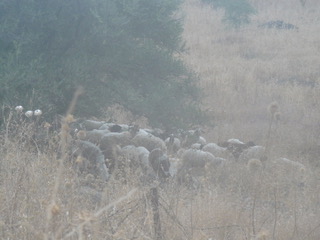
Sheep at dawn, Bethsaida 2015.
Dry, harsh, landscape, small flock, nomadic shepherd (not in shot)
Easter 4 – 2026
Good Shepherd Sunday John 10:1-10
Marian Free
In the name of God, Source of all being, Eternal Word and Holy Spirit. Amen.
It is fascinating how images can take hold of us even when they bear no relationship to reality. For. example, I often ponder about the biblical image of the shepherd which holds a place in our imaginations that seems to have little resemblance to actual shepherding – either here or in the Middle East. I imagine that most of us picture Jesus as shepherd in the way that he is depicted in religious art rather than from our own experience. The Good Shepherd is clean and neat, the grass in the pictures is a beautiful green and the sheep or lambs are white and fluffy – content to be held in Jesus’ arms or to rest motionless across his shoulders. In reality, shepherds in the Middle East, certainly in Jesus’ time, were considered to be thieves and drunkards – not respectable members of society and certainly not selfless leaders. Israel is not covered in lush green pasture and sheep in the Middle East are often more like goats in appearance and are certainly not clean, cuddly, white lambs, willing to be held in one’s arms.
All this aside, images of leaders as a shepherds and of the people as sheep have ancient roots stemming from a pastoral, nomadic culture in which the wealth of anyone individual was dependent on their flock. Protecting one’s flock when always on the move required constant attention and finding adequate pasture was a priority for the health of the sheep. In the Near East in ancient times, a shepherd’s rod and staff were used as symbols of royal authority – a reminder of a leader’s responsibility to protect and to build up their people.
It is not surprising then that this imagery is found throughout the Old Testament. In Numbers 27:16f Moses addresses God saying: “Let the LORD, the God of the spirits of all flesh, appoint someone over the congregation who shall go out before them and come in before them, who shall lead them out and bring them in, so that the congregation of the LORD may not be like sheep without a shepherd.” Isaiah 40:11 imagines and intimate relationship with God as shepherd: “He will feed his flock like a shepherd; he will gather the lambs in his arms, and carry them in his bosom, and gently lead the mother sheep.” And of course there is the familiar imagery of Psalm 23.
The longest reference to shepherds occurs in Ezekiel 34 in which, through the prophet, God assures Israel:” I myself will search for my sheep, and will seek them out. As shepherds seek out their flocks when they are among their scattered sheep, so I will seek out my sheep. I will feed them with good pasture, and the mountain heights of Israel shall be their pasture; there they shall lie down in good grazing land, and they shall feed on rich pasture on the mountains of Israel. I myself will be the shepherd of my sheep.
The leaders of Israel at this time are not good leaders. “Thus says the Lord GOD: Ah, you shepherds of Israel who have been feeding yourselves! Should not shepherds feed the sheep? You eat the fat, you clothe yourselves with the wool, you slaughter the fatlings; but you do not feed the sheep. You have not strengthened the weak, you have not healed the sick, you have not bound up the injured, you have not brought back the strayed, you have not sought the lost, but with force and harshness you have ruled them”.
Ezekiel’s image of the “good shepherd” and his tirade against the “shepherds” of Israel is not too dissimilar to the imagery of John 10.
John 10, like all biblical texts has to be read in its literary context – Jesus’ giving sight to the man born blind. In typical Johannine fashion Jesus’ action is followed by a lengthy discourse or explanation.
In today’s gospel, Jesus doesn’t directly name the Pharisees as the thieves and bandits who have come before him, but it is clear from the context that he has them in mind as those who do not hear his voice. After all, they do not believe that Jesus gave the man his sight. In fact, they have disparaged the once-blind man and driven him out of the Temple. They refuse to hear the voice of Jesus or see what he is doing.
As with much of John’s gospel, the imagery of chapter 10 is layered and complex, which means we will not find exact parallels with chapter nine. One this is clear – Jesus’ discourse on shepherding is a critique of the Pharisees leadership, their failure to hear his voice, and their assumed role as gatekeepers.
As shepherds or gatekeepers of the sheep, the Pharisees have made it their business to determine how the people observe law and what they believe and to decide who does and does not belong. Such is their power and influence that even the parents of the man born blind do not have the courage to say that Jesus gave their son his sight for fear that they would be cast out. The Pharisees, believing they know what is best, and resisting any hint of change have taken away the freedom of the people to think for themselves, to act as they think best and their ability to grow and flourish.
In describing himself as both the gate and the shepherd, Jesus highlights the difference between himself and the Pharisees. While the Pharisees want the people to live within strict boundaries determined by themselves, Jesus wants the sheep to be able to roam freely and to follow him of their own accord. He does not want limit and constrain his followers. His stated goal is for all “to have life and to have it abundantly”.
Throughout the history of the Christian faith (and the world in general) leaders have emerged who believe that they have all the answers – the leaders of the Inquisition, cult leaders and others – who believe that they have the right to impose their will and their way of seeing the world and faith on others. Jesus opens the gate wide, confident that those who have come to know and believe him may come and go but will always make their way home without coercion.
We know that we are following the Good Shepherd because we have been set free to live life to the full.
Tags: authority, Freedom, gatekeeping, gates, imagery, life in abundance, shepherding, shepherds
 Swallowsrest