Archive for the ‘John’s Gospel’ Category

Loving and letting go – Mary Magdalene

July 24, 2021

Mary Magdalene – 2021
John 20:1-18
Marian Free

In the name of God who frees us from the grief and pain of the past and who sends us to proclaim hope to the world. Amen.

I was so lucky! Imagine being able to spend seven weeks overseas with not a care in the world. You will remember that in 2018 I was fortunate enough to spend seven weeks in Europe for my long service leave. As part of that holiday, I had two weeks in Florence. Before travelling I met with David Henderson who has lived in Italy. He told me what would be his top five places to go, things to do. I was so grateful, it meant that instead of trying to fit everything in, I could focus on just a few special experiences and do the remainder if I had time. One of his suggestions was that if I did nothing else that I should see Donatello’s Mary Magdalene in the Museo dell’Opera del Duomo.

I am so grateful. The Penitent Mary Magdalene has a room to herself and is so extraordinary and so moving, that, had there been a chair, I could have spent half a day contemplating the figure. As it was I was so moved that finally I had to tear myself away. I have included a photograph in the Pew Sheet, but it is hard to do her justice. Donatello has carved a figure that is utterly bereft, completely desolate. His image is of a woman who is so stricken with grief, that she has lost all sense of pride. She looks haggard, her hair has grown to her ankles, teeth are missing, and she looks as though she has been wandering around the countryside, living in the open .

The idea of a penitent Mary stems from end of the 6th century when Pope Gregory 1 made the association between Magdalene and the sinful woman from the street who anointed Jesus’ feet (in Luke 8). There are many reasons why these cannot be the same woman. It is true that we are told that Mary Magdalene was the one from whom 7 demons were cast out but that suggests that she was suffering from a physical ailment or a mental illness, not that she was making her living from prostitution. Mary was among the women who supported Jesus from their own incomes, she was at the foot of the cross when all the disciples had fled and, as every gospel records, she was at the tomb early in the morning of the third day. That Mary’s role in the ministry of Jesus was remembered (at a time when women were being written out of the story) is indicative of the role that Mary went on to play in the early church. This is further supported by the fact that Mary is mentioned in the Gospel of Philip in which Jesus is said to have shared secrets with her and to have kissed her on the lips.

The Biblical Mary is someone who has been empowered by Jesus, not someone who was overwhelmed by guilt. Indeed, Mary is often called the “apostle among apostles” as it was Magdalene who was commissioned by Jesus to tell the disciples that he had risen from the dead . For this reason, it is impossible for me to marry the Mary that I know, with the Penitent Mary popular with artists in the 15th and 16th centuries.

When I saw Donatello’s sculpture, I knew only that it was his Mary Magdalene, and it is only in preparing for today that I discovered the ascription “Penitent” given to the sculpture by the artist . It was because I knew the Mary of the New Testament that Donatello’s Mary spoke to me of grief and not of penitence, of despair and not of guilt. In fact, for me Donatello’s Mary comes straight from this morning’s gospel. Mary has come to the tomb alone. Having discovered that Jesus was not there she has run and told Peter and the disciple whom Jesus loved. They ran to see for themselves and, having seen, returned to their homes.

Mary stayed, weeping – utterly alone, utterly disconsolate. It is this desperate grief that I see in Donatellos’ sculpture – a woman who has lost, apparently forever – someone who had loved her and affirmed her and whom she had loved in return. This Mary knew that nothing would ever fill the void that filled her heart at that moment. Her life, which for a time had had meaning and purpose at this moment stretched out, empty, before her. Now, even his body had gone. Now there was no grave, no place where she could go to mourn him.

Lost in her thoughts and overwhelmed by sorrow, Mary could not recognise the risen Jesus until he called her name. Then, apparently fearing that she would lose him for a second time, Mary – physically or metaphorically – clung to him. But the future that she imagined cannot be. Jesus tells her to let go. He must leave and she, Mary must take on a new role – that of apostle, one sent by Jesus to spread the gospel.

Our story is very different from that of Mary, but over the last twenty months we have said good-bye to many of our hopes and dreams, we have endured separations from those whom we loved, some of us have experienced financial hardships and all of us find ourselves facing a future that is very different from that which we had expected. Our lives will never be the same but, like Mary, we cannot cling to the past, we cannot put our lives on hold, hoping that they will return to what they were. We must move forward, impelled by our faith and confident that Jesus, our risen Saviour goes before us, having faced his own demons, experienced the worst that life can throw at him and come out triumphant on the other side.

Grief is a natural response to loss, but we cannot allow it to hold us forever in its grip for none of us know what the future may hold.
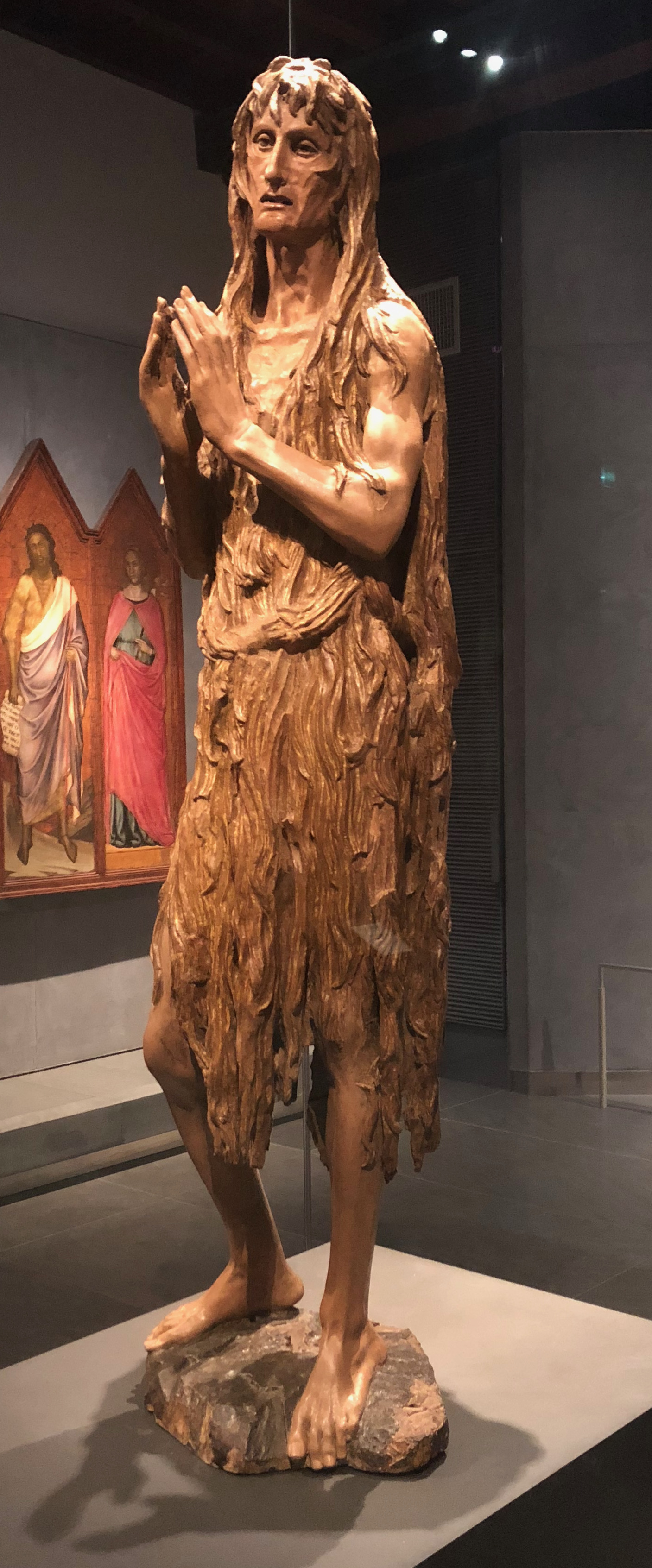
Penitent Mary Magdalene, Donatello, Museo dell’Opera del Duomo

Scripture should never imprison, love should never hurt.

May 15, 2021

Easter 7 – 2021

John 17:6-19

Marian Free

In the name of God who calls us to love selflessly and unconditionally. Amen.

In the past two years, we have been rightly shocked and appalled by the horrific deaths of Hannah Clark and her children and more recently that of Kelly Wilkinson. Both women died at the hands of the men who had promised to “love and protect them”, both had endured years of abuse prior to making the decision that enough was enough and both were failed by a system that was unable to keep them safe. In recent times, a crisis that used to be hidden (or ignored) because it occurred behind closed doors has become front and centre. The very public acts of violence like the murders of Luke Batty and of Hannah Clark and her children have exposed the extent of the problem and the weakness of the response. 

In Australia one woman every week is murdered by an intimate partner. Many more are locked in abusive or coercive relationships that they find impossible to escape. It is estimated that one in 6 Australian women and 1 in 16 men have been subjected, since the age of 15, to physical and/or sexual violence by a current or previous cohabiting partner (ABS 2017b). Despite the statistics, despite public awareness and despite the attempts to strengthen the law and to police it, we seem unable to keep vulnerable women safe and unable to change the behaviour of men who abuse them. 

Historically, and to our shame, the church has often been complicit in the situation. A misunderstanding of the nature of forgiveness, a misinterpretation of scripture and a misplaced conviction regarding the sanctity of marriage has meant that the church has often turned a blind eye to domestic violence and worse, sent women back to their violent partners rather than confronting the partner’s abusive behaviour.

As we have seen with the issue of child sex abuse, too often a church that has focussed on outward appearance has fostered a culture of silence. Our embarrassment and confusion regarding the misbehaviour of our some of our members and our failure to confront what amounts to a misunderstanding of sacraments and the misuse of scripture has meant that not only have we not adequately addressed the issue of domestic violence, but we have created an environment in which women feel too ashamed to admit what is going on behind closed doors.  

For one reason or another in the past and continuing into the present the Bible has been used to coerce and control others. Individual verses have been used to ensure that women know and keep their place within an intimate relationship and to justify the use of controlling and abusive behaviour by men towards their partners. 

Three passages in particular are used to justify the control of or domination over a woman by a man.

The first of these is the creation story. It has been argued that because Eve was created from Adam, she was somehow inferior, and that it was her role to serve Adam rather than to be his partner. What is more, it was believed that because Eve persuaded Adam to eat the apple, women were by their nature both vulnerable andseductive -(as if that wasn’t a contradiction) – and therefore dangerous and in need of control by the more superior man. 

The other two texts come from Colossians and Ephesians. “Wives, be subject to your husbands, as is fitting in the Lord” (Col 3:18-19) and “Wives, submit to your own husbands, as to the Lord. For the husband is the head of the wife as Christ is the head of the church, his body, and is himself its Saviour” (Eph 5:22-33). Both these texts have been used to coerce a woman into compliance and to take responsibility for the violent behaviour of her partner. (After all, she must have behaved in such a way as to provoke such a response.) These verses are probably the source of the language of Holy Matrimony in the Book of Common Prayer in which the words “obey and serve” are added to the words of consent said by the woman alone.

All these texts are misrepresented by those who use them to justify violence against women. Yet what sort of God would not only condone, but actually incite violence against women I wonder? 

All our scripture readings have to be seen in context including these. For example, the creation of Eve occurs in the second of the two accounts of creation. In the first God creates humankind in God’s image, male andfemale (Gen 1:26-27). There is no hierarchy here. In the second account of creation woman is created to be Adam’s partner and equal because none of the animals could fulfill that role. (We note that Eve may have taken the apple, but as the story goes, Adam was weak enough to eat it. If blame is to be apportioned, both are culpable.)

The verses in Colossians and Ephesians are conveniently taken out of context – both historical and literal. If we were to read on, the next verse in Colossians says: “Husbands, love your wives and never treat them harshly” and Ephesians emphasises mutual subjection: “Be subject to one another out of reverence for Christ.” Misused these minute pieces of scripture have done considerable damage – not only to the lives of those impacted by domestic violence and but also to the gospel itself that has at its heart a message of love, respect and empowerment, regardless of gender, class or race.

As individuals and as church it is incumbent on us to break the code of silence and to free women (and men) to speak of their experiences without shame or fear of judgement. In order to truly show the love of Christ, we must equip ourselves to respond to occurrences of domestic violence, not only by understanding the issues surrounding it, but also by being able to offer alternative interpretations of the biblical texts that have had such a damaging impact on the lives of many.

After all, our scriptures should never imprison and love should never hurt.

Jesus is a vine, not a vineyard

May 1, 2021

Easter 5 – 2021

John 15:1-8

Marian Free

In the name of Jesus our Saviour, source of our life, our nourishment and our well-being. Amen.

I am the fertile soil. I am the warm sun. I am the source of comfort. 

If I, or anyone else were to make such claims you would think that we were mad. Yet Jesus makes several such assertions: “I am the bread of life, I am living water, I am the true vine, I am the good shepherd, I am the light of the world, I am the resurrection and the life, and I am the way the truth and the life”.  At least seven times Jesus claims “I AM”. At face value these statements hold a great deal of meaning. Jesus is telling his disciples that if they place their trust in him he will protect them from harm, he will be their light in the darkest of times, he will be their source of goodness and strength and he will satisfy their deepest needs. 

As you know, the Gospel of John is rich with symbolism, so we should not be surprised that there is much more to this imagery than first meets the eye. In fact there are at least three different usages of the expression, “I AM”. It occurs without a predicate, simply as “I AM”. “Unless you believe that I AM” (7:28). “When it does happen, you will believe that “I AM” (12:19). Occasionally the phrase is used simply in the sense of “I am he”. For instance, when Jesus comes to the disciples across the water he says: “I AM do not be afraid.” Lastly, “I AM” is used with a predicate as in today’s gospel: “I AM the true vine.” 

“I AM” is the language used by God as God’s self-designation. When God appears to Moses in the burning bush and commissions him to bring the Israelites out of Egypt Moses says: “Whom shall I say sent me?” God replies: “Thus you shall say to the Israelites, ‘I AM has sent me to you’” (Ex 3:14). In using this terminology then, Jesus is identifying himself as God.

It appears from the context of the gospel that not only is John making it clear that Jesus and God are one and the same, he is also helping the community for whom he writes find an identity that does not depend on the synagogue or the Temple. A number of references suggest that the gospel was written at a time – after the destruction of the Temple – when Jews who believed in Jesus had been expelled from the synagogue (John 9:22, 12:42, 16:2). One of the goals of this gospel is to answer the question: ‘What does it mean to belong to a community that believes in Jesus and how could the community’s worship be ordered now that they could not attend the synagogue or participate in the Jewish Festivals?’ 

It is impossible to go into detail here, but one of the ways that the author of John addresses the problem is by indicating that a believer’s relationship with Jesus is sufficient because in one way or another Jesus has replaced important Jewish symbols, Festivals, and perhaps even the Temple. For example, when Jesus says: “I AM living water” and “I AM the light of the world”, he is using symbols that relate to the Festival of the Booths during which water is brought into the Temple and huge candles are lit. Several of the images in Jesus’ ‘I AM’ statements – bread, light, water, shepherding and vine – are commonly used in the Old Testament to describe the relationship between God and Israel. Jesus’ adoption of these images for himself, indicates that the relationship between God and Israel has been extended to those who believe in Jesus. The relationship between God and the people of God is no longer dependent on externals but is focussed on the person of Jesus. 

It is important to note here, that God’s relationship is with Israel as a whole and not with individual members of the people of Israel. When we remember this, the imagery takes on a whole new meaning. This is particularly the case with today’s gospel.

Jesus’ claim to be the true vine, is a reminder of our collective nature and it challenges our modern concepts of individuality. If Jesus is the vine and we are part of the vine then, as people of faith, we do not exist as individuals but as a community. One of the reasons for divisions in the church – whether at a Parish level or at international level – is that we don’t fully understand that we do not belong to the vine as individuals, but as a group. It would be a nonsense to suggest that every branch or every twig on a vine somehow existed separately. The life of the vine flows through to the whole plant in equal measure. My life in the vine is not different or separate from your life in the vine. Individual branches do not draw their sustenance from different sources but from one and the same vine. 

Being attached to the vine challenges our individualism in another way. It is only by being connected to the vine that we can bear fruit. Only if we, the branches, are receiving the life-giving sap from the vine are we able to be productive. Or put the other way around, if we bear fruit, if our life and actions show forth the presence of God in the world, it is only because we are integrally connected to each other and to Jesus the true vine who is the source of our life. Just as our life in the vine is one and the same, so it is with the fruit we produce. In this image, fruit does not mean the fruit that you produce or the fruit that I produce, it refers to the fruit that we produce together.

Jesus is the true vine, not the true vineyard. There is one vine, and we are all connected to that one vine. Let us pray that our connection to the true vine will nourish and sustain us, so that through our lives as part of the community of faith we may collectively bear fruit that reflects the source from which it comes. 

How do we see Jesus?

March 20, 2021

Lent 5 – 2021

John 12-20-33 (++)

Marian Free

May I speak in the name of God Earth-Maker, Pain-Bearer, Life-Giver. Amen.

On the night before she was due to be executed, Edith Cavell – a British nurse serving during the first world war – had a visit from a chaplain. After they had spoken for a while, they prayed, and Edith asked that they might sing the hymn “Abide with me”. “Hold thou thy cross before my closing eyes, shine through the gloom and point me to the skies. Heav’ns morning breaks and earth’s vain shadows flee. In life, in death, O Lord, abide with me.” Cavell had it right – at what was her lowest point she looked – not to Jesus’ resurrection – but to the cross – for it was there that the victory had been won.   

Today’s reading from the gospel of John has been ripped from its context and presented as if it could stand on its own. While the metaphor of the seed falling to the ground makes a certain amount of sense, the surrounding text seems unconnected both to the metaphor and to the request of the Greeks. We are left in the dark as to why the Greeks want to see Jesus in the first place and indeed why the Greeks are in Jerusalem at all. Without the wider context, we are left wondering why Jesus appears to have so rudely ignored their request.

If we lived in the first or perhaps even the second century, we might have expected to hear the story as John told it from beginning to end in one sitting. In so doing we would have seen how the different parts of the story connect with and speak to each other. We would have become aware of the way in which the Johannine author winds back around on himself, reiterating and reinforcing some of the key Johannine concepts as he goes. Light and dark, life and death, joy and the relationship between the Father and the Son are all repeated over and over. By the time the reader had reached this point in the story, we would have understood that the phrase “being lifted up” referred to Jesus’ death on the cross. 

The immediate context of today’s gospel is Jesus’ entry into Jerusalem, but in order to truly understand what is happening here and where the story is going, we have to go back a little further – to the raising of Lazarus. Bethany was close to Jerusalem, so it is not surprising that some informants had reported Jesus’ actions to the Pharisees who in turn had called a council with the chief priests to consider what to do about Jesus and the threat that he posed. The raising of Lazarus had greatly increased Jesus’ stature and renown and witnesses to the event could not help but testify to it, which made Jesus even more of an attraction. According to the gospel, people were deserting the Jews and believing in Jesus – which only exacerbated the antagonism of the Pharisees and chief priests. 

It was dangerous for Jesus to come to Jerusalem for the Passover – orders had been given that anyone who knew his whereabouts should inform the chief priests and Pharisees so they could arrest him. Many wondered if Jesus would actually come, but come he did, and when the crowds heard of his arrival, they took branches to greet him, shouting “Hosanna to the King of Israel”.  At this the Pharisees despaired: “You see, you can do nothing. Look, the world has gone after him (12:19).” 

Knowing the context helps us to make better sense of this morning’s gospel. We know that people from every nation, Jew and Greek, flooded to Jerusalem for the Passover. Many of them will have heard of Jesus and will have known that he raised Lazarus from the dead. No doubt they were both amazed and curious – anxious to see the man behind the stories. It may be for this reason that Jesus didn’t respond when he was told that the Greeks wished to see him. He resented being seen as a tourist attraction. He felt that it was important that those who wanted to see him realized that they must learn to see not the miracle worker but the crucified one. In response to the request of the Greeks Jesus reiterated what he had said at the beginning of his ministry (as we heard last week) that the “Son of Man must be lifted up” – on the cross. Those who sought him out must understand that following Jesus had nothing to do with fame and fortune but rather would lead to suffering and to death. They would need to find the courage to lose their lives in order to gain their lives.

Instead of agreeing to see the Greeks, Jesus spoke about the life of discipleship. He reflected on what lay ahead wondered to himself whether he could avoid the pain and agony of the cross. But he knew that it was for the cross that he had come. He understood that it was when he was lifted up, that all who chose to, would be able to see him and would understand that he had sought, not fame and fortune, but to give himself entirely into God’s hands. In this is Jesus’ victory not that he raised someone from the dead but that he faced the worst, confident that God would not abandon him. He submitted his life to God’s will rather than seeking to create a life of his own making. The Greekswould see him but only if they had the courage to see victory in defeat, success in failure, life in death. 

We cannot have the resurrection without the crucifixion. We cannot be truly alive unless we put to death those things that are life-denying. As we draw near to Good Friday we are reminded that we follow a Saviour who was brutally crucified and whose triumph lies not in what he did, but in what he allowed to be done to him. 

Do we have the courage to face the agony and shame of the cross, or do we look past the cross to the victory of Easter Day?

Jesus and snakes

March 13, 2021

Lent 4 – 2021

John 3:14-21

Marian Free

In the name of God who gives us victory over death. Amen.

I am one of those people for whom vaccines of some sort have always been a part of my life. Apparently, I received a polio vaccine before I was six weeks old so that my mother could accompany my father to Nigeria and not face the trip alone with a newborn baby. I can still remember lining up at the City Hall to receive a free jab for something or other and the nurses who came to the school to inoculate us against something else – probably tetanus. In retrospect, my generation had a lot of needles. Still, unlike my children, I was not vaccinated against measles, chicken pox and rubella so I caught the first two though not the third. The parents of my generation had their own system of immunisation. If someone in the neighbourhood had measles, instead of being kept away we were encouraged to visit – the idea being that it was much better have these illnesses when we were young and to develop an immunity to them than to risk having them when we were adults when the disease might make us seriously unwell.

At last, the vaccine for COVID is being rolled out. President Biden has claimed that most Americans will have received their shots by Independence Day. In the UK my friends and family have all had at least one shot and even if the roll out is slower than anticipated, Australians are receiving their first does of the vaccine.

Vaccination is counter intuitive. In order to be protected against disease, we are injected with that very disease. It all began smallpox. Smallpox was incredibly infectious and out of every ten people infected with the disease three people died. Those who survived were often badly scarred. In 1796 Dr Edward Jenner noticed that milkmaids who had had cowpox did not subsequently become ill when exposed to smallpox. He experimented by taking a sample from a cow pox sore and inoculating it into the arm of the son of his gardener – James Phipps. After some time, he exposed James (on several occasions) to the smallpox virus, but James did not get ill with the disease. Dr Jenner’s methods might appal us today and they certainly would not pass the medical ethics test, but his discovery has helped us to almost eradicate polio, smallpox, measles, mumps and chicken pox. Diseases that used to strike fear into the hearts of parents are, so long as we are vigilant, a thing of the past.

We have become much more sophisticated and more ethical than Dr Jenner. When it comes to COVID for example, we are not actually injected with the virus but, as I understand it, we are inoculated with components of the virus which enable our body to recognise it and to fight it[1]. When it comes to fighting disease then, very often like cures like, the virus in effect fights against itself.

Today’s readings are complex, and sadly we don’t have time to explore why God sends snakes, or why, instead of providing the cure, God didn’t simply stop the snakes. Whatever lay behind God’s actions, the idea of the image of a snake being the cure for a snake bite is almost contemporary. It resonates with the modern science of a virus being used to cure a virus. Just as the snakes did not disappear, but that looking at the snake stopped people dying, so, while the virus will not disappear, we, once vaccinated, should not die from it.

So much for the snakes in the desert – but what about Jesus? As part of his discussion with Nicodemus, Jesus compares himself to the bronze serpent lifted up by Moses. “And just as Moses lifted up the serpent in the wilderness, so must the Son of Man be lifted up,” he says. It is a difficult image to grasp. In what way do Jesus’ contemporaries resemble the Israelites in the desert, and how does Jesus’ being lifted up on the cross bear any similarity to a bronze serpent on a pole? Jesus and a serpent have nothing in common.

To understand Jesus’ imagery, we have to first of all understand that according to the author of John’s gospel, it is on the cross that Jesus’ victory over death occurs. The cross is the key to eternal life, to Jesus’ being recognised and to Jesus’ drawing all people to himself. (3:14, 8:28 and 12:32). In the fourth gospel the cross does not represent defeat, but triumph. It is Jesus’ willingness to die that allows him to conquer death. The resurrection is important, but there can be no resurrection, no life after death, unless Jesus dies – really dies. Jesus experiences death in order to overcome death. Jesus’ death is the cure for our death, just as the bronze serpent was the cure for the Israelite’s snake bite. Jesus’ death not only inoculates him against death, but his victory over death inoculates each one of us against eternal death.

Jesus has been lifted up. He was displayed on the cross – so that all could see him and seeing him, believe and believing, have eternal life. Death has not been entirely vanquished, but it no longer has dominion over us, it is no longer something to be feared because we know that death is not the end of the story.

Jesus has been lifted up – just as Moses lifted up the serpent in the wilderness – to show us that death will not have the last word. Jesus has conquered death and so long as we hold his death before us, we can be sure that we will share in his victory over death.


[1] For an explanation go to the Centres for Disease Control and Prevention

https://www.cdc.gov/coronavirus/2019-ncov/vaccines/different-vaccines/how-they-work.html?CDC_AA_refVal=https%3A%2F%2Fwww.cdc.gov%2Fcoronavirus%2F2019-ncov%2Fvaccines%2Fabout-vaccines%2Fhow-they-work.html


Angry enough to do something?

March 6, 2021

Lent 3 – 2021

John 2:13-22

Marian Free

In the name of God who calls us to do justice, love mercy, and to walk humbly with our God. Amen.

On Friday I attended the UN Women’s International Women’s Day lunch. It was an inspiring, if somewhat gruelling experience – especially in the light of recent events. Australian of the Year, Grace Tame was the key speaker. I imagine by now that most of you know at least the outline of her story. Grace is a powerful and direct speaker, and she doesn’t spare her audience the intimate details of her ordeal. Sadly, her story is not unique, but even if you have heard other stories of abuse, you cannot help but be shocked and brought to tears as she recounts the way in which a much older man, a teacher in a position of trust, targeted her at her most vulnerable and manipulated her to the point where she felt utterly unable to refuse his sexual advances. How, in this day and age, could this man’s behaviour – in his office, on school grounds – go unnoticed? Why, in a world sensitised to child sex abuse, did no one notice or think to question what was going on? 

Equally shocking and revelatory was the speech by Dr Kirstin Ferguson who, at the beginning of her presentation provided a dramatic, visual illustration of the prevalence of sexual harassment in the workplace.  Before she began, Dr Ferguson asked those in attendance (men and women) to stand if they had ever experienced sexual harassment at work. At least two thirds of the room rose to their feet – two thirds of a room filled with professional people. Dr Ferguson went on to tell us that 1,600 hundred women a week, experience some sort of sexual harassment at work. 

Listening to the two women was a salutary and sobering experience.

What does it say about our society that a fifteen-year-old girl can be raped every day at school – in the office of a 58-year-old teacher? Who are we that one woman dies every week at the hands of someone who professes to love her? How is it that our aged care system is so broken that vulnerable older people are over-medicated, mistreated and badly fed? Why is that we cannot assume that our workplaces and schools are safe and nurturing environments? Why can’t we keep our children safe from abuse? 

Something at the very heart of human nature is broken. Countless Royal Commissions and changes to legislation have been powerless to bring about the institutional change that is required so that all people can live and work with dignity. More importantly, no amount of legislation has been able to bring about the personal transformation that is required to build a society in which all the vulnerable are protected and nurtured – not abused or exploited.

In today’s gospel Jesus is angry, very angry. He is angry that the Temple (or at least its forecourt) has been turned into a marketplace. He is angry because he can see the way in which Temple practices exploit the poor, take advantage of the vulnerable and exclude those who cannot take part in the Jewish rituals. 

This event is the most explicit description of Jesus’ anger. It is the moment at which all his frustration and rage reaches boiling point – resulting in his fashioning a whip so that he can drive traders and animals from the Temple and overthrowing tables covered with money. It is the most explicit expression of Jesus’ anger, but it is not the only time that he gets angry.

We know that Jesus got angry at the hypocrisy of the Pharisees, at the indifference of the rich towards the poor and at the apathy of the comfortable towards those who were suffering. Jesus got angry when he saw the religious leaders put the law before compassion while congratulating themselves on their own state of righteousness. Jesus got angry at the complacency, self-satisfaction and judgementalism of those who thought themselves better than sinners, prostitutes and tax collectors. Jesus got angry with those who put burdens on the shoulders of others and who created barriers which prevented them from seeing how much God loved them.  Jesus got angry at the failure of the disciples to understand, at their desire for power and at their belief that they should be rewarded for joining his cause. 

Most importantly, Jesus got angry because the religious institution of his day was broken. Despite John’s call to repentance nothing had changed. Jesus’ contemporaries still believed that the outward practices of sacrifice and ritual were sufficient. Jesus could see that what was really needed was a change of heart, repentance and personal transformation – all of which are much more difficult to achieve than simply presenting a semblance of goodness, observing rituals or consoling oneself with the knowledge that at least one is not as bad as the next person.    

Jesus got angry at injustice and suffering, at pretention and arrogance, at self-serving behaviour and at the refusal to take responsibility for one’s behaviour. Jesus got angry at indifference and inaction. 

Jesus saw a broken world. His grief and angry at what he saw spurred him into action. 

We live in a broken and damaged world, but do we get angry? Do we get angry enough about the exploitation of the poor, the disenfranchised or the refugee? Do we voice our anger loudly enough with regard to people trafficking and slavery? Do we speak out loudly enough against violence towards women or the abuse of children? Do we protest strongly enough about the neglect and abuse of the elderly or the destruction of indigenous sacred sites? Do we rage against injustice, corporate greed and the destruction of the planet? Do we rail against indifference and carelessness? Do we care enough to do something about what we see?

Our world is broken and needs from each of us a change of heart. When will we be angry enough to take action? 

.


In the name of God who calls us to do justice, love mercy, and to walk humbly with our God. Amen.

Equally shocking and revelatory was the speech by Dr Kirstin Ferguson who, at the beginning of her presentation provided a dramatic, visual illustration of the prevalence of sexual harassment in the workplace.  Before she began, Dr Ferguson asked those in attendance (men and women) to stand if they had ever experienced sexual harassment at work. At least two thirds of the room rose to their feet – two thirds of a room filled with professionals. Dr Ferguson went on to tell us that 1,600 hundred women a week, experience some sort of sexual harassment at work. 

Listening to the two women was a salutary and sobering experience.

\


Inviting others to meet Jesus

January 16, 2021

Epiphany 2 – 2021

John 1:43-51 (you might like to begin at 35)

Marian Free

In the name of God who calls us to into relationship with God and with each other. Amen.

Those of you who pay attention to detail will have noticed that our Gospel readings this year have changed from Matthew to Mark. According to the lectionary we are now in Year B. Throughout this year we will be reading from Mark’s gospel and hearing this author’s particular slant on Jesus’ life and teaching. Why then, you might ask, does today’s gospel come from the gospel of John? The answer is this. We have a three-year cycle which allows us to give one year each to Matthew, Mark and Luke. Because there is considerable overlap between the three Synoptic gospels, it is possible to manage one gospel a year. The lectionary omits at least some repetitions. For example, in Year A we read Jesus’ parable of the talents as recorded by Matthew but in Year C we do not read Luke’s account of the same parable. 

Mark is the shortest of the three synoptic gospels – 12 chapters shorter than Matthew in fact! This allows room for John’s gospel to be read in Year B – this year. During both Lent, and the season of Easter, we will be reading from the gospel of John. This allows us to cover all four gospels over the three-year period. 

John’s gospel is quite different from the Synoptic gospels as is very evident in today’s reading. I’m sure that if I asked you to tell me about Jesus’ calling of the disciples, you would repeat the story of Jesus’ walking by the lake and calling the fishermen – Peter and Andrew, James and John – from their fishing and you would remember that Jesus said that he would make them “fish for people”. If, however, John’s was the only gospel available to us, we would tell quite a different story. John’s version of events begins not with Jesus, but with John the Baptist Jesus doesn’t call people, they come to him and, having come to believe, bring others to Jesus. It is, as Jerome Neyrey points out, a pattern of evangelisation that is repeated four, if not five times in the gospel.[i]

Neyrey identifies the following pattern:

  • A believer in Jesus evangelizes another person (2) by using a special title of Jesus. (3) The evangelizer leads the convert to Jesus (4) who sees the newcomer and confirms his decision. (5) The conversion is sealed.

I am grateful for the insight, but I would word it differently.  A believer tells another person about Jesus (1) using a title that that person would recognise (2). He or she brings that person to Jesus who (3), in some way engages them (4) in such a way that they too come to believe (5). Whichever way you choose to look at it, John appears to be describing evangelism – bringing people to faith. 

The link to the article from which I have drawn this argument gives a fuller story, but in summary, the four/five examples are as follows.

John the Baptist (1), who has earlier recognised Jesus (Jn 1:34) draws the attention of two of his disciples to the “Lamb of God” (2). The disciples follow Jesus (3) and are convinced that the Baptist is right (4). They then become followers of Jesus (5).  In the second example, one of the original two, Andrew (1) finds his brother and tells him that they have found the “Messiah” (2). He brings Peter to Jesus (3). In this instance, Jesus’ acknowledges Peter and gives him a new name (Cephas) (4) which draws him into Jesus’ band of followers (5). Our third example is abbreviated. We are not told who finds Philip (Andrew or Peter) and Jesus is not given a title, but Philip’s discipleship is confirmed by Jesus – “follow me”.

Finally, at least in terms of those who become numbered among the twelve, is Nathaniel. Again, someone who already believes, in this instance Philip, (1) tells Nathaniel that “we have found the one about whom Moses in the law and also the prophets wrote (2).” Despite Nathanael’s resistance, Philip brings Nathaniel to Jesus (3), Jesus engages Nathaniel in discussion (4) and promises him that he will witness extraordinary things thus affirming him as a member of the twelve (5).  

A further example of one person bringing others to faith is found in the account of the woman at the well who, having met Jesus, tells her community (1) about the “Messiah” (2). The community come to see Jesus for themselves (3), listen to Jesus (4) and come to faith for themselves (5).

John’s account of discipleship provides a model for evangelism or mission in every age – those who know and believe in Jesus, introduce their families, friends and communities to Jesus, using expressions that would lead them to understand who Jesus is. In turn, those who are introduced to Jesus come to faith themselves. 

If the church of the 21st century is shrinking rather than growing, perhaps it is because we have not learnt from John that we bring others to faith simply by bringing them to Jesus and letting him do the rest.


[i] John J. Pitch https://liturgy.slu.edu/2OrdB011721/theword_cultural.html

God’s prayer for us

May 23, 2020

Easter 7 – 2020

John 17:1-11

Marian Free

In the name of God who holds us in prayer. Amen.

In life, and particularly in ministry, we have the privilege to meet some amazing people – people who challenge, confront and support us in our faith journey. Such encounters are very often humbling especially if we take the opportunity to be open to the lessons provided or to the care that is expressed in such meetings. The examples are myriad, but today I would like to share a couple that pick up the theme of today’s gospel – prayer. 

Many years ago, before I was ordained, I attended Parish planning days. On these occasions we were often divided into small groups to consider, among other things, the ways in which we practiced our faith. Anglicans are not very good at sharing such things, so it was extraordinary to be in a situation in which congregation members were willing to confide in each other. On not one, but two separate occasions, in two different parishes, I found myself in groups with women who were in their seventies or eighties (in other words with women whom I only knew as the elderly members of the congregation). I was deeply moved (and chastened) to hear that they rose at 4:00am in the morning so that they could pray without interruption. I was, and still am, struck by their discipline and by the importance that they placed on their faith and their prayer life.  (And on mornings such as this when it is only 12 degrees at 8:00am I am overawed by their resilience!)

I confess that I have not adopted their practice, but all these years later their rigor and discipline continue to call me to account. From time to time I find myself comparing my prayer life to theirs and being challenged to pray more and to pray more regularly.

A quite different, but equally humbling story relates to my first incumbency. During that time, I had the joy of meeting Ruby. Ruby was beautiful and wise and was only eight years old. She was the granddaughter of a parishioner. Her mother was an addict and her grandmother had to maintain a fine (non-judgmental) line in order to retain her contact with her granddaughter. I was fond of Ruby and concerned for her and her situation. So it was that I was completely blown away when her grandmother informed me that Ruby had set up a little altar in her bedroom and even more astounded to learn that, among other things, Ruby said a prayer for me every day!  It is impossible to tell you how moved I was by that knowledge. Knowing that Ruby was praying for me filled me with an overwhelming sense of being loved and held and supported. Whenever I felt underappreciated or overworked, I remembered Ruby’s prayers and regained my sense of perspective. 

John chapter 17 concludes Jesus’ farewell speech. In this section he moves from instruction and encouragement to prayer – not for himself, but for those who are close to him and by extension for those who will come to faith through them. In the face of his impending death Jesus expresses a sense of completion. Despite what lies ahead, Jesus is not anxious for himself. He knows that his relationship with God is clear and is assured. He sees his death as his glorification (or perhaps a confirmation of the glory that was his from the beginning). Jesus’ death might mark the end of his earthly ministry, but Jesus knows that that in itself was only a brief interruption to the existence that he has shared from the beginning with God and to which death will restore him.  

Jesus’ anxiety is not for himself or for his future, but for his disciples – those who have come to faith in him (and therefore to faith in God). Their earthly lives, which have been dramatically changed by their relationship with Jesus, will have to continue in the world without his physical presence to protect and defend them. Knowing that their faith in him has placed them in danger, Jesus prays for them, committing them to God’s care and protection. 

Interestingly, Jesus does not break off his conversation with the disciples in order to pray. He does not separate himself from them or adopt a pious stance (head bowed; hands clasped). He does not feel the need to go to the Temple to pray.  Instead he remains where he is, at the dinner table, surrounded – we must assume – by the empty plates, the cups and the leftovers. Jesus’ prayer – the only prayer recorded in John’s gospel takes place in the presence of his disciples who must surely notice that he is no longer addressing them, but God. This means that they can hear everything he says and the tone in which he says it. 

Because Jesus prays in their presence, the disciples are first-hand witnesses of Jesus’ love for them, his confidence in them, his desire that God should protect them from  harm and his firm belief that because they know him, they know God and that such knowledge is the key to eternal life. Jesus’ prayer assures the disciples that they already belong to God and that they share with Jesus his unity with God. I wonder how the disciples felt – not only to know that Jesus was praying for them, but to overhear the words of that prayer – to know that through Jesus’ prayer they were held and loved and supported – no matter what that future might hold.

Verse 20 tells us that Jesus’ prayer encompasses those who believe in him through the words of the disciples. Twenty centuries later, through the gospel we can eavesdrop on Jesus praying for us – not in private but for all the world to hear. We are so used to hoping that God will hear our prayer that perhaps we do not pay enough attention to God’s prayer for us.

Jesus is always overturning the tables, forcing us to rethink our ways of seeing the world, opening our hearts and minds to new possibilities. What does it mean that God is praying for us, for you?

How does it change your relationship to prayer, to God? 

Life not death

May 9, 2020

Easter 5 – 2020
John 14:1-14
Marian Free

In the name of God who empowers and directs our lives. Amen.

As is the case with much of John’s gospel, today’s passage is complex and is filled with a number of different ideas that cannot be adequately dealt with in one sermon. The passage is the beginning of Jesus’ farewell speech, spoken after Jesus had washed the feet of the disciples and after Judas had been exposed as the one who would hand Jesus over to the authorities and who had gone off into the night. In the previous verses Jesus had announced that he would be with the disciples only a little longer and he had told them that they would not be able to follow him. In response, Peter had brashly said that he would follow Jesus even if it meant laying down his life for him. In reply Jesus had said that not only was Peter’s an empty promise, but that before daybreak, he would deny Jesus three times.

In our passage then, Jesus was addressing disciples who were confused, anxious and perhaps even frightened. Nothing made sense to them. Jesus appeared to be speaking in riddles. He had said that they could not follow him, but now he was saying: “You know the way”. Jesus has not given them a road map but has suggested that their relationship with him was all the direction that they needed. In essence, Jesus was saying, that if the disciples had found him, then they had already found the Father, that is they had already reached their destination. This relationship – with Jesus and therefore with the Father – Jesus had gone on to explain, was not passive but active. If the disciples had grasped the unity of Jesus and the Father, not only would they know the way, but they would enter into that relationship. In turn, their relationship with the Father through the Son, would empower them not only to do the works that Jesus had done, but even greater works! It was no wonder that the disciples were overwhelmed.

The first 6 verses of this chapter are regularly chosen as the reading for a funeral. Those who are grieving find comfort and reassurance in the knowledge that Jesus has gone ahead to prepare a place for us. However, if we leave it there and don’t explore the wider context, we miss the point of this and the subsequent passages. That is to say Jesus might have announced his departure and reassured the disciples of his return, but he is not preparing his disciples for death. He is equipping them for life. Jesus’ death will not be the end of the disciples’ life together, it will herald a new chapter in the life of the community, a life, we will discover that is enlivened and empowered by the Holy Spirit.
Chapter 14 begins what is known as Jesus’ ‘farewell speech’. A farewell speech was a well-known literary genre in the Old Testament and in the Graeco-Roman world. It “highlighted the speaker’s impending death, care of those remaining, the regulation of discipleship, thanks to the gods, an accounting for his life, consolation to an inner-circles of followers, didactic speeches and political and philosophical testaments” . There was a great deal of variation in content and expression. For example, Deuteronomy in its entirety is Moses’ farewell speech. He recounts the escape from Egypt; reminds the Israelites of their covenant relationship with Yahweh, the responsibilities that that entails and the consequences of failing to live up to Yahweh’s expectations. In Genesis the final chapters record Jacob’s farewell speech to his sons which takes the form of a blessing for each one of them.

In John’s gospel Jesus’ farewell speech prepares his disciples for the future. He tells them that he is going away, promises that he will send the Holy Spirit, encourages them to love one another (to the point of death) and to be strong in the face of opposition. Jesus’ words were not intended to provide comfort for the dying or the grieving but instruction for the living. It is Jesus who is dying, not those to whom he is speaking. He does not want the disciples to put their lives on hold waiting for his return or for their own deaths. Rather his expectation is that their relationship with him – and by extension with the Father – will ensure that even in his absence they will continue to do what he has done and to do much more besides.

Jesus begins his speech with the words: “Do not let your hearts be troubled”, words that he repeats towards the end of the chapter. “Do not let your hearts be troubled.” Jesus’ words could not be any more pertinent in today’s climate. In recent weeks we, and the community around us have lived with uncertainty, anxiety and perhaps even with fear of death or the loss of a loved. Even now, as the restrictions are being lifted, we do not have a clear road map of the way ahead or of what the world will look like. Some things will never be the same and we will not know the true cost to the community for some years.

“Do not let your hearts be troubled.” Faith in Jesus enables us to face the present with resilience, confidence and even, dare I say, a sense of wonder as to what this time of seclusion might have had to teach us and the church of which we are a part. As we begin to come out of isolation to a future that is as yet unknown, we do well to remember that Jesus is “the way, the truth and the life” and that in fellowship with him we can and will face whatever it is that life has to throw at us.

Putting meaning into the abyss

May 2, 2020

Easter 4 – 2020

Good Shepherd Sunday John 10:1-10

Marian Free


In the name of God who gave us life and encourages to live it abundantly. Amen.

In 2001, Richard Holloway (the former Primate of the church of Scotland) spoke at the Grafton Festival of Philosophy, Science and Theology. At that point he had retired and was not attending church. He had become disillusioned with the Anglican church and disturbed by its certainties and its steadfast refusal to include gay and lesbian Christians. His lecture took the form of a series of reflections on life, death and faith. Towards the end he said: “Faith for me is now romantic defiance against meaninglessness. Even if it doesn’t mean anything, I choose to live as though it did. And the philosopher of this faith as romantic defiance is the great passionate Castilian Miguel de Unamuno, in the tragic sense of life a magnificent romantic quixotic book, and something that Unamuno wrote and I’d love stencilled on my tombstone: ‘Man is perishing that may be, but if it is nothingness that awaits us, then let us so live that it will be an unjust fate.’ If it is abyss, if we come from the abyss, if we go to the abyss, if the abyss is what it means, then let us so live that we will put meaning into that abyss. That’s to live by faith.

How then are we to live? What is the end of it? I think we’re to live in a state of permanent, expectant uncertainty, and we’re to celebrate it. Even if faith doesn’t mean anything, I choose to live as though it did. If it is abyss, let us so live that we will put meaning into that abyss – to live by faith.”[1]

Even if faith doesn’t mean anything, let us so live that we will put meaning into that abyss. What a confronting and astounding statement. So many people believe that the purpose of faith is to attain entry into heaven that it would be difficult for them to comprehend living a life of faith that did not have eternal life as its end goal. Yet Holloway suggests that even without that hope, even if there is nothing at the end of life but an empty abyss, we should still live by faith. Whatever he believes, he is convinced that there is something about faith (in our case, and his, the Christian faith) that makes sense of life in the present and makes life worth living. He is confident that the practice of faith makes a difference to life in the here and now whether or not there is a life to be lived in the future.

Even though in 2001 Holloway had an uneasy relationship with the church and with the faith that it represented, he was still able to say that given a choice he would not live his life in any other way. Unfortunately Holloway doesn’t not expand on this idea, but I would suggest that the gifts that faith has to offer of strength in the face of difficulty, of hope in the face of despair, peace in the face of tumult, joy in the midst of sorrow, and steadiness in the midst of uncertainty are gifts that few would willingly give up (whether they believed or not). I would claim that the practices of faith – forgiveness, humility and generosity – are not to be discarded lightly because they enrich and ennoble our lives in the present regardless of their impact on our future.

It is even possible to argue the reverse – that faith lived only with an eye on the future can be stultifying and unfulfilling. If we believe and live faithful lives only because we are afraid of the consequences of not doing so we will fail to reap the benefits of grasping the life faith offers in the present.

Jesus’ promise of life is both for the present and for the future. Images of resurrection are applicable to the surmounting of difficulties and setbacks in the present as much as they apply to the rewards of eternal life.

In today’s gospel Jesus says: “I have come that you may have life and have it in abundance.” It is not just that faith in Jesus is life-giving, it is abundantly life giving. Jesus’ gifts are not half-hearted but generous and overflowing (water to wine, bread to feed 5,000, death so that we might live). More than that, in John’s gospel Jesus claims to be water, bread, light and life – all of which are necessities for life in the present (in the future there will be no need for water, bread, light or even life as we know it).

This suggests that people of faith are not to live timidly and cautiously, but boldly and confidently, they are not to avoid danger and hurt but to grasp every opportunity to live a life that is rich and full and they should not to live in fear of disapproval, but in expectation of the abundance of God’s provisions.

Holloway’s doubt may not sit comfortably with me, but questions about the existence of God or the possibility of heaven do not throw me into a spin because for me a life of faith is so rich and meaningful that as Holloway says: “If it is abyss, let us so live that we will put meaning into that abyss – to live by faith.”

Our faith holds out a future hope, but it is a hope that should fill our present with confidence, joy and courage and enable us to live in “a state of permanent, expectant uncertainty.” In today’s world could we ask for better advice or, as those who believe, set a better example?


[1] ABC Encounter Programme, Sunday 23 December 2001 7:10AM