Archive for the ‘Luke’s gospel’ Category

Christmas – Shepherds for a change

December 24, 2025

Christmas Eve – 2025

Luke 2:1-14

Marian Free

In the name of God who reveals Godself to the most unlikely, the most uneducated and most despised and who entrusts them with the message of salvation. Amen.

There are so many sub-plots to the Christmas narrative that it is impossible to do justice to all the different elements. 

So where does one start to explore the Christmas narrative –the announcement of Jesus’ birth to Mary or to Joseph, the journey to Bethlehem, the inn keeper who found room, the shepherds, the angels, the magi, the star? We could as some do, let our imaginations go wild and wonder about the reactions of the donkey who carried Mary or animals in the barn where he was born, or we could invent characters like the little drummer boy (What makes anyone think that a sleep deprived mother would be grateful when a young, uninvited guest strikes up a drumbeat in her crowded accommodation?)

This year, I found myself thinking about the shepherds, their place in the story and what they have to tell us.

It is easy to be sentimental about the shepherds, who in our nativity scenes are respectable, if poor men out in the fields protecting their sheep when suddenly they are surprised by not one but a whole host of angels; shepherds who leave everything to race to Bethlehem with white fluffy lambs in the crook of their arms and whose role is to bear witness to Jesus’ birth.

But when we ignore the picture-perfect Christmas cards and pay close attention, we discover that there is much more to the story of the shepherds. The shepherds, whom we are led to believe are and humble, decent men were, in reality, among the most despised people in Jesus’ day. In the ancient Middle East shepherds were usually itinerant workers, moving from place to place in search of work, and taking whatever work they could find. 

Shepherding was not a job of choice. A shepherd was always on the move looking for pasture and a shepherd had to be on guard day and night to protect the sheep from bears, lions, foxes and other threats which might just as well kill a shepherd as a sheep. Shepherds were living and sleeping in the outdoors without proper protection from the elements and were reputed to be thieves, suspected of stealing the sheep they were supposed to protect.  A few, if not all, would take comfort in the bottle to keep them warm at night. 

In short, if you were to draw up a list of people who were worthy to be the first to receive notice of Jesus’ birth, the shepherds would not even make the long list. And yet here they are so they must have something to teach us. When we look at the story with the shepherds in mind we notice a number of things.

First of all, after they overcome their terror, the shepherds believe and respond immediately. There is no hint that they think the angel’s story is too ridiculous to be true. The angel has said that the Saviour, the Christ has been born and so it must be. And, even though the only clue to the baby’s whereabouts is that, like every other baby in Bethlehem, the child will be wrapped in swaddling cloths in a manger, the shepherds leave everything, including their sheep and hurry to Bethlehem to see the child for themselves.

Second, even though the shepherds were usually shunned and ignored, they could not stop themselves from sharing the good news with everyone. This means that, the shepherds, the marginalised and despised, become the first evangelists – the first to share the good news.

Third, the shepherds were so overwhelmed with what they heard and saw that they couldn’t stop praising and glorifying God.

Fourth, the shepherds did not give a moment’s thought as to what might happen to the sheep when they abandoned them to go to Bethlehem – that is they did not look behind them but trusted the sheep to God.

Last, and this is probably Luke’s point, by sending angels to the shepherds, we are shown that God often chooses the least respected, the least equipped, and the least expected to be the first to hear the good news, and that God’s faith in the shepherds was proved right when the excitement and passion of the shepherds gave them credibility which ensured that their message was heard.

It is always tempting for us to believe that the task of evangelism belongs to those who are more articulate, more authoritative, and more attractive than we are. But if God can choose and use those disreputable scoundrels – the shepherds – God can and will choose and use us. And when God does reveal godself to us, the response of the shepherds can be a model for our own reaction. 

Luke tells us that the shepherds are open and receptive to the unexpected presence of the angels, they are not suspicious, butt respond immediately to the angel’s news with joy and enthusiasm, they trust God that what they leave behind will come to no harm, they find the experience of coming face-to-face with God’s messengers so overwhelming that they simply cannot keep the news to themselves and they respond to all that has happened by praising God. 

For us tonight, the story of Christ’s birth lacks the novelty of that first Christmas, but that does not mean that we should not be open and receptive to the possibility of God’s revealing godself to us. When that happens and however that happens, will we be sufficiently open to the possibility that God that we will take heed and respond immediately? Is the good news that brings us here tonight so extraordinary that we. cannot keep it to ourselves? Can we trust God enough to leave the past behind and step into an uncertain future? Do we really believe that God can and will use us to share the story of God’s presence in the world – shepherds and kings, poor and rich, homeless and housed, ignorant and educated?

If we do surely that is certainly cause for praising and glorifying God.
Christ the King?

November 22, 2025

The Reign of Christ -2025

Luke 21:33-43

Marian Free


In the name of God, Earth-maker, Pain-bearer, Life-giver. Amen.

I have to admit that I approach the Feast of Christ the King with mixed feelings. In fact, you will notice the contradiction between this sermon and my choice of hymns! I am not immune to the sense of jubilation, of victory even, as we celebrate Christ’s exaltation in glory to the right hand of God. The Feast of Christ the King is a fitting end to the Church year, the culmination of the Jesus’ story, a reminder of Christ’s triumph over the forces of evil and a recognition of his power and authority as king and judge.

 It was in part to reassert the authority of Jesus (in contrast to that of worldly powers) that Pope Leo XI introduced this Feast Day in 1925 – the last of the Feast Days to be added to the church calendar.  The then Pope was concerned about the increased secularism and nationalism that followed the First World War. His solution was to remind Catholic Christians of Jesus’ authority over all creation. He also wanted to drive home the point that while earthly governments come and go, Christ the King rules forever – one power to rule all powers.

 My ambivalence concerning this feast is the danger of it being taken to represent triumphalism and authoritarianism both of which are hinted at in another name for today’s Feast – The Solemnity of our Lord Jesus Christ, King of the Universe. Indeed, the encyclical which announced the Feast states that: One person of the Trinity unites himself to human nature and reigns over all creation as the Incarnate Son of God. “From this it follows not only that Christ is to be adored by angels and men, but that to him as man angels and men are subject, and must recognise his empire; by reason of the hypostatic union Christ has power over all creatures” (Quas primas, 13).

Such language causes me considerable disquiet. Empire, rule, and subjection are the language of colonialism, not of the kingdom of God that was revealed in the gospels. In fact, the language of the gospels (and the Pauline correspondence) subverts rather than adopts the language of Empire.

 As I came to today’s sermon I realised that the idea of Jesus’ kingship barely rates a mention in the gospels. There are only two occasions on which Jesus is named as King by his own people (or by the gospel writers).  The first occurs in Matthew’s account of the visit of the magi and in Luke’s gospel, Jesus is greeted as King when he enters Jerusalem. Otherwise, the question of whether or not Jesus is king occurs only in the Passion narrative in which Pilate asks Jesus if he is “the King of the Jews” and when he writes “King of the Jews” on the inscription above Jesus’ cross. Many other titles are used for Jesus, but I won’t go into them here except to mention that God addresses Jesus as “beloved Son” and Jesus most commonly refers to himself as the Son of Man.  So, the idea of Jesus as king or as a ruler of nations (let alone a ruler of his followers) does not come from the gospels except indirectly.

 The kingdom of God or heaven is a more common theme in the gospels and could imply kingship, but even this expression is fraught with difficulty and scholars cannot say exactly what it means. It seems to refer to an ideal situation in which God reigns over all, but whether it refers to a future or present kingdom, an earthly or a heavenly kingdom is unclear. A number of other terms seem to refer to what is essentially the same thing: Paradise and kingdom are used interchangeably in today’s gospel, God is in heaven and it is possible that resurrection and eternal life refer to a place where God is. In any case the meaning of all these terms seem to be fluid and inconsistent and some could refer to an earth which looks like heaven and some seem to refer specifically to heaven.

 So I ask, as did Pilate: Is Jesus the king of the Jews? His contemporaries did not treat Jesus like a king, and Jesus certainly did not behave like a king, nor did he expect to be treated in the way in which a king might expect to be treated. If fact, as I thought about today’s feast, I became unsure as to whether I thought of the earthly or even the heavenly Jesus as king.

 In Jesus’ life and teaching there is no evidence of triumphalism or of authority, no assertion of power or domination, and no attempt to draw attention to himself. In many ways Jesus seems determined to go under the radar – exercising his ministry among those least likely to elevate him, among those least able to give him a sense of power, and among those who are in no position to confer status on him. Jesus did not impose himself on anyone, he made very few demands, refused to enforce laws and, rather than lord it over others, chose to be their servant.

 Jesus’ style of leadership is the antithesis of everything that we associate with kingship.  It is a leadership based on service, self-negation and the encouragement of and the building up of others. It is never about claiming power, but always about empowering others.

 As we celebrate today, let us not lose sight of the tension that is at the heart of the gospel and of the Reign of Christ – that God, creator and ruler of the universe chose to abandon heaven for the humiliation and vulnerability of human existence – not as an all-powerful King, but as an infant, not as the leader of an army, but as a nurturer of the outsider, not as a High Priest but as someone who lived an ordinary life in submission to God. Jesus proclaimed an upside down kingdom, one governed by love not force, one which valued those who had little or nothing to offer and one in which there are no distinctions, no hierarchies and in which those who serve are greater than those who lead. 

 May we like Christ build a kingdom in which all are welcomed, all are valued and in which no one lords it over another.

God is in the here and now

November 15, 2025

Pentecost 22 – 2025

Luke 21:5-19

Marian Free

In the name of God in whose hands are all things. Amen.

We live in particularly unsettled times. It is impossible to be unaware of the fragility of social structures, of national borders and of infrastructure. In some places democracy appears to be under threat; wars in the Ukraine, the Sudan and elsewhere threaten to change the shape of the world and typhoons, hurricanes and earthquakes reveal the vulnerability of our built structures.

For those of us who have lived through at time of relative of security, peace and prosperity  the current state of the world can feel destabilizing and disturbing. We just don’t know how to plan ahead.

Jesus’ disciples knew what it was to live in uncertain times. Most of them lived a hand to mouth existence. Except for a brief period under the Maccabees their country had been under foreign domination for centuries. At this point in the first century Galilee was ruled by a cruel and capricious Herod and the marginally more benign Pilate ruled in Judah. Everything that could be taxed was taxed and punishment for unrest was swift and violent. Their ability to make plans for the future was severely limited.

One point of stability and confidence was the Temple. The Temple, built as it was on the Temple Mount was a magnificent and imposing building. Constructed in 516 BCE to replace the original that had been destroyed by the Babylonians, the Temple had been significantly enhanced by Herod the Great (the father of the current Herod) and was known as Herod’s Temple. For Herod it was a symbol of power and might and control and for the Jews it was a symbol of God’s presence in their midst, a holy place in which the ancient rituals of sacrifice and atonement could be carried out, a place of prayer, a meeting place and a place in which even the Gentiles could worship the God of the Jews. Above all, it was a reminder of the universal nature of God, a sign of solidity, strength and endurance.

The Temple dominated the city of Jerusalem, it would have been almost impossible to imagine that it could be razed to the ground.  

Yet, on overhearing people marvel at the Temple Jesus warns that: “the days will come when not one stone will be left upon another; all will be thrown down.” And in response to the disciples’ question: “When will this be?” Jesus doesn’t answer their questions but continues with a number of seemingly unrelated warnings – about false teachers, wars, insurrections, earthquakes, famines and plagues,  betrayals and persecution.

This section of the gospel is usually referred to as the “little apocalypse”, a litany of what might be expected at the end of time. It is possible that is reflecting  a commonly held view that things are so bad that God will surely intervene and bring the world as it is to an end. If so, he is helping his disciples to make sense of the chaos that they see around them and assuring them that a) they will survive if they hold fast and b) that God will ultimately have the upper hand.

Equally possible is that Jesus, recognising the anxiety of his disciples, is warning them that the future is unpredictable and that God doesn’t work to a time line. Jesus is encouraging the disciples not to waste time by focusing on what might or might not happen but instead to live in the present and to take things as they come, knowing that God will equip them to cope with whatever comes their way – be it political upheaval, natural disaster or persecution. Jesus is reminding the disciples  that they cannot and should not try to second guess God, that they should try to trust that God has things in hand and that the future will unfold in God’s own time.

Jesus is reminding his disciples that life is precarious and the world is unpredictable and that they shouldn’t allow themselves to be caught up wondering what will happen and when. Rather they should concentrate on what they can and cannot do in the present. They should learn to place their trust only in God, because God is the only constant  – not political systems, not buildings and certainly not the natural environment.  Living in the present and leaving the future to God is the only way to cope with uncertainty. Trying to take control is futile. Worrying about the future and trying to create systems and structures that will cushion us from the visiccitudes of existence, keeps us in stasis and prevents us from experiencing life with its joys as well as its sorrows. Obsessing about how one might face a situation (a situation that may not arise) prevents us from seeing and grasping how God is acting right here right now.

Jesus advice is as relevant now as it was two thousand years ago. In uncertain times, he says, we must avoid the temptation to trust in those who make false promises that all will be well. When we are are tempted to read the signs of the times, we must remember that there will always be wars, insurrections and natural disasters and that they are not accurate indications that the end is near, but simply a reflection of the nature of humanity and of the instability of the planet. If we are tempted to see the hand of God behind the awful events in our lives and in the world Jesus reminds us of our limited understanding and asks that we leave the ordering of events to God.

The disciples want Jesus to tell them what the future will hold. Jesus’ response is to tell them not to waste time worrying about the future, not to build up barriers the hope that they can protect themselves from hurt and from harm, but rather to embrace the present with all it difficulties and complexities and to trust in God to give them the confidence to accept what is, the courage to persevere and the words to say.

No one knows what the future will hold so let us trust God in the present rather than placing our hope in an unknown future and being paralyzed by unnecessary fear.


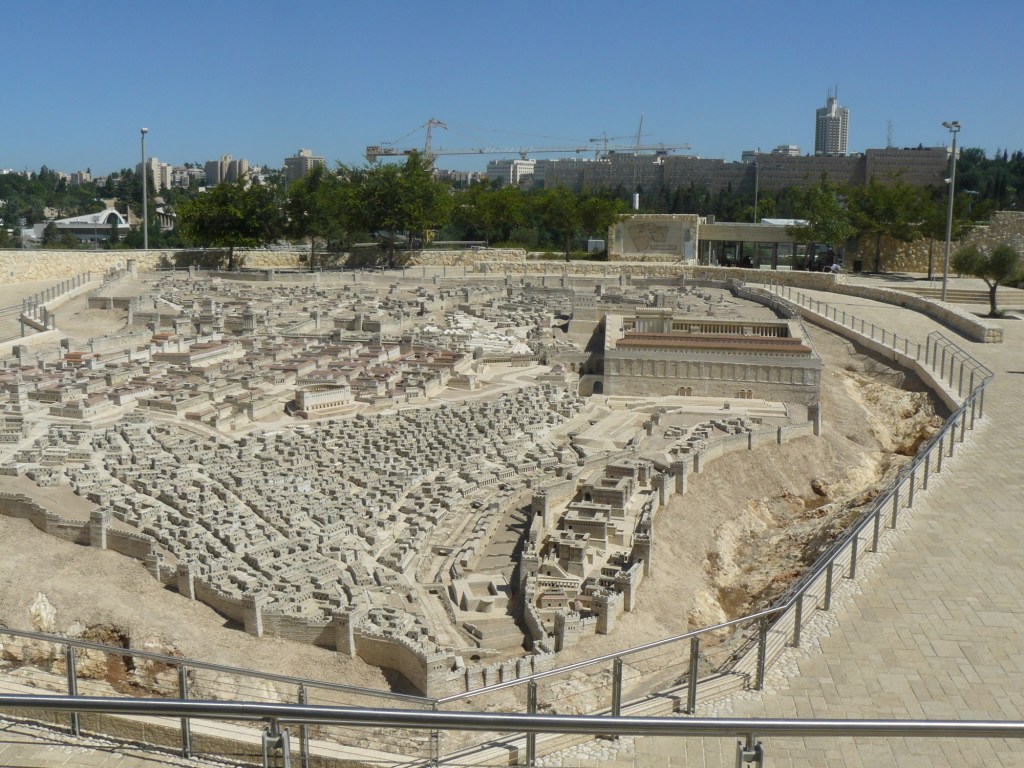
Model of first century Jerusalem

A matter of life or death. Willingness to change and be changed

November 9, 2025

Pentecost 21 – 2025

Luke 20:27-40

Marian Free


In the name of God, Earth-maker, Pain-bearer, Life-giver. Amen.

There are many who tend to think of the tenets of faith as fixed and unchanging that God is one thing and one alone, yet experience shows us that nothing could be further from the truth. Apart from anything else,  God is beyond our comprehension we, and we as mere humans, are always grasping for understanding, we are only ever ‘seeing through a mirror dimly’ (to quote the Apostle Paul). God is both known and unknown and our scriptures, our traditions and our dogmas are simply human attempts to put into words and actions the revelations about God that have been made manifest or experienced since the beginning of time. What this means is that over time changes, subtle and not so subtle, come about as believers form new insights, as scientists broaden our horizons, or as the faith moves into and learns from or adapts to new situations.

We should not be surprised that this is the case, for we are followers of that great disrupter Jesus who challenged cherished traditions, confronted outmoded regulations and who insisted that sinners (even Samaritans) be included in God’s kingdom. We are followers of Jesus, Jesus the change-maker who so offended the religious establishment of his day that they put him to death rather than change their fixed ideas about God and faith.

Christianity itself did not emerge from a monolithic, stable belief system. The Old Testament demonstrates that there were changes over time as the people responded to the prompting of the Holy Spirit – through direct communication, through the prophets and through changes in circumstance.

A clear example of this willingness to accept and adopt new insights is demonstrated by the development of a belief in angels and a belief in the resurrection of the dead. Up until the time of the exile in Babylon, neither of these formed a part of the Jewish faith. Prior to the exile for example, it was believed that a person went to Sheol after death, to “a land of deep gloom and darkness” according to Job (10:21). It was thought that all humanity (good and bad alike) would end up in that dark and joyless place in which, the Psalmist tells us, there is no memory of God (6:5). In Babylon, the exiles were exposed to a belief in life after death, a belief which many embraced and incorporated into their ancient faith. Likewise with angels. Winged creatures had no place in the earliest forms of Judaism. Messengers from God, intermediaries between God and humanity, such as those who visited Abraham took the form of people.  It is only after the return from exile that angels find their way into our ancient texts.  Decades of living among the Babylonians saw the absorption of Babylonian ideas into the Jewish faith.

Change as we know is not always universally embraced. Some cling on to the old ideas, confident that faith is static and fixed. So the idea of a resurrection of the dead was not universally accepted which explains the debate in this morning’s gospel. In the first century there were many different expressions of Judaism – different attitudes to the purity regulations, to the Temple and to a belief in the resurrection. The Pharisees, lay men who preferenced the law over ritual, believed in the resurrection. Sadducees, priests who preferenced ritual over law did not. Both groups in their different ways tried to catch Jesus on the practice of the law or the interpretation of the scriptures primarily so that they could discredit him before the people and in so doing diminish Jesus’ influence and the threat he posed to their influence over the people.

Today it is the turn of the Sadducees to try to trick Jesus. Referring to the law of Moses, they are confident that they can expose the folly of a belief in the resurrection of the dead. Jesus, however, is not is easily trapped and he in turn reveals the narrowness and foolishness of the thinking of the Sadducees. Resurrection life Jesus points out, is not a replication of our earthly existence but something different altogether.

Though they had different ideas about the resurrection of the dead, the Sadducees, the Pharisees thought that they had God and faith and the law worked out. They knew or thought they knew what God wanted and lived their lives accordingly. Jesus, with his new and different teaching, his willingness to break the law and his refusal to conform unsettled their sense of complacency and security. In the end, they felt that it was only by destroying him that they could find peace.

Over the centuries the church has made the same mistakes as their forbears- setting in stone, things that were never intended to be immutable. Yet, at the same time the church has demonstrated a willingness to re-examine ancient practices and beliefs and to acknowledge that at times we have got it wrong and that at times we have caused more harm than good – the endorsement of slavery being the most obvious example. The world and the church is in a constant state of flux. If we are not to become self satisfied and complacent like the Pharisees and the Sadducees, if we are to avoid the trap of believing that we know all there is to know and if we are ready to acknowledge that we do not have the mind of God, we have to develop a a sense of curios expectancy, remain prayerfully open to the movement of the Holy Spirit and examine new ideas thoughtfully and prayerfully rather than fearfully and timidly.

We have to find the courage to admit, as Paul did that our knowledge can only ever be partial because a God that can be fully known is no god and the opposite of faith is certainty. (God is God of the living not do the dead.)

May we have the courage to listen for the voice of the Holy Spirit, be responsive to the winds of change and humbly acknowledge that God, as God, can never be defined or confined by the limits of our minds.


Giving it all away – what must I do to inherit the kingdom?

October 25, 2025

Pentecost 20 – 2025

Luke 18:15-30

Marian Free

In the name of God, Earth-maker, Pain-bearer and Life-giver. Amen.

The Gospel of Luke differs from Mark and Matthew in a number of significant ways. Among other things, Luke demonstrates a particular interest in the Holy Spirit and in prayer – Jesus is often to be found praying in this gospel. Another way in which Luke differs from Mark and Matthew – one which is evident in today’s gospel – is wealth: its power to seduce and its false assurance of security.

Some parables are found only in Luke and some of these specifically target the wealthy. The parable of the barn builder exposes the folly of holding on to excess wealth. You will remember that after a particularly good harvest, a rich man thinks that he will store up his wealth for himself and will “eat, drink and be merry.”  That very night he dies. His wealth has not been able to protect him, nor has he benefitted from it.

In the parable of the rich man and Lazarus, the rich man is convinced that he is justly rich and that Lazarus deservedly poor. Even though Lazarus lies at his door, the rich man does nothing to alleviate his hunger. Finally, the rich man dies and finds himself in Hades, looking up at Lazarus who is in the arms of Abraham. The chasm that divided them in life has been reversed in death and it is too late now to change anything. In life the rich man’s wealth might have given him all that he needed, in death no amount of wealth will serve to quench his thirst.

That said, Luke doesn’t seem to have a problem with wealth per se, but with a person’s attitude to it. As best we can tell, Theophilus was an educated, and possibly comfortably well-off Greek and the parable of the steward who makes provision for his future supports the view that Luke doesn’t advocate that to follow Christ all of us need to give everything away.

In Luke’s mind, the problem with wealth is at least three-fold. In the first instance, Luke can see that wealth often gives to those who have it a sense of entitlement and that this has the potential to blind the rich to the suffering of others. Secondly, Luke understands that those who possess wealth tend to become dependent on their standard of living and unwilling to make do with less. They do all that they can to preserve their wealth because they don’t want to experience the sacrifices endured by poor.  Thirdly, Luke observes that wealth has the ability to seduce the one who possesses it such that he or she can believe that enough money and sufficient possessions will be able to protect them from the vicissitudes of life. Those who are rich are tempted to place their trust in their possessions rather than in God.

Unlike the barn-builder and the rich man who ignores Lazarus, the certain ruler in today’s gospel is a real person, a man who, as his query implies, is seeking to faithfully practice his beliefs. It is possible that his query is sincere. He seems to have a sense that something is missing, that despite his observance of the rules, something is not quite right.

It is equally possible that he is trying to justify or reassure himself – after all the language he uses – that of inheritance – suggests a degree of entitlement.  

Jesus’ response is to tell the ruler to obey just five of the commandments which, in and of itself, should tell us something. Intriguingly, Jesus omits reference to the two commandments that elsewhere he insists are the most important – love of God and love of neighbour. Instead, he refers to the commandments that flow from those two: “you shall not commit adultery; you shall not murder; you shall not steal; you shall not bear false witness; honour your father and mother.” Why these five? My best guess is that Jesus has already discerned the problem – the ruler is good at obeying the law, but not so good at trusting God. Of all the commandments, these five are the easiest, they are those that even non-believers can subscribe to. What is more is that these five are measurable, evidence based. The ruler can (as can we), hand on heart say: I have never committed adultery, I have never murdered anyone, I do not steal or lie, and I give my parents the honour due to them. I obey the law in every respect.

More difficult to keep, and almost impossible to measure, are the two great commandments: to love God with all one’s heart and all one’s mind and all one’s soul, and one’s neighbour as oneself – to put all one’s trust in God and to live in such a way that one’s life benefits rather than harms another.

Jesus’ radical solution to the ruler’s problem is twofold. First, that he should sell all that he has and give the proceeds to the poor.  Second, that he follow Jesus. Only in this way, Jesus claims, will the ruler find the peace he is seeking and the treasure that is above all his worldly goods. Only by selling all that he has and giving it away will he be able to demonstrate his love for his neighbour. Only by following Jesus will he be able to demonstrate that he loves God with his whole being and trusts God with his life.

In this dialogue Jesus is directly responding to the ruler’s question. The answer for the ruler is clear.

As for us, it is only by listening to and responding to Jesus that we will fully understand what is demanded of us. In the meantime it is clear that belonging to the kingdom does not mean blindly following a set of  rules that anyone can follow but rather that belonging to the kingdom means aligning ourselves body,  mind and soul to the one God who created heaven and earth, who sent Jesus to redeem a sinful humanity and who continues to guide and strengthen us through the Holy Spirit. And if that means giving up all that we have then that is what it takes.

Knocking on heaven’s door – the persistent widow

October 18, 2025

Pentecost 19 – 2025

Luke 18:1-14

Marian Free

In the name of God whose love is dispassionate and constant. Amen.

I have to confess that over the last ten (is it as long as that?) ten years, I have found myself not only wondering about the state of the world, but also about how to effectively pray for the world. No amount of prayer on my part has changed the current erosion of democracy in the United States, my daily prayer has not ended the war in Ukraine or prevented the devastating loss of life and destruction of infrastructure in Gaza, and my consistent prayer has not created the political will for our governments to act in ways that will save the environment. So yes, there are times in which not only do I despair about the direction in which the world is going, but in which I feel utterly powerless to make a difference and I feel acutely conscious of the ineffectiveness of my prayer in particular and prayer in general. 

Today’s parable, taken in isolation from the text around it, does not provide a solution to my problem – in fact, it seems to place the blame at my feet, to suggest that if only I had prayed long enough, hard enough all would be well. Yet I feel as if I have already battered down the doors of heaven to no avail. No matter how many times I go back, no matter how just I feel my cause to be, it seems as though my prayers, my desperate pleas, continue to go unanswered. Greed and selfishness, and the need for power and control seem to go unchecked, the poor are getting poorer, and the rich are getting richer, homelessness is increasing as is the number of people unable to access timely healthcare, or enough food for their families (and I could go on) and despite the fact that more people than I are praying God has not yet intervened in any way that would make a substantial difference. 

Yet the parable encourages persistence, the judge eventually responds to the widow’s request – annoyed by her persistence and fearful that she might resort to violence and cause him to lose face[1].

Before we fall into utter despair at the inadequacy of our prayer, we need to have a closer look at the parable. Firstly, and importantly, we must not make the mistake of interpreting the parable as an allegory. The judge (though he is the person with all the power in the parable) does not represent God – which is the exactly the point that Jesus is making. The judge may have no respect for people, but God will hear the cry of his people and God will grant justice. 

God is not aloof, corrupt and obstructionist, ignoring the poor and indifferent to justice. God, unlike the judge, cannot be bullied or forced to do our will by persistence or violence.  There would be no point in God if God was like the judge.

Why then does Jesus tell a parable about persistence? Here, as is often the case, context is important. Our lectionary has moved from the healing of the lepers to the parable on prayer thus omitting an important conversation with the disciples about the coming of the Son of Man.  Jesus, in line with many apocalyptic prophets, paints a picture of a time of great tribulation which will precede the coming of the Son on Man – times perhaps not unlike those we are living through. He suggests that the time before his return will parallel the time before the great flood, that its coming will be as sudden and unexpected as the destruction of Sodom, that those on the housetop must not come down and those in the field must not turn back, that one will be taken and another left and so on.

The wider socio-cultural context is also important. Jesus’ disciples were, by and large poor peasants oppressed by a foreign power which had stripped them of their land, demanded the payment of taxes on the meagre living which they were able to make, and which brutally suppressed any opposition. It would not be at all surprising to discover that the disciples were anxious to know when everything would be put right, when justice would be restored to the land. How easy it would be to fall into despair when day-by-day their prayers for release seem to come to nothing.

It is into this space that Jesus’ tells this parable about persistence. Jesus is not saying that God will miraculously bring justice on earth through our constant nagging or through our belief that we know what justice is.  Jesus is acknowledging that there will be times when it seems that God is absent, when we will feel that our prayers fall on deaf ears, and when it seems that there will never be an end to injustice, war, oppression, poverty or violence. Into that place of despair, Jesus urges us to persist, to maintain our relationship with God despite, not because of, what is happening in the world around us.

This, perhaps explains the final question of this morning’s passage: “When the Son of Man comes will he find faith on earth?” When Jesus returns, will he find those who have hoped against hope, those who have persisted when persistence seemed futile and those who have continued to believe despite God’s apparent powerlessness in the face of humanity’s propensity for evil.

We are to retain our confidence in God’s loving justice, in the face of humanity’s constant efforts to suppress it, we are to maintain our certainty of God’s love, despite its apparent absence in some places of the world and we are to keep the faith, knowing that God is with and for us, despite evidence to the contrary.

Prayer is not about getting what we want. Prayer is a means of holding open the door to God, listening to God’s word, allowing ourselves to be formed in God’s image and maintaining our relationship with God through all the trials and tribulations of our own lives and through all the things we cannot control in the world around us. Prayer reminds us that, despite all evidence to the contrary, God is with us, God loves us, and, in God’stime, not ours, God will bring justice on the earth.


[1] The Greek of Matthew 18:5 suggests that the judge is worried the widow might slap him in the face, or even to beat black and blue.

Gratitude or salvation – the thankful leper

October 11, 2025

Pentecost 18 – 2025

Luke 17:11-19

Marian Free

In the name of God who leaves no one out and no one behind. Amen.

Ward 13 is the last remaining structure of the former Dunwich Benevolent Asylum on Stradbroke Island in Morton Bay. Stradbroke Island is 62 Kilometres from the mainland and 2 hours 8 minutes by boat. The Benevolent Asylum housed many different groups of people particularly those who were unable to support themselves for a variety of reasons – age, unemployment, illness or mental or physical disability. Immediately next to the Asylum and beside a swamp was a Lazaret – which housed men who were diagnosed with leprosy – a disease which, rightly or wrongly was deemed an incurable, communicable disease.

A visit to Ward 13 and the associated information centre reveals just how isolating and cruel the treatment of lepers used to be. A person, once diagnosed, was sent to Stradbroke (and later Peel) Island with no hope of ever returning home. A married man would never set eyes on his wife and children again. A child would be separated forever from her siblings and a mother from her children. Though the care of such people seems to have been reasonable, nothing would ever have made up for the stigma, the shame, the self-loathing, the pain, but above all the isolation and the sense of loss.

Leprosy which leads to the damaging of nerve endings and the disfigurement and subsequent loss of digits, hands, feet and even limbs is a dehumanising disease which for millenia created fear and disgust in the wider community. A leper not only had to deal with the disease and its consequences, but also with the reaction of those around them. In order to protect themselves, communities from ancient times have secluded and excluded not only those with the disease that we know to be leprosy, but also those with any form of obvious skin disease[1]. This is why the lepers in our gospel story this morning are keeping their distance from Jesus.

For obvious reasons, Jesus’ healing of the lepers is most often interpreted as a story of gratitude – the gratitude of the Samaritan in contrast with the apparent self-absorption of the nine. There are a few problems with this simplistic approach, perhaps the most serious of which is the implication that gratitude is an obligation. The idea that God demands our gratitude turns gratitude from a freely offered reaction to God’s love to a formal, superficial response. Gratitude that is not freely given is not really gratitude but rather the rote observation of a code of conduct. It does not come from the heart but is simply the fulfilment of an expectation. 

Another problem with an emphasis on gratitude is the implied judgement of the nine who did not return and the belief that Jesus’ comment is pejorative and judgemental. Certainly, Jesus expresses astonishment and perhaps disappointment that nine of the ten did not return, but after all they were doing what Jesus told them to do. 

Luke’s first readers will have noticed a number of other surprises that are at least, if not more, significant than gratitude or lack of it. Firstly, the one who did return was a Samaritan, a person who was doubly burdened by the disease and by his race, who was considered doubly unclean because of the leprosy and his exclusion from the religious practices of the Jews.  He was an outsider. He did not, could not belong.

Readers would also have been surprised that it was the Samaritan, a man who not Jewish by heritage, who was the only one of the ten to identify the hand of God in his healing and therefore the only one to recognise that Jesus was God, that is, the only one of the ten to demonstrate that he truly belonged in the family of God[2]

A third and perhaps the most important surprise for the first readers of this gospel would have been Jesus’ response to the Samaritan’s declaration. Here, unfortunately, our translation lets us down. The English usually reads: “Get up and go on your way; your faith has made you well.” This leads us to the conclusion that faith and wellness are connected and to the misconception that if only we have enough faith we will be made well. In fact, it is only after the Samaritan notices that he is healed that he understands that the one who made him well is God – his healing has led to faith, not the other way around. 

The Greek text makes more sense of this order of events. Jesus actually says: “your faith has saved you”. By identifying Jesus as God, the Samaritan has been saved from exclusion and has earned the salvation previously associated only with the Hebrews. In other words, the Samaritan’s faith has earned him a place in the people of God. The one who was doubly excluded – from his community and from God’s family has been doubly saved – restored to his family and friends and saved in the sense of becoming a child of God.

In my experience, it is much easier to construct a faith based on rules and expectations. Many of us want to know what to do and how to behave so that we can be sure to get it right.  Such a view can lead to rote performances of gratitude and praise, a desire to please instead of a wiliness to be pleased.

The Samaritan shows us that our sense of belonging depends not on timidly, fearfully doing things that might earn us God’s good favour, but by recognising that God’s abundant love is already poured out on us and responding freely and spontaneously with joyful gratitude and praise that springs from our wonder and delight at all that God does in and for us.

Let us not be tied down by rote observance of rules, but liberated to joyfully and gratefully praise the God who has already saved us.


[1] That “leprosy” included diseases which could be cured or could be temporary, is evidenced by the fact that those who were “healed” could be reinstated into the community if the priest gave them the all-clear.

[2] In fact, the Samaritan has a unique role in this gospel as he is the only one apart from Peter, who identifies Jesus as God, a point that is often overlooked. 

Forgiving as God forgives – uprooting trees and replanting them

October 4, 2025

Pentecost 17 – 2025

Luke 17:1-10

Marian Free

In the name of God, who seeks out the lost and welcomes the sinner. Amen.

Corrie Ten Boom, a Dutch woman, the daughter of a watchmaker, was transported to a concentration camp during WWII for sheltering a Jew in contravention of the Nazi policy. Her father was sent to a different camp, but Corrie and her sister Betsy were not separated. Throughout their ordeal Corrie and Betsy showed enormous courage, holding fast to and sharing their deep faith and finding the positives in the most awful of circumstances.  During their imprisonment they made a pledge that after the war, they would not be bitter or hold grudges against the perpetrators of their suffering but would establish centres of forgiveness and healing. Sadly, Betsy did not survive, but Connie spent her lifetime fulfilling their goal and travelling the world preaching forgiveness. 

Despite her deeply held belief that forgiveness was the only way to move forward from hurt and trauma, Connie tells two stories against herself that demonstrate that forgiveness requires much more than the conviction that it is the right thing to do. She discovered that while she had forgiven the corporate sin of the Nazis, there were still personal hurts that were more difficult to overcome.  

In one instance, after Connie had spoken to a large audience on the importance of forgiveness, she was approached by a man whom she immediately recognised as one of her former guards, someone who had humiliated her beloved sister Betsy. The man said to her: “I know God has forgiven me, but I would like to know that you have forgiven me.” He held out hand, but Connie, despite having spoken so passionately about forgiveness only moments before, found herself unable to move. It was only after pleading with God for help that Connie was able to take the man’s hand.

On another occasion Connie was deeply hurt by the actions of some friends. When asked by another friend if she had forgiven her offenders Connie insisted that yes she had. Then she pointed to a pile of letters. “It’s all there in black and white,” she said. In reality, by holding on to the letters and to the evidence of the offense, Connie was demonstrating that her forgiveness was only skin deep.

I tell these stories as a reminder that forgiveness is not a light superficial action but something that demands complete selflessness, and a willingness, despite all evidence to the contrary) to see others worthy of our love and compassion.  In other words, true forgiveness insists that we see the perpetrator of our hurt as God sees them – as the lost coin, the lost sheep or the lost coin – and that we ourselves are so confident of God’s love that we do not need affirmation from any other source.  Few of us are so self-assured!

It is no wonder then that when Jesus tells the disciples that they have to forgive an offender over and over again (even on the same day) that the disciples respond as one: “Increase our faith!”

“Increase our faith!”

In my bible, and I suspect in most translations verses 5 and 6 of chapter 17 stand alone, as if faith was unrelated to what precedes and what follows.  But, as I have just made clear, the disciples’ request and Jesus’ response follow directly from Jesus’ instruction on forgiveness, suggesting that in this instance at least, faith has a very specific meaning. That is, when Jesus replies: ““If you had faith the size of a mustard seed, you could say to this mulberry tree, ‘Be uprooted and planted in the sea,’ and it would obey you,’” he is not necessarily saying: “If only you truly believed, you could do anything you put your mind to,” but rather, “the smallest amount of confidence in God’s love would allow you to love as God loves and to forgive as God forgives.”

Unfortunately, too often having enough faith has been seen as a prerequisite for healing or for other sorts of miracles. Too many good, faithful Christians have been made to feel lacking, been made to feel that in some way their faith was insufficient because they were unable to control the circumstances of their lives, unable to prevent their cancer from spreading, unable to pray hard enough to end their child’s addiction to drugs or gambling and so on. 

To interpret this verse as meaning that faith enables us to do anything, that faith is a power that can be used to our own benefit or that having sufficient faith enables us to do the impossible suggests that God needs us to prove our faith or to demonstrate our conviction or worth before God will intervene in our lives or in the lives of those whom we love. It assumes that the God who created the universe can be manipulated by our pleas or appeased by our obsequiousness. It assumes that “faith” in some way allows us (not God) to control our destiny. 

To suggest that if we have enough faith we can move mountains or uproot trees and replant them at will, is to forget that Jesus himself resisted the temptation to engage in dramatic, attention-getting stunts – turning stones into bread and jumping off cliffs. Nor did Jesus’ faith prevent him from being tortured and crucified.

No, faith is not a simple matter of trusting in God to put things right.

In this context, I suggest that to have faith is to so completely align oneself with God, that we cannot help but behave as God, that our lives cannot help but reveal the presence of God within us. To have faith, even if it is only the size of a mustard seed, would enable us to see with God’s eyes, to love with God’s heart and therefore to forgive as God forgives. To have the faith that Jesus speaks of here is to see, beyond the words and actions of the person who has hurt us, to the neglect that has formed them and to wounds that have been inflicted on them. To have faith is to see all people as God sees them – as children of God, who given love and acceptance, will find healing and wholeness and who will grow into their full potential. To have the faith that will forgive over and over and over again, is to acknowledge the hurts that our own insecurities and carelessness cause on a daily basis and to remember that, despite our own imperfections God loves us still.

“Increase our faith!” Help us to love as God loves – both ourselves and those who cause us harm.

Seeing Lazarus

September 27, 2025

Pentecost 16 – 2025

Luke 16:19-31

Marian Free

In the name of God whose preference is for the poor, the widowed and the orphaned. Amen.

During the week I learnt a new expression which was coined to describe Elizabeth Gilbert’s book Eat, Pray, Love[1]The expression “Priv Lit” or “Privileged Literature” was introduced in 2010 by writers Joshunda Sanders and Diana Barnes-Brown in an article titled Eat, Pray, Spend. I came across the expression in a comment on Gilbert’s latest offering All the Way to the River in which (as I understand it) Gilbert describes the wild ride she and her lover go on when the latter is diagnosed with cancer.  The expression ‘Priv Lit’ refers to: “literature or media whose expressed goal is one of spiritual, existential, or philosophical enlightenment contingent upon women’s hard work, commitment, and patience, but whose actual barriers to entry are primarily financial”.

Authors of these sorts of biographical narratives use their own life experiences as a model for others, assuming that these can be universalised and forgetting that they write from a position of wealth and privilege that few others can aspire to.

While this term was first applied to Gilbert, it could just as well refer to a number of other authors who are so focussed on their own issues (and resulting solutions) that they are blind to the very real problems faced by women (children and men) all over the world – including in their own country of the United States. Self-actualisation, dealing with grief through travel, or restoring a villa in Italy pale into insignificance in comparison with the hour-by-hour struggles of homelessness, starvation, injury and loss experienced right now by millions in Gaza, the Sudan and elsewhere. These (usually expensive) “solutions” to pain and grief are meaningless to the millions struggling to survive in many of first world countries who cannot afford homes or, who if they have homes have to decide between keeping the lights on and feeding their children.

In today’s parable the unnamed rich man could (like the authors above) be described as tone-deaf and blind. Lazarus, the only person named in parable, lies at the gate of the rich man. It is inconceivable that the rich man doesn’t know that he is there, or that Lazarus is hungry, dependent and covered in sores that are licked by dogs. Not only would the rich man have to pass Lazarus every time he left the house, but Lazarus would also have been visible from within the house. The architecture of the time was such that even the homes of the wealthy were built directly on the street, and those going past would have been able to see inside to the courtyard. Lazarus would have been able to at least glimpse the goings-on inside the home and maybe the obvious signs of wealth.  All the daily to-ing and fro-ing, including the delivery of food, would have to have passed by him[2].

There was nothing in the way of social services in the first century Mediterranean. Those without families, those unable to work, the widowed and orphaned were often forced to beg.  Jewish law made up for this lack by building into it an obligation to provide for the poor, the widowed and the orphaned not, as AI helpfully summarises, “as an optional act of charity, but as a fundamental expression of the righteousness and justice of God”. This is perhaps most clearly expressed in Deuteronomy 15:7, 11 – “If there is among you anyone in need, a member of your community in any of your towns within the land that the LORD your God is giving you, do not be hard-hearted or tight-fisted toward your needy neighbour.” “Since there will never cease to be some in need on the earth, I therefore command you, ‘Open your hand to the poor and needy neighbour in your land.’”[3]

The rich man in the parable was a Jew; he knew the law; as we learn when he appeals to Father Abraham after his death. In life though, the rich man appears to have no self-awareness, no understanding that his wealth is a privilege not a right, and no concept of the obligations his position and his faith entails. He is either so self-absorbed, or so self-righteous or perhaps so disgusted by Lazarus’ condition that he looks right past or right through him. 

We live in a time in which the problems facing the world seem insurmountable. Many of us find ourselves frozen in indecision because any contribution we can make to the solution is but a drop in the ocean. On our own we cannot impact the systemic abuses that lead to entrenched poverty, we cannot end the wars in the Ukraine, in Gaza, in the Sudan and elsewhere, and we can’t, as individuals, stop climate change. We can, however, examine our own lives and try to understand how our attitudes, our lifestyles and even our political allegiances impact the poorest of the poor. We can try to understand how systems we unwittingly support further entrench poverty and inequity. We can recognise and be thankful for the advantages that we do have and acknowledge that throughout the world and in our own nation there are those who, through no fault of their own live in situations of dire poverty, unable to properly house and feed themselves or their families let alone manage to fund health. 

If nothing else this parable urges us not turn away, but to keep our eyes firmly focussed on the state of the world around us, to try to comprehend (and change) the systems that trap people in poverty and to do all in our power to ensure that all people have adequate access to food and shelter, health care and education.  


Like the rich man (and his brothers) we already know what to do – it is all there in our scriptures.

He has told you, O mortal, what is good;

                                    and what does the LORD require of you

                  but to do justice, and to love kindness,

                                    and to walk humbly with your God? (Micah 6:8)

Today is the day to open our eyes and ears to the cries of the poor, the oppressed and the overlooked.

This poem could be our daily prayer:

If it should be, loving Father of all,

that, all unknown to us,

our eating causes others to starve, 

our plenty springs from other’s poverty,

or our choice feeds off other’s denial,

then, Lord,

forgive us,

enlighten us,

and strengthen us to work for fairer trade

and just reward. Amen. (Donald Hilton, Blessed be the Table)[4]


[1] Gilbert’s journey of self discovery was actually subsidized by her publisher.

[2] Many scholars assert that Luke was written for an audience that was well-off and urban dwelling. The inclusion of this parable, not found elsewhere, seems to support this view.

[3] Or this from Amos 6:4f  Alas for those who lie on beds of ivory,

                                    and lounge on their couches,

                  and eat lambs from the flock,

                                    and calves from the stall; 

                  who sing idle songs to the sound of the harp,

                                    and like David improvise on instruments of music; 

                  who drink wine from bowls,

                                    and anoint themselves with the finest oils,

                                    but are not grieved over the ruin of Joseph! 

[4] Quoted by Chelsea Harmon, Working Preacher, September 25, 2022.

Dishonesty or forward planning?

September 21, 2025

Pentecost 15 – 2022

Luke 16:1-13

Marian Free

In the name of God who asks us to attend to the future with as much care as we attend to the present. Amen.

Then Jesus said to the disciples, “There was a rich man who had a manager, and charges were brought to him that this man was squandering his property.  2 So he summoned him and said to him, ‘What is this that I hear about you? Give me an accounting of your management, because you cannot be my manager any longer.’  3 Then the manager said to himself, ‘What will I do, now that my master is taking the position away from me? I am not strong enough to dig, and I am ashamed to beg.  4 I have decided what to do so that, when I am dismissed as manager, people may welcome me into their homes.’  5 So, summoning his master’s debtors one by one, he asked the first, ‘How much do you owe my master?’  6 He answered, ‘A hundred jugs of olive oil.’ He said to him, ‘Take your bill, sit down quickly, and make it fifty.’  7Then he asked another, ‘And how much do you owe?’ He replied, ‘A hundred containers of wheat.’ He said to him, ‘Take your bill and make it eighty.’  8 And his master commended the dishonest manager because he had acted shrewdly; for the children of this age are more shrewd in dealing with their own generation than are the children of light.  9 And I tell you, make friends for yourselves by means of dishonest wealth so that when it is gone, they may welcome you into the eternal homes. (NRSV)

“Make friends for yourselves by means of dishonest wealth.” Surely Jesus is not saying that the entrance into eternity is through making others indebted to us by the dishonest use of funds. This is one of, if not the most, difficult parables to understand. In order to begin to unpack it we have to understand both the context in which it was told and the editorial process that has brought it to us. 

We are so familiar with the gospels and their use in our current context that we tend to forget that Jesus was speaking to a culture far removed in time and place from our own. Those who lived in first century Palestine were seriously impacted by the fact that they had existed under foreign occupation for generations. The rural economy in which land had passed from father to son for generations had been disrupted by the Emperors’ practice of giving grants of land to returning soldiers or to others whom they wanted to reward. The new landowners rarely took up residence on their land, choosing instead to live somewhere more attractive and to appoint managers or stewards to administer their estates. Such managers (many of whom were slaves) were empowered to act on the owner’s behalf. A manager would make decisions about the day-to-day running of the property and was able to make decisions about the expenditure of money, the offering loans and the incurring and forgiveness of debts. Much as is the case in large landholdings in Australia today – the manager had the same authority as the owner.

As I mentioned a couple of weeks ago, the principles of honour and shame were a central feature of the ordering of society and a guide to interpersonal relationships in the first century Mediterranean world. A person’s honour determined their place in society, was easily lost and was more valuable than money, land or possessions. Also, in a world where life was precarious, there was not the luxury of planning for distant events. People in Jesus’ time were more likely to act out of current desires than in pursuit of a long-term goal.

So, we need to grasp that most of the land was in the hands of managers on behalf of absentee owners, everyone knew their place in a culture governed by principles of honour and shame and the focus was on the present reality rather than an unimaginable, perhaps unrealisable future.

If we are to fully grasp the meaning of the parable we also have to have a basic understanding of biblical criticism. The gospels were not compiled until some 40-50 years after Jesus’ death, meaning they were not written by eyewitnesses. Until that time Jesus’ teachings had circulated as oral tradition. They were retold from memory and told in ways appropriate to the situation of those who are listening. Finally, when the gospels were written, the authors took the material available to them and shaped it in ways which suited their particular emphasis. In order for the sayings and parable to make sense, the editors would add linking sentences and even their own commentary. 

It is also helpful to note that the divisions into chapters did not occur until the 13th century and the addition of verses in the 17th century. Our task is try to discern how the authors compiled the material and not to rely on arbitrary divisions.

All this brings us to the parable of the Unjust Steward (a parable recorded only by Luke). 

Scholars agree that the parable proper consists of verses 1-8a and that v8b introduces a sermonising commentary – not the language of master to servant. This means that the parable proper ends with the master commending the steward for acting shrewdly.  Shrewdness not dishonesty is the point.

The parable concerns a rich man and his steward. We are told nothing about the steward’s character or his previous behaviour, only that a report has been brought to the landowner alleging that he is squandering his master’s property. A first century audience would immediately know that whether or not the steward was innocent the reputation (honour) of the landowner had already been compromised and his reputation damaged. They would also know that the steward would have had no means of self-defence – no external party to appeal to – his fate is sealed.

Interestingly, though the landowner asks the steward for an accounting of his management, he tells him he is fired without any reference to the financial record. Also important is that though he fires the steward, he doesn’t ask the steward to repay any debt, nor does he threaten to punish him by beating or imprisonment. (This tells us something about the generosity of the landowner which will make more sense of the conclusion). 

In verses 2 and 3 we hear the steward’s internal dialogue as he considers what to do[1]. Once again honour (as well as age) is a contributing factor in his decision. Finally, the manager announces that he has made a decision. He will place other people in his debt by reducing the value of their debts (v4, which he does in verses 5-7)! This means that though the master (who is already rich) might lose some income, the master’s honour – the far more important commodity – will not only have been restored it will have been enhanced! The landowner commends the steward for his shrewdness because the steward’s actions have increased the landowner’s status in the eyes of the community thus ensuring that his honour has not been compromised and the steward has secured his own future. (Again we are surprised by the generosity of the landowner, who commends rather than condemns.)

Jeffrey Durkin whose article has informed my research, summarises the situation in this way: “a master has a steward who has wasted his possessions and dishonoured him. The master dismisses the steward, creating a crisis for the steward, but he does not punish him. The steward hatches a risky plan to take advantage of his master’s forgiving nature and to secure his own future. By reducing the amounts of the debts owed to his master, he creates goodwill in the community for both himself and his master. The master praises the steward for his purposeful action in the securing of his own future.” [2]

The parable then is not about management, honesty or dishonestly, rather it is about futureproofing, it is about living in the present while focussing firmly on the future – on eternity.

It begs the question – where does our focus lie. Are we shrewd enough to recognise that eternal life is not simply a matter of chance but might take some forward planning? If so how are we going about it?


[1] This is a characteristic of Luke’s writing – see Luke 12:13-21.

[2] “A Cultural Reading of Luke 16:1-9.” Journal of Theta Alpha Kappa. January 1, 2007, 7-18.