Archive for the ‘Uncategorized’ Category

The Holy Spirit – wild and exuberant or quiet and restrained?

June 7, 2014

Pentecost – 2014

Acts 2:1-21, 1 Corinthians 12:1-13, John 20:19-23

Marian Free

In the name of God whose holy Spirit energises, enlivens and empowers us. Amen.


We have a feast of readings today. They reveal, among other things, a variety of ways in which we can think about the Holy Spirit, the third person of the Trinity. Of course, there are other readings that would shed a still further light on the subject and give us an even wider perspective. Today however, let’s just look at those we have heard this morning – Acts, John and 1 Corinthians. The first two provide us with two different accounts of the coming of the Holy Spirit to the disciples whereas the letter to the Corinthians gives us a glimpse into how the Spirit was experienced by at least one early community.

The descriptions in Acts and in John are so different that we could be excused from thinking that they were accounts of different events. In Acts the Spirit is explosive, uncontrollable, empowering and life changing. The Spirit appears out of nowhere and yet is visibly and audibly present to the disciples in the violent wind and tongues of fire. Jesus had promised that the Holy Spirit would give the disciples power that would enable them to take the gospel to the ends of the earth, still I imagine that the actual event took them by surprise. Whether it did or not the effect was immediate – without warning and without years of study – the disciples discovered that they could speak in the variety of languages represented in a cosmopolitan Jerusalem. As a consequence of their newly acquired skill 3000 people joined the believers on that day.

In contrast to the very dramatic and public event described by Luke, is the report in John’s gospel. Here the coming (or the giving of the Spirit) is quiet, discrete, peaceful and controlled. In Acts, the disciples are depicted as a confident community – they meet together to pray and sing. They have just elected someone to replace Judas which suggests some sort of leadership structure. This more settled situation may reflect the fact that in Luke’s account the Holy Spirit comes to the disciples at least forty days after the resurrection. They have had time to get used to Jesus’ risen presence and to think about the future. John’s version however, takes place on the very same day that Jesus rose from the dead.The disciples have heard the reports of the empty tomb, but they are yet to see Jesus for themselves. They are frightened and disorganized and have no apparent plan. Into this fear filled situation Jesus (not the Spirit) quietly appears. He offers them peace and breathes his Spirit on them. There is no wind or fire, just the gentle breath of the risen Christ. The event is private and personal and the consequences subtle and indeterminate. Instead of being given the ability to speak in difference tongues, John’s disciples are empowered to forgive or to retain sins. No converts are added to John’s community on that day, but the disciples have been armed with an important tool for the formation and building of a community of faith – the forgiveness of sins. The giving of the Spirit and Jesus’ resurrection appearance occur concurrently. Frightened disciples are not only assured of Jesus’ victory over death, but are powerfully reminded that, as promised, Jesus will not leave them alone.

Finally (for today) the reading from Corinthians provides us with an insight into the experience of the Spirit in one particular situation – the community in Corinth. Here the work of the Spirit does not equip the recipients for mission. Rather the Spirit endows members of the community with the gifts that will enable them to play a variety of roles within that community – the use of unintelligible language to worship God and to prophesy, the ability to utter wisdom and knowledge or to work miracles and heal. If we read further, we discover that the Spirit also empowers those who teach, lead and administer. In this fledgling community the Spirit seems to be inwardly focused rather than outwardly directed. The Spirit gives to members of the community different skills and these are to be used within the community for the building up of the church. As in Acts, the impression here is that the Spirit is exuberant and unable to be contained and that it leads it recipients to behave in ways that they would not otherwise behave.

What are we to take from all this? It seems clear that we will be able to build a coherent or accurate historical picture of the sending/receiving of the Spirit or that from today’s readings we will be able to neatly sum up the way that the Spirit is manifested in the communities that made up the early church. What we can do is to use all the information that we have to hand to help us to understand and to interpret our own experience. In so doing, it will be important for us to hold together the various biblical accounts and to allow each to inform the other, to recognise that just as the first Christian communities experienced the Spirit in different ways, so too, our experiences may differ one from the other. For some the presence of the Spirit might be wild and unrestrained and for others it might be understated and contained. Some of us will be gifted with the more extraordinary gifts and others will have to be content with those that seem to be less glamorous.

As we try to interpret our experience and to recognise our gifts it is important that we heed Paul’s caution and understand that the Spirit is of God and cannot be used or manipulated for our own ends, nor should the Spirit provide us with a means to compare ourselves favourably with others. The Holy Spirit is not something that we own or control, but a gift from God – the presence of God with and in us that prods us to take risks, that reveals skills that we did not know that we had, that gives us courage in the face of persecution, provides us with wisdom and understanding and opens us to new things, new teaching and new experiences and helps us to build and sustain Christian communities.

As we seek to recreate and renew the church both here and elsewhere, let us be alert to the Spirit in and among us, open to the Spirit’s leading and willing to be led into whatever future the Spirit has in store for us.


Reading the Bible through the lens of Jesus

May 17, 2014

<Easter 5 2014
1 Peter 2:11-25
Marian Free

In the name of God, whose love and inclusiveness provide a lens through which to read our scripture. Amen.

One of the problems with the Bible and with religious literature of other traditions is that it can be used in a variety of ways to support a number of different points of view. For nearly nineteen centuries the bible was used to justify and to continue the practice of enslaving people. Some texts were used to support the argument that those with dark skins were a different and more base form of humanity than those with white skin and therefore were created to serve others. Other texts, including 1 Peter seemed to imply the biblical expectation that slavery was a normal aspect of human society. Up until the mid twentieth century and beyond 1 Peter and other texts have been used by some to justify violence against women and the domination and abuse of children.

Religious texts can be used by those who are mentally unstable, cruel or hungry for power to dominate and manipulate the vulnerable, the easily led and those on the margins of our society. The bible can also be used to support and maintain the status quo even when it isolates, limits or marginalises sub-sections of society and reinforces the power of a few.

It for this reason that it is imperative that as many of us as possible should be biblically and theologically literate. It is why it is important to try to understand the social, cultural and political climate in which the bible was written as well as the different styles of writing that were employed to write it.

While we might like to think otherwise, faith and culture are often very closely intertwined. One example is the practice of slavery. In the first century a staggering 30% of the population of the Empire were slaves. Not only was slavery an integral part of the social fabric, it was in some instances a means of social advancement. Many slaves held positions of authority – as managers of estates, as agents (representatives) of their owners and so on. It was possible for a slave to amass wealth, own property and receive an education. They could buy their freedom, but many chose to remain slaves and to hold onto their social position. While slavery was often cruel, demanding and debasing, Paul and his contemporaries probably could not have conceived of a world without slavery and so did not try to build a society without it. That said, the gospel impacted on this practice in a number of ways, not least of which was the demand that slave owners who were believers would treat their slaves with respect. Paul further makes the radical claim: “There is no longer Jew or Greek, there is no longer slave or free, there is no longer male and female; for all of you are one in Christ Jesus” (Gal 3:28). Seventeen hundred years later this statement gave some biblical force to the argument for emancipation for slaves (and two centuries later still for the full inclusion of women in the workforce and in the life of the church.)

The culture in which the bible was written affects what was recorded, conversely it is important to note that the culture in which we find ourselves also impacts our understanding and interpretation of scripture. Those of us who were born prior to 1960 have clear memories of being given a new hat every Christmas so that we could wear it to church according to Paul’s instruction in 1 Corinthians 11:5. Few of us remember exactly when and why the practice of wearing hats to church stopped, but we know that by the mid-sixties it was no longer expected Sunday dress. Intriguingly, a practice that for centuries was defended by reference to scripture quietly disappeared with no discussion or fanfare.

There are countless examples of the ways in which culture affected the writing of scripture and at least as many examples of the ways in which our interpretation and understanding has been refined over the centuries that have followed.

It is for this reason that we need to use caution when trying to make sense of passages such as that in 1 Peter today. Among other things, the author urges us to: “accept the authority of every human institution, whether of the emperor as supreme, or of governors, as sent by him to punish those who do wrong and to praise those who do right” (1 Peter 2:13,14). Paul likewise exhorts those in Rome to: “be subject to the governing authorities; for there is no authority except from God, and those authorities that exist have been instituted by God” (Rom 13:1-7). In their original context such exhortations made perfect sense. Judaism was well understood and respected in the Roman Empire whereas emerging Christianity made little sense. As long as those who believed in Jesus sheltered under the umbrella of Judaism, they benefitted from the privileges afforded Jews which included freedom of association.

In the year 49 CE Nero expelled the Jews from Rome. Christians who were not Jews remained but they no longer enjoyed the protection afforded by the synagogue. In Romans 13, Paul is advising the community not to draw attention to themselves, but to stay under the radar so that they would be allowed to continue the practice of their faith. I don’t imagine for one moment that Paul, who writing in the first century, thought that two thousand years later his words, which related to a very specific context, would be applied literally by a very different nation in a very different time. (That is that German scholars would have developed an understanding of Romans 13 which would allow German citizens to believe that they owed allegiance to a government which exterminated six million of Paul’s fellow Jews). Nor do I imagine that the author of 1 Peter thought that God would empower leaders to engage in such wholesale destruction.

Some knowledge of context makes it easier to interpret difficult passages of scripture, but even without that knowledge it seems to me that there are some basic principles that we can apply when we read the bible. The God revealed by Jesus is one who cares for the vulnerable and the marginalised. This God does not seek authority and power but, in Jesus, gives himself completely for others. The God revealed by Jesus does not impose laws that hurt, but gives us commands which set us free. The same God places love at the centre of all that we do and turns upside down cultural values and expectations replacing authority with service for example.

If we read scripture through the lens of the God revealed by Jesus, we will look for evidence of God’s inclusive, forgiving and all embracing love and we will know and expect that the bible will show us how to extend that love to those around us, and that it will teach us to to build up and not to break down those who do not have the advantages that birth, nationality or education have bestowed upon us. We will not use the bible to dominate, exclude, abuse or judge, but rather to serve, to include, to offer love and to show compassion.

The absence of God- what makes this Friday “Good”?

April 18, 2014

Good Friday 2014Good Friday – 2014

(Read in conjunction with the Good Friday liturgy on this site

https://swallowsrest.wordpress.com/good-friday-liturgies/)

“My God, my God, why have you forsaken me?”

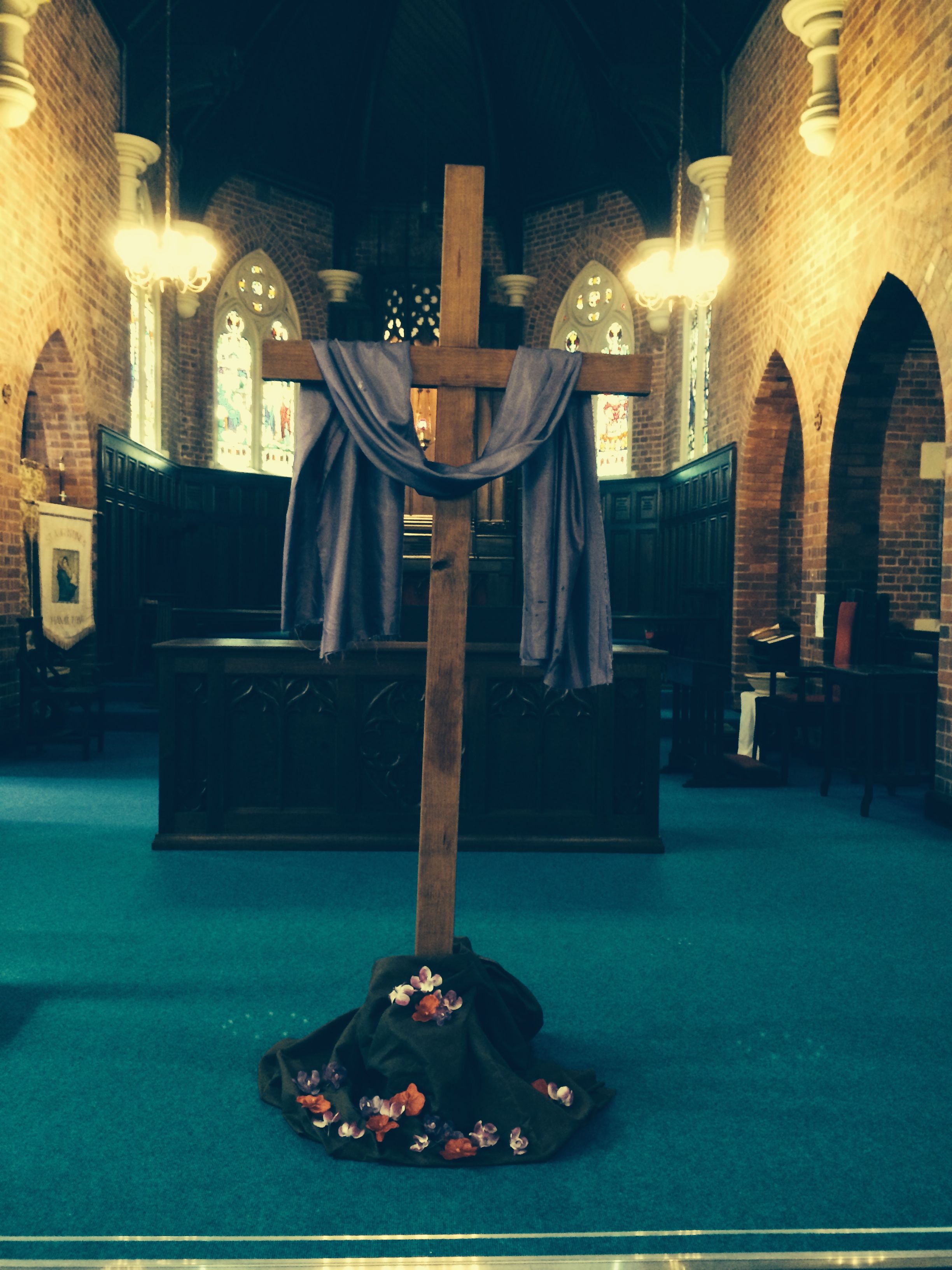
A bare church, an empty altar speaks to me of absence – God’s absence.

The Bible is full of God’s absence, times when people have called to God and have been met with silence. Of all the biblical images of absence, Jesus’ cry from the cross and his ultimate death are the most poignant.

If Jesus is God, where is God when Jesus hangs dying on the cross? Is there a moment when there is no God?

If Jesus is God – and we believe that he is – then God is Jesus and Jesus is dying/dead.

How can it possibly be Good Friday? The shocking failure of Jesus’ potential, Jesus’ promise, the destruction of the hopes of all who followed him, the brutality of the crucifixion are anything but “good”.

“My God, my God, why?

The paradox is this – God’s apparent absence is also God’s ultimate presence.

The cross confronts us with the uncomfortable truth that God is so intimate, so completely identified, with the human condition, that God would go so far as to share a human death. You can’t get any closer to human experience, to us than that.

This is perhaps the ultimate contradiction. Not only that Jesus’ death is God’s death, but that God’s death is a confirmation of God’s deep, unswerving, unreserved love for us – a love shown by God in Jesus who not only goes through the motions of dying, but who actually dies – dies a we will all one day die.

It is a contraction – God’s absence serves to demonstrate God’s intense, immediate, never-ending presence with us and in us.


And that is what makes this Friday “Good.”

Judas – one of the twelve?

April 17, 2014


Maundy Thursday – 2014
Marian Free

In the name of God, Creator, Redeemer and Sanctifier. Amen.

Recently, the Cathedral Chapter had the opportunity to think about a number of statues to be placed in niches in the Cathedral. Most of the choices were uncontroversial – the 12 disciples, John the Baptist, Mary and Martha. No one could argue about their right to be there. The character who caused the most discussion was Judas. Should Judas, the person who handed Jesus over, be included? What would be the reaction of the Building and Furnishing Advisory Committee to the idea? If they gave permission for the work to go ahead, what would be the reaction of the Cathedral congregation, of the public? After much discussion it was agreed to include Judas and permission was given.

It is some time since the debate, but it seems to me that there are a number of arguments for including the twelfth disciple.

Perhaps the most important reason for including Judas is the fact that he was one of the twelve, he was a disciple and he was chosen by Jesus. These are irrefutable parts of Jesus’ story. To omit Judas is to deny part of the story – whether it was that Jesus made a mistake in choosing a man who would betray him, or that Jesus deliberately chose someone whom he knew would not make it to the end of the road. No matter, that Jesus chose Judas is part of the story.

It is because Judas is an essential part of the story, that he should not be left out. In fact, without Judas, there is no story. Had Judas not got cold feet, or been driven by greed the story would have been quite different. There would have been no covert arrest, no trial, no crucifixion, no resurrection. The most important part of the story would simply not have taken place. There would have been no opportunity for the centurion – a complete outsider – to declare that Jesus truly was the Son of God, no resurrection to change a group of frightened men into a driving force that changed the course of history. Without Judas, it is possible that Jesus would have lived to a ripe old age and would possibly have been forgotten by all but those whose lives he touched. Without Judas it is possible that there would be no faith.

Last but not least it is essential that Judas not be excluded because Judas is a reminder to us of our own humanity, our own propensity to let Jesus down. Whether Judas acted out of timidity or anxiety, out of greed or a desire for power, he simply represents the weakness that is in all our natures. Even then, Judas was not alone. Not one of the disciples really understood Jesus’ mission, all of them at cone time or another let him down. In Jesus’ moment of greatest need, all of his disciples abandoned him and left him to face his fate alone. Judas is not worse than us, Judas is one of us. If we forget Judas, we risk forgetting a part of ourselves.

Jesus chose twelve. If we forget one, we forget so much more.

A matter of life and death

April 5, 2014

Lent 5 – 2014
John 11:1-42
Marian Free

In the name of God who gives us life in abundance. Amen

One of the mysteries in the account of the raising of Lazarus is Jesus’ tardiness – when Jesus hears that Lazarus is ill he stays where he is for two more days. This is even harder to understand when the narrator tells us that Jesus loved Lazarus and that Jesus wept when he learned that Lazarus had died. This confusion is shared by the characters in the narrative. The disciples take Jesus literally when he says that Lazarus is merely asleep, Martha exclaims: “if you had been here my brother would not have died” – a sentiment echoed by her sister Mary. The Jews wonder: “could not the man who opened the eyes of the blind man have kept this man from dying?” Why, when Jesus cares so much for his friends and obviously has the power to cure the sick, does he delay?

An obvious reason for Jesus’ hesitation is that the Judeans are trying to kill him. If Jesus returns to Jerusalem it will place him (and by association his disciples) at great risk. It is little wonder then that he takes some time to think about the consequences of his going . What changes his mind appears to be his belief that Lazarus has died. This simply adds to the confusion – why, having chosen to play it safe, would he now risk his life and that of others to go to someone who is already dead? Again the answer is in the text: “so that you might believe”. Believe what is an obvious question, the answer to which is found in Jesus’ discussion with Martha. In response to Martha’s assertion that Lazarus will rise again on the last day, Jesus responds: “I am the resurrection and the life. Those who believe in me, even though they die will live.”

Throughout his ministry, Jesus has been claiming to be life. The gospel begins with the claim that “in him was life and the life was the light of all people” and the word life occurs at least forty more times – sometimes with the descriptor eternal life, but often on its own. “I came that they might have life and have it abundantly” (10:10). It is this focus on life in the gospel as a whole that helps us to get a handle on this chapter. When Jesus says that Lazarus’ illness is not unto death he is not trying to deceive or mislead the disciples. What he is trying to do is to get the disciples and the Jews to understand life and therefore death differently, to understand that somehow, as a consequence of his presence in the world, the relationship between life and death has radically changed – a fact that will become clear after Jesus’ own death and resurrection, but which he wants them to take on faith in the present.

Physical death is brutally real – the raising of Lazarus does not alter that fact, neither does Jesus try to sugar coat the reality of death. Lazarus is not raised to eternal life, but to life in the present, a life that will eventually end with death. Death separates us from the one who has died and the one who has died loses any benefits he or she might have had in life. The grief that Lazarus’ sisters and friends (including Jesus) feel cannot be avoided. In raising Lazarus Jesus’ attempt to redefine the ways that his followers think about death. (In order for that to happen, Lazarus has to physically die.)

There are a number of aspects to this redefinition of death. First of all, Jesus’ apparent lack of concern does not indicate indifference to Lazarus’ illness or indifference with regard to the sister’s grief. Jesus’ refusal to be hurried demonstrates that death (even his own) is not a matter over which human beings have any control. Death is something that is determined by God (not illness or other cause). Pilate himself would have no power to crucify Jesus unless that power had first been given him by God. Secondly, by creating ambiguity around Lazarus’ death – saying the illness will not lead to death, saying that Lazarus is asleep when he is not, opening the grave when it is certain he is dead, Jesus opens the possibility that death is not the definitive end to life. Death is more open ended – life does not cease completely after the death of the physical body.

A third way in which death is redefined is the notion that death is in some way for the glory of God. In the case of Lazarus, death glorifies God because his being raised to life will help the disciples to believe that Jesus is life. When Jesus raises Lazarus, he demonstrates that death cannot defeat life – something that will be definitively proven when Jesus is raised from the dead never to die again. Life and death are in the hands of God. Finally, the raising of Lazarus shows the disciples that death does not lead to separation something that will be clearly evident to them when Jesus rises from the dead. Jesus’ resurrection life will break into the world of the disciples ensuring that they are never separated from him.

In the account of the raising of Lazarus, both life and death are radically redefined for the disciples of Jesus. They learn that death has lost its power to overcome life. That said, Jesus offers no false promises of happy endings, no assurance that pain and sorrow have been eliminated from the world, just an assurance that this life can, with confidence be understood as a prelude to the life to come, that the separation from loved ones is only a temporary condition and that no matter what happens in the present, Jesus will never abandon those who believe in him because death itself cannot separate him from those whom he loves.

Restoring creation to its true purpose

March 8, 2014

Lent 1 – 2014
Matthew 4:1-11
Marian Free

In the name of God who alone is good and holy and true. Amen.

What does one say to a father whose daughter has been brutally raped and left to die, or to a wife whose husband has been killed in a mindless attack, to a child who experiences the deprivation of a refugee camp or who witnesses the violence of war. How does one defend the notion of a God who is love in a world that is filled with hate? How can one claim that God is good, when the world that God created is anything but good? These are questions that can trouble even people of faith and which can be used as ammunition by those who want to discredit Christianity. “Why, if God is good, do such terrible things happen?” “Why, if God is all powerful, does God not step in and stop all the madness?”

These are questions that are generations old, as the Book of Genesis can attest. It is easy in a scientific age to dismiss Genesis as pure myth. For those of us who have grown up cognizant of the theory of evolution, the creation stories are just that – stories. It is difficult to defend the notion that all humanity is descendant from incestuous couplings between the off-spring of just two people. If Adam and Eve were really alone in the world, how did Cain and Seth find wives and the remaining sons and daughters find spouses?

We don’t need to puzzle over these conundrums if we accept that the account of Adam and Eve, and of their encounter with the serpent is not to tell us about the birth of humankind, but to answer the vexed question of the presence of evil in the world. The second chapter of Genesis describes an ideal world in which humanity has a perfect relationship with God. Adam and Eve, representatives of humanity have all that they need and are content until they discover that there is one thing in their world that is forbidden them. Instead of trusting that God has their well-being at heart, they form (or are led to form) the idea that God is with holding something that would empower or enrich them. Like teenagers, who think that their parents are obstructive, simply conservative or over-protective, Adam and Eve want to find out for themselves what will happen if they eat the fruit. Becoming like God is, after all a very seductive possibility – who could resist? And so do they do the one thing that they have been asked not to do. They eat the fruit and their eyes are opened. They can never regain their innocence, never again return to simple pleasures, never again be satisfied with what they have. Their lives have been blighted – thinking that they knew better than God they have put themselves into competition with God.

For the author of this story, the source of evil in the world results from humanity’s failure to trust God; their failure to accept that “obedience” to God is not intended to be burdensome or limiting, but easy to bear and liberating and their inability to comprehend that “submission” to God is not stultifying but the one thing that is required to enable us to reach our full potential as children formed in the image of God.

In the first century of our era, a similar story is played out in the desert. This time with a very different ending. In the desert, at a time when he is most vulnerable, Jesus is faced with a number of choices. He could alleviate his hunger by changing stones into bread (not too much of a stretch for someone who would shortly feed five thousand hungry people). If he jumped off the pinnacle of the temple (and was saved from harm by angels) he would draw the attention of hundreds (maybe thousands) of people – much easier than performing miracles for relatively few. Then again, why not simply take over the world – after all Jesus is the Son of God!

Surprisingly, Jesus rejects all these possibilities. Unlike his fictional forebears, Jesus understands both that “God really does know best” and that the best possible outcome will be achieved, not by taking short-cuts, but by doing things God’s way. Jesus demonstrates that a good world is a world in which God is given control. A world that is good is one that is achieved by self-denial, self-effacement and humility, not by greed or by grasping for power or desiring recognition. For the world to be the way that God intended, the world has to recognise that only God can ensure that goodness triumphs over evil, that peace reigns in place of war and that love, joy and happiness squeeze out hatred, sorrow and disquiet. If we truly want a world without despair, hardship, violence and oppression, then we must accept that only a good God can create such a world and we must allow God a free hand to rule such a world.

The account of Adam and Eve tells us that evil entered the world because humanity set itself up in opposition to God. Jesus’ temptations in the wilderness remind us that the way to heal the world is to restore it to its original condition – that of humanity in perfect harmony with its creator. Jesus demonstrates that it can be done, that our relationship with God can be restored, that it is possible to go along with rather than compete with God. It remains for us to take up the challenge and to follow his example.

Temptation has nothing to do with chocolate cake, and everything to do with setting ourselves against God. This Lent, let us examine our lives and endeavour to rid them of all that separates us from God and prevents us from restoring creation to its true purpose.

Eternity meets the present

March 2, 2014

Transfiguration – 2014
Matthew 17:1-9
Marian Free

In the name of God who reveals Godself in myriad and wonderful ways. Amen.

In Australia the highest mountain is only 2,280 meters high. In comparison, Everest is 8,850m. Brisbane is hilly, but the the “mountains” are even lower – Mt Coot-tha being only 287m in height. As a Brisbanite, it is amazing to be in Christchurch, New Zealand where the snow capped mountains appear to rise straight out of the plains to heights of up to 3754 m. The stunning view can catch you by surprise when you turn a corner. Flying over the peaks is amazing and landing on the source of a glacier makes you feel as though you are standing on the top of the world. No wonder people speak about “mountain-top” experiences. A mountain top is like nowhere else – the grandeur is overwhelming, the silence is profound and the rugged beauty unlike any other.

It is perhaps no surprise that mountains feature in both the Old and New Testaments as a place in which a person might encounter God. Elijah was in the mountains when he heard the “still, small voice of God”. Moses went up the mountain to meet face-to-face with God and it is on a mountain that Jesus meets with Moses and Elijah and is “transfigured” before his surprised and frightened disciples.

In Matthew’s Gospel, the account of the Transfiguration not only takes place on a mountain top, but it is in itself a watershed moment in the narrative. The account is positioned in such a way as to have maximum impact. Elements of the narrative point both forwards and backwards – to the beginning and end of the story as well as to the stories which form the immediate context of the account. It is as if everything that precedes the Transfiguration has led up to that moment and the Transfiguration points to everything that is to follow. The entire Gospel is concentrated in these few verses. We learn who Jesus is, his relationship to God and at the same time are confronted with the earthly reality of his impending death.

The question of Jesus’ identity has arisen in the previous chapter. Jesus has asked the disciples; “Who do people say that I am?” In that chapter there are a number of allusions or themes that recur in the story of the Transfiguration: Elijah is mentioned (as is John the Baptist), Peter is the speaker, or the spokesperson for the disciples, Jesus is identified as the Christ and the disciples have been enjoined to keep Jesus’ identity hidden. In the same chapter, Jesus reveals that he is to suffer and die and on the third day be raised from the dead. On the mountain, Elijah is present, Peter is the speaker, Jesus insists on secrecy and alludes to his death and resurrection. Peter’s claim that Jesus is the Christ is affirmed by the voice of God who speaks from the cloud.

This voice, and in particular the spoken words: “This is my beloved Son”, take us back to the beginning of the story and to Jesus’ baptism. At the same time, we are transported to the end of the story – to another mountain, to Jesus’ death, the fear of the disciples and the bystanders, the centurion’s declaration that this is the Son of God and to the white garment for which the soldiers throw dice.

As Jesus and the disciples come down the mountain, we come once again come across Elijah (and John the Baptist). We are reminded yet again that Jesus will suffer and die and once again Jesus insists on the disciples’ secrecy. By pointing backwards and forwards Matthew’s account of the Transfiguration focuses our attention on the whole of Jesus’ from beginning to end.

Not only does Matthew’s telling of the Transfiguration focus our attention on the whole gospel story from beginning to end, it also takes us back to the very beginning of God’s relationship with God’s people – the forming of a covenant in the giving of the law. The allusions to Moses and to this seminal story of the Hebrews, would have been obvious to Matthew’s Jewish readers. It was on a mountain that Moses met with God and there too that God spoke from the cloud saying: “Listen to him”. Like Jesus, Moses takes three others with him and the event occurs “after six days”. Moses is so changed by the experience that his face is radiant.

The resonances with Moses would have connected Jesus with a tradition with which Matthew’s readers would have been intimately familiar. The religious symbolism of mountain and cloud would have spoken to them of communion with God. These allusions and references would have ensured the impact of the story. Matthew’s audience would have been left in no doubt as to the identity of Jesus. He belongs in the line of the great prophets of their tradition Moses and Elijah, but he is so much more. Jesus is none other than the Son of God albeit a different Son from the one that was expected – he was to suffer and die (and on the third day rise).

From now on, both figuratively and literally, everything will go down hill. Jesus’ trajectory will lead him into conflict with the authorities, he will be brought to trial and put to death. That done, he will confound his followers and detractors alike – death will not be able to hold him, the one who is transfigured on the mountain will break through the confines and limitations of his human form and be restored not only to life, but to his heavenly existence.

The Transfiguration reveals who Jesus really is and prepares the reader for a future that will shock and confound the disciples no matter how much Jesus has tried to prepared them.

In the tradition of Elijah and Moses, and following on from John the Baptist, Jesus proves not only to be an integral part of, and development of the tradition into which he was born. At the same time, Jesus is so much more than all who have come before him. He is the pinnacle of the law, the completion and fulfillment of God’s plans for God’s people. Much of the story is yet to come, but here on the mountaintop it is encapsulated into a single moment – Jesus’ earthly life from his baptism to his death and resurrection is held in a moment of time. In that moment eternity meets the present, Jesus’ earthly presence is married with his heavenly existence, a voice from heaven confirms what the disciples already know what the centurion will soon confirm that this is indeed the Son of God.

God’s insistent call

January 25, 2014

Epiphany 3

Paul’s Conversion – Galatians 1:11-24

Marian Free

In the name of God whose insistent call draws us out of ourselves and into God’s service. Amen.

Throughout history there have been numerous accounts of people coming to faith, or coming to what they believe is a deeper and truer understanding of their faith. Many such accounts are dramatic and powerful of the sort that turn a person’s life around and lead them to serve God in ways that are risky and demanding, or that have a profound effect on the world around them and on the church in particular.

One such person was Augustine of Hippo whose spiritual quest had so far failed to satisfy him when his heart was touched by God. His own account goes like this: “As I was weeping in the bitter agony of my heart, suddenly I heard a voice from the nearby house chanting and repeating over and over again. “Pick it up and read, pick it up and read.” I began to think intently whether there might be some sort of children’s game in which such a chant is used. But I could not remember having heard of one. I checked the flood of tears and stood up. I interpreted it solely as a divine command to open the book and read the first chapter I might find. So I hurried back to the place where I had put down the book of the apostle when I got up. I seized it, opened it and in silence read the first passage on which my eyes lit. “Not in riots and drunken parties, not in eroticism and indecencies, not in strife and rivalry, but put on the Lord Jesus Christ and make no provision for the flesh in its lusts.” (Rom 13:13-14) I neither wished nor needed to read further. At once, with the last words of the sentence, it was as if a light relief from all anxiety flooded into my heart. All shadows of doubt were dispelled” (Chadwick, St Augustines Confessions, 152).

Much later in Germany, Martin Luther, a monk of the Augustinian Order had been going through “hell” obsessed with his own sinfulness and the impossibility of remembering all his sins in order to confess them. He tried all kinds of self-abasement to atone for his perceived sinfulness – sleeping in the snow, lying almost naked in the belfry tower at night – nothing seemed to work.

Part of his struggle was: “ to understand Paul’s expression, ‘the justice of God’ because I took it to mean that God is just and deals justly in punishing the unjust. My situation was that, although an impeccable monk I had no confidence that my merit would assuage God. Therefore I did not love a just and angry God, but rather hated and murmured against him. Night and day I pondered this until I grasped that the justice of God is that the righteousness by which through grace and sheer mercy God justifies us by faith. Thereupon I felt myself to be reborn and to have gone through open doors into Paradise. The whole of scripture took on a new meaning and whereas before the phrase ‘the righteousness of God’ had filled me with hate, now it became to me inexpressibly sweet in great love. This passage of Paul became to me a gate to heaven ….” (Bainton, R. Here I Stand – The Classic Biography of Martin Luther. Sutherland, NSW: Albatross Books, 1978, 65.)

An encounter with God not only gives relief from anxiety or opens a gate to heaven, it gives new insights, a different perspective of God and the world. An encounter with God can draw people out of their comfort zone and compel them to respond to a call on their lives that they would not have thought possible and of which they would not have believed themselves capable. The Bible is full of such figures. Abraham and Sarah who responded to a God whom they did not know and set off to a place they had never heard of. Moses who protested that he could not speak, liberated God’s people from slavery and led them to the promised land. Isaiah and Jeremiah who likewise did not believe that they were capable of the task God was asking them to fulfill challenged Kings to change their ways. Jonah who ran away, before he did what God required. Mary and Joseph who said “yes” and enabled Jesus to enter the world. Then there was the rag-tag bunch of unlikely people who left all they had to follow Jesus. People from all walks of life drawn out of their comfort zone to serve a God or a Christ whom they did or did not know who might take them who know where.

Among this great crowd of people we find Paul – that passionate, self-assured servant of God whose life radically changed direction after a “revelation of Jesus Christ”. Unlike Augustine and Luther Paul was not troubled by a search for faith or a fear that he could not please God. By all accounts Paul was a proud and confident Jew, absolutely convinced of his righteousness, his place in the world and before God. He was so sure of himself and his beliefs that he set out to persecute the misguided Jews who believed that Jesus was the Christ. He says of himself: “I advanced in Judaism beyond many among my people of the same age, for I was far more zealous for the traditions of my ancestors. If anyone else has reason to be confident in the flesh, I have more: circumcised on the eighth day, a member of the people of Israel, of the tribe of Benjamin, a Hebrew born of Hebrews; as to the law, a Pharisee; as to zeal, a persecutor of the church; as to righteousness under the law, blameless” (Phil 3:4-6). Nothing, so far as Paul could tell, was lacking in his life or faith – his credentials were impeccable, his behaviour exemplary and his actions a clear demonstration of his commitment to the faith of his fathers.

Then all this changed: “Yet whatever gains I had, these I have come to regard as loss because of Christ” (Phil 3:7). Those things of which he was so proud now count for nothing, the beliefs that led him to persecute Jesus-followers have been overturned. Now he proclaims the faith that “he once tried to destroy.” What happened? The truth is that we do not really know. Paul provides no more details than those in today’s reading from Galatians. He says only that he received a “revelation of Jesus Christ”, that “God called him through his grace and was pleased  to reveal his Son to him, so that he might proclaim him among the Gentiles,.”

We may not know what form the revelation took but we can see that the results are astounding – the one who persecuted believers is now preaching the faith he once tried to destroy. More than that, he is so convinced that there is no other way to understand God’s action in Christ that he will brook no other interpretation or accept any other view. “As we have said before, so now I repeat, if anyone proclaims to you a gospel contrary to what you received, let that one be accursed!” (Gal 1:9). Paul preaches as though his life depends on it, and in fact, he does believe that his eternal salvation is intimately bound to that of the communities who have come to faith through him.

Paul’s encounter with God sharpens and refines the faith that he has held from birth. His new, God-revealed perspective allows him to see that God always intended that Gentiles can be included in the Abrahamic faith, that believers be led by the Spirit (not determined by the law) and that God’s grace is not something to be earned, but something that is freely given. Empowered by his experience of God, driven by the conviction that he was called to share what he hd received and enabled by his passion and his great intellect, Paul became a potent force for change in the world. Some twenty years before the Gospels were written, Paul was making sense of Jesus’ life death and resurrection and finding ways in which emerging communities, made of of people who had come from different faiths and different social groupings could worship together.

Paul’s impact on the church is demonstrated by his place in the New Testament – one-fourth of which consists of letters written by or attributed to Paul. Half of the Book of Acts deals with the life and ministry of Paul which means that he accounts for one-third of the New Testament. Paul’s letters are the earliest written documents of the church and provide us with valuable information about the struggles to build community and to come to some consensus as to what faith in Jesus meant for Jew and Gentile alike.

God has ways of getting ours attention, often when we least expect it.  Whether it is a thunder-clap or a whisper, a blinding light or a moment of insight, a call to change the world or a call to change ourselves, a demand to protest against injustice or an insistence to maintain our integrity, empowerment to do something heroic for others or strength to face a personal battle. God’s insistent call will not be denied. We can run, but we cannot hide. God will find us and take us where we do not want or did to expect to go. But whatever it is, whatever God asks of us, we can be sure that God will equip us, support and sustain us and that God will never abandon us until our task is done.

A gift of love

January 11, 2014

Baptism of our Lord – 2013

Matthew 3:13-17

Marian Free 

In the name of God, Creator, Redeemer and Sustainer. Amen.

 Last Sunday I attended a friend’s annual Epiphany party. In the course of the afternoon one of the guests began a discussion about godparents and in particular when the practice of having godparents began. Frankly, I had no idea. I thought that it was probably a late development as, up until the fourth century and even later, whole families, if not whole tribes, were baptised at the same time. It was an all or nothing situation, the head of the family or the king would be converted and the family and the tribe had no choice but to go along. There was no need for anyone to make promises for the children who would have had no say, then or in the future, as to whether they were Christian or not. As they grew up, it would simply have been a part of their identity. They would have absorbed by osmosis what it meant and their own children would have likewise been brought up in the faith of those around them

 An examination of that great source of wisdom and knowledge – the internet – revealed that I was wrong. Apparently, the equivalent of godparents came into being as early as the second century when parents made the confession of faith on the part of their child and were charged with their children’s spiritual upbringing. St Augustine allowed for exceptions to that practice, but apparently within a hundred years the exception had become the rule – parents were no longer allowed to sponsor their children for baptism.  However the relationship of a godparent  to the child was considered as close as that of a parent. This can be seen in the practice from the fifth century when baptismal sponsors were called “commaters” and “compaters” – co parents whose relationship to the child was considered sufficiently close that they were forbidden from marrying them.

Until recently, most children in this country were baptised. There was an assumption that this was a Christian country and that even those who rarely attended church were Christians and that their children should be formally identified as such. For some, there lay behind this practice a belief that a child who was not baptised would go to purgatory or to hell, but for many baptism was simply part of the culture of the day. Fear is no longer a driving force and in our time a great many people who no longer have any connection to the church, or who do not profess the faith, have come to the conclusion that baptism is at best unnecessary and at worst hypocritical.

The church has also undergone a change. Far from wanting to rescue so many innocents from the clutches of the devil, the church has had conversation after conversation about the practice of infant baptism and whether or not children of non-practicing families should be baptised. Some churches, including some Anglican congregations insist that parents attend church for a minimum number of weeks and attend classes before their child is accepted for baptism. The purpose of this is to ensure that the parents take their commitment seriously and that they will have some knowledge of the faith that they will claim to profess. Sadly this practice has led to a feeling of rejection and alienation among those who have felt that their good intentions were rejected when they were genuinely trying to do the right thing by their child.

Baptism as a form of initiation appears to be a Christian innovation. There is no evidence of a practice of baptism in Judaism. Purity laws meant that believers regularly had ritual baths to purify  themselves, but there is little to suggest that converts to the faith were washed or baptised. The Greek word Βαπτίζω simply means to wash. Jews washed away their impurities, but did not extend this practice to include the initiation of new believers.  John the Baptist appears to have taken the practice of ritual cleansing to a new level –  the idea of washing away sins and renewing of one’s relationship with God was unique to him.

Jesus’ baptism by John was controversial for at least two reasons. It was impossible for the Gospel writers to believe that Jesus had any sins to be washed away and it was equally impossible to imagine that John’s stature was such that it would warrant his baptizing Jesus. For both these reasons Jesus’ baptism seems to have been a cause of embarrassment for the authors of Matthew and John. Matthew tries to explain Jesus’ baptism away telling us that the Baptist insisted that Jesus should baptise him, to which Jesus responds that it is “proper for us to fulfill all righteousness”. John’s gospel does not mention Jesus’ baptism at all. However it clear that Jesus did seek and did receive baptism from John.

It is probably because Jesus himself was baptised that the early church adopted the practice as its form of initiation even though Jesus himself baptised no one. We have only a few New Testament references to baptism. Some scholars believe that Gal 3:28 is a baptism formula: “In Christ there is no Jew or Greek, slave or free, male or female” and Romans 6 uses the language of dying and rising with Christ. We heard in today’s reading from the Book of Acts that water was important for baptism – even though those who heard the message had already been filled with the Holy Spirit.

It is in the Didache (a second century document) that we find the first instructions for Baptism. The Didache tells us that we should baptise in this way. “After explaining all things you should baptise them in the name of the Father, the Son and the Holy Spirit. If you cannot do it in flowing water then do it in cold water, if not in cold then warm. If you have very little water pour it on the head three times in the name of the Father, the Son and the Holy Spirit. Before the baptism both the baptizer and the candidate for baptism, plus any others who can, should fast. The candidate should fast for one or two days beforehand.” (The practice of fasting during Lent is an extension of this practice. The whole community would fast in preparation for the baptisms that were to take place at Easter.)

I’m not sure how many people fast before a baptism these days. Certainly, even for those encouraged to attend church for six weeks, the preparation is a far cry from the days when a candidate would spend four years learning the faith before they were accepted for baptism.

Over the centuries, the details of baptism services have differed, but the intent remains the same. Through baptism an individual, or godparents on behalf of that individual, declare an allegiance to the Christian faith and in so doing recognise and accept the place of God in their lives. In this overtly materialist world, those who bring their children for baptism acknowledge that the material world has its limitations and they express a desire to expose their child to the world beyond this world, to give their child an opportunity to see that there is more to life than what can be seen and felt and touched. The children whom we welcome into our faith community are already loved by God. In baptism we acknowledge God’s love for them and formalize their entitlement to that love. We recognise that everyone is loved by God and is a child of God.

Of course, that is only the beginning.  Jesus’ baptism signaled the beginning of his ministry. So too for us – our baptism is a gift that shows its true potential only when we set it free to act in and on us. Baptism is a gift of love that is activated most fully when we respond to that love. If we allow it, if we set it free, God’s love will empower and direct our lives, it will fill us with joy and it will activate our compassion and desire for justice and peace. Knowing our place in the spiritual realm will enable us to sit lightly with this world – not to be tossed about and driven by desire for material possessions, status and wealth.  Conscience of God’s presence always with us, we will face every difficulty with courage and every set back with grace. Having been affirmed as a child of God, we will strive to be worthy of that privilege.

Let our beginning not be our ending. May we, the baptised, give God the freedom to renew and transform us, so that we may become more truly ourselves – set free to love and be loved and to make God’s presence known to all around us.


 [1]

Bridging the gap

December 24, 2013

Christmas Eve 2013

John 1:1-14 – a reflection

Marian Free

In the name of God who will stop at nothing to ensure that we reach our full potential. Amen.

“In the beginning was the Word and the word was with God and the Word was God.” Have you ever noticed that John’s gospel denies us the Nativity. Not for John the angels, the shepherds or the Magi. John does not mention Mary or Joseph or Bethlehem. Those looking for familiar images or for the Christmas card stories will find none of that sentimentality here. The author of John takes us back to the very beginning – to creation. Whereas Matthew and Luke use genealogies to trace Jesus’ lineage – Matthew to Abraham, Luke all the way back to God. John makes it very clear that Jesus existed before anything else. According to John, Jesus is much more than Luke’s “Son of God”. Before time began – the Word, Jesus, co-existed with God, in fact was God.

Luke and Matthew try to engage us with stories of Jesus’ human beginnings, John is much more interested in connecting us with the mystery of Jesus’ being both God and human. John tells us that in Jesus, God takes on human flesh and becomes fully engaged in human existence. John not only takes us back to the very beginning, but he also grounds us in the present. In the fourth Gospel we come face-to-face with the confronting reality(?) of a God who is fully human and a human who is fully God. Instead of contemplating a baby, we are forced to consider the deeper realities of our faith, to ask ourselves what does it mean? How can Jesus be both fully human and fully divine? Why would God abandon the heavenly realms for the messy, dirty, risky experience of earthly existence?

God enters our existence to bridge the gap, to heal the divide between human and divine, to show once and for all that all creation – including the human species – is infused with the presence of God, and to demonstrate that God is intimately engaged with God’s creation. The Word made flesh is not a dispassionate, detached deity who is uninterested in human affairs, but in the person of Jesus, has fully identified with the human condition – assuring us that nothing is outside of God’s concern, that our daily lives are not so dull that God is not interested in them. The Word made flesh is proof positive that unlike us, God does not make a distinction between the holy and the mundane, the extraordinary and the ordinary. When God in Jesus took on human form, God in effect declared that all creation bears the image of God.

When we revisit the baby, we discover that the child in the cradle is just as confronting and challenging as the Word made flesh. There, vulnerable and dependent lies God himself – totally (and at great risk) entering into the human condition. This is what we discover once more at Christmas time. God’s love for the world was so great that God could not stand aloof, but had to become one with God’s creation, so that creation could achieve its true purpose – to become one with God.