Archive for the ‘Uncategorized’ Category

The offense of Jesus as bread of life

August 8, 2009

Pentecost 10
John 6:41-51
Marian Free

In the name of God who in Jesus gives us life, both now and forever. Amen

Chapter 6 of John’s gospel is considered so significant that we are spending five weeks trying to unravel its complex argument. We began two weeks ago with the account of the feeding of the five thousand. Last week we saw how John moved from the miracle to a discourse on bread culminating with his statement that he is the bread of life and that those who believe in him will neither hunger or thirst. Jesus’ audience misunderstood what he was saying. Having seen the multiplication of the loaves, they interpret Jesus’ statement literally. They see it from a materialistic point of view. Here is someone who can meet their basic needs for survival – they want to have this bread always!

Jesus, as we know, is referring to a spiritual truth. Faith in Jesus can ease the craving for worldly goods and give us real satisfaction and peace. In today’s gospel Jesus seeks to clarify what he has said – he is speaking of heavenly bread, bread that will lead to eternal life. This bread, he says, is vastly different from the manna provided in the wilderness – those who ate that bread died, those who depend on him will live forever.

Throughout Chapter 6, the author of John’s gospel has made a number of illusions to the Passover festival. In Jesus’ time this celebrated not only the liberation of the Israelites from Egypt, but also the provision of manna in the wilderness. His audience would have picked up the references and understood that Jesus was not only claiming to be greater than Moses, but that, in claiming to be the bread from heaven, he was suggesting that he had replaced the manna which God provided in the wilderness. This claim was significant in itself, but it takes on a completely radical tone when one realizes that by the first century, the manna had come to represent the law – the source of life. Jesus’ claim then, is not just that he can provide spiritual sustenance, but that he has replaced the law as the source of life! No wonder there is murmuring in the crowd – just who does this man think that he is.

As controversial as Jesus’ claim to bread is, his claim to have come from heaven is equally confronting for his audience and this is where we begin today. Having kept quiet until now, the audience feel they have to challenge the arrogance which claims an intimate relationship with God and a heavenly origin. However, the crowd with whom Jesus debates in the earlier verse is replaced here with “the Jews”. This is a technique John employs whenever he wants to introduce controversy – he narrows the conversation partners down to the leaders of the people – it is they according to John – who are most guilty of failing to understand. The illusion to the Exodus story would have been clear to Jesus’ audience they would have heard the reference to complaint as an illusion to the Israelites murmuring against Moses in the desert (in particular in reference to having bread to eat).

The question “the Jews” ask seems to us to be quite reasonable quite reasonable. How can Jesus possibly claim to be the bread which comes down from heaven? They know where he came from. His father is Joseph. They know his mother and father. This makes Jesus’ claim quite outrageous. How can he possibly have come from heaven when those who know him, know that he has had an earthly birth and earthly parents?

But Jesus is not interested in pacifying his opponents or responding to their complaints. If anything what he goes on to say will only further antagonize them! He quotes the OT to suggest that the prophets predicted a time when the people would be taught by directly by God – that is they would no longer need the intermediary of the law. Further, he is suggesting that those who are open to this direct teaching from God are able to recognise Jesus and come to faith in him.

Jesus’ claim that he has come from the Father coupled with the allusion that he has replaced the law as a means of knowing God was not only contentious, it was clearly heretical. Jesus takes his discourse even further claiming that faith in him leads to eternal life. He is the bread of life. The manna in the wilderness came from God (not Moses), but its efficacy was limited to the meeting of the human need of hunger- feeding the Israelites in the wilderness of the desert. As the bread of life, Jesus provides life not only now, but for all eternity. Those who receive this bread will never die.

Throughout this chapter, the author of John seems to be trying to escalate the offense that Jesus’ words cause. He is the bread, he replaces the law, he is the source of life, he has come down from heaven, he is the source of eternal life, he is living bread.

Finally, in verse 51, Jesus adds a further affront, the straw that for many will break the camel’s back and turn them away from following him. Jesus says: “Whoever eats of this bread will live for ever; and the bread that I will give for the life of the world is my flesh.”  It was bad enough that Jesus claimed to replace manna and therefore the law, but now he is equating bread with flesh which implies the unthinkable – eating flesh.

You and I are so used to the language of the Eucharist that we may completely miss offense that equates bread with flesh. His first century listeners would have heard Jesus’ statement literally – that somehow he was going to use his flesh as the source of their nourishment. For many, this was impossible to accept. With the advantage of hindsight, we understand that Jesus when Jesus speaks of giving his flesh for the life of the world, he is predicting his death – his giving up of his life for the sake of the world. Jesus’ audience, however, would have had no idea what he meant. They were interested in him when he performed miracles and demonstrated his healing power. They were much less willing to have their world view challenged and expanded and their faith deepened and enriched.

Our scriptures contain puzzling and confusing texts which challenge our faith and our understanding of God. We can choose to ignore them or we can choose to wrestle with them. Only if we take the more difficult route of seeking understanding, will we enter into a deeper and richer relationship with the one who gave himself for us.

Bread of life

August 1, 2009

Pentecost 9
John 6:24-35
Marian Free

In the name of God source of our life and ground of our being. Amen.

There is a lot of misunderstanding and confusion in John’s gospel. For one thing, the Jesus of John’s gospel speaks in riddles – speaking of being born again, walking in the light and not the dark, saying that they know where he comes from when it is clear that they do not. He often speaks indirectly about himself, speaking in the third person of the one sent by God, the one who came down from heaven. In this gospel, the expectations of the people don’t match up with who Jesus is and what he is trying to do. The Jesus of John is trying to reveal spiritual truths but his hearers misunderstand and think that he is going to meet their physical needs. They are interested in signs and wonders that Jesus performs, but not so ready to accept what those signs reveal about who he is.

We see this confusion and misunderstanding amply demonstrated in today’s gospel. The author of the gospel has taken a piece of the story of Jesus – the feeding of the five thousand – and has developed a discourse around it. In this instance, he has used the image of bread to link Jesus with the Passover feast, a Jewish festival which celebrated both the escape from Egypt and the journey in the wilderness. The original listeners would have picked up themes which are no longer accessible to us. For example, in the first century, the manna from heaven was associated with the law of Moses and keeping the law of Moses was the “work” that one did to inherit eternal life. First century listeners would also have picked up the patterns which frame different parts of the discourse. For instance, there are a number of discrete sections, each of which is introduced by a question or statement from those with whom the conversation is being held. “When did you come here?” “What must we do to perform the works of God?” “What sign are you going to give us?” All of which allow the author to introduce another point.

The crowds who have followed because of the signs that he did, have become distracted by the miracle of the loaves – so much so that Jesus can accuse them of being interested in meeting only their superficial bodily needs rather than their inner spiritual needs. Jesus challenges them to search for something more substantial, something which will last forever – eternal life. Don’t work for that which perishes he says. So they ask what they must do – they associate “work” with the Jewish understanding of the law. The law is a work that they have to do for God. Jesus responds that “works” in that sense are no longer relevant. Inheriting life now depends on belief in the one whom God has sent. Faith not works is key to the new revelation which Jesus represents.

The hearers seem to grasp this, but are not prepared to give in so easily. How do they know Jesus is who he implies he is? How can they have confidence in him? Is he of the same class as Moses, can he perform miracles in the wilderness by providing manna to eat? (Intriguingly, they appear to have already forgotten the miracles of the loaves. Equally interesting is the fact that they seem to understand that when Jesus speaks of the one sent by God is referring to himself.)
Jesus corrects their misunderstanding, God, not Moses gave the manna, and God has given them a sign – the true bread from heaven. Like the woman at the well, his hearers think that Jesus is speaking of physical sustenance – and they are eager to partake. They have missed Jesus’ true meaning – that faith in him provides a deeper meaning and satisfaction, than anything which the world is able to offer. They are distracted by the possibility that he can provide them with something real, something that will make life easier for them.

It is not surprising that the people misunderstand Jesus – not only is he vague in the extreme about who he is, but he is changing the rules, he is taking the rug out from under their feet. Up until now, it was relatively easy to know if they were keeping the faith. Moses gave the law and if one obeyed the law all would be well. The law was something tangible and measurable. You knew where you stood.  Changing the dynamic to belief in Jesus is not only confusing, it is full of uncertainty. How can they be sure that Jesus is the one sent by God? What does it really mean that he is the bread of life? Has he replaced the law as the means to be in relationship with God? As we will see, it was easier for many of the people to continue in the way that they had always lived. They could not place their trust in Jesus, they did not feel that they could depend on him; they did not understand what it all meant.

In saying that he is the bread of life, Jesus is claiming that faith in him will go to the heart of people’s deepest needs, that if only they can let go of their expectations, if only they can put their trust in him, they will find a peace that all their striving will not achieve.

Many people today have similar problems to those of first century Palestine. They find it difficult to believe in God or in Jesus without physical proof that God exists. They want God to demonstrate his existence by a number of different proofs and when those proofs are not forthcoming they give up looking. Others expect God to constantly intervene in their lives such that they are miraculously spared suffering and misfortune. If God fails to deliver, that is evidence of God’s non-existence or ineffectiveness. Still others are unable to have confidence that God will in fact give their lives meaning. It is much easier for these people to believe in the things that can be seen, to place one’s trust and one’s hope in the material, physical world to provide comfort and protection. Others again, want to believe that God expects something from them, that there is a standard they have reach in order to please God. So they spend their lives striving to be accepted by a God who has already said that they are acceptable.

In this elaboration of the multiplication of the loaves, Jesus is encouraging us to reconsider our values, to ask ourselves in what we place our trust and reminding us that if we have the courage to let go and to have faith in him, we will discover that he will satisfy our deepest longing and meet our strongest desires.

God’s abundance

July 25, 2009

Pentecost 8

John 6:1-15

Marian Free

In the name of God whose abundant love is far more than we need or deserve. Amen.

I wonder what you had for dinner last night. We had mustard beef with thyme butter and a selection of vegetables.  It was very satisfying – nothing, I imagine like a meal which consisted of one five thousandth of five barley loaves. Until now, I hadn’t really thought about what that really meant. How much did each person really get? What did one thousandth of a barley loaf look like?

One loafIn order to find out, I bought myself five small loaves of bread (not barley sadly) and tried to work out how to cut them into five thousand pieces. The easiest way seemed to be to take just one loaf as a sample. First, I cut the loaf into four pieces. Then I took one of those pieces and cut it lengthwise into five pieces (20 pieces in total). With just one one of the five pieces, I cut five strips from top to bottom (bringing the total number of pieces to 100). Finally I cut those strips into 10  pieces. That gave me the requisite 1000 pieces from one loaf.


P1010671

One thousandth of a loaf

As you can see, the pieces are not as small as you might imagine, but certainly too small to chew, let alone to satisfy.

Finally, having separated the 1000 pieces of bread, I gathered up the crumbs. Barely a tablespoon – hardly the two and half baskets of the story. (One loaf, not five.)

One fifth of the crumbs

While the piece of bread each person got, was slightly larger than I had envisaged, the fact that it apparently satisfied people who had not eaten all day, and that a vast quantity was left over is still mind-blowing.

From the gift of a boy’s lunch Jesus satisfied a hungry throng with far more than they could eat. Just imagine what God can do with our gifts, if we hold nothing back, but give all that we can.

Recognising Jesus

July 18, 2009
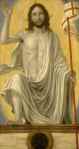
Ambrogio de Stefano Borgognone, 1510

Ambrogio de Stefano Borgognone, 1510

Pentecost 7
Mark 6:30-34m 53-56
Marian Free

In the name of Jesus, who has come, who is present with us now and who will return to take us to himself. Amen.

One of my enduring memories from a childhood visit to an art gallery in Cologne is of an entire room filled with bloody and vivid images of the crucifixion. As a ten year old I was fascinated and repulsed. At the same time, I had no idea why anyone, let alone so many artists would want to focus exclusively on this aspect of the Christian faith and why they would make them so appallingly realistic. Weren’t there other aspects of Jesus’ life that were worthy of representation, I wondered?

I am not an art historian, but I know that if we were to look at depictions of Jesus over the last two millennia, we would find a wide variety of themes and an equally wide variety of images – from the chubby child of the nativity to the tortured image of the cross. Every age has made its own interpretation of Jesus – artistic or otherwise – depending on the social and political climate of the time. Even the New Testament is not free from this sort of development. Each gospel represents Jesus in a slightly different way according to the needs and interpretations of the community for which they were written. The letters which succeeded those of Paul have changed the image of the church as the body, to the image of the cosmic Christ as the head of the body. By the time of the writing of Revelation, Jesus the Good Shepherd has become the Paschal Lamb. .

In the Middle Ages, Jesus the judge became Jesus the mother, and closer to our own time, the “social worker” Jesus of the late 1800s became the “apocalyptic, revolutionary Jesus” for much of the 1900s.

Artists are part of the society in which they find themselves and their images of Jesus reflect the mood of their society. Jesus is at times wild-eyed and fierce, at others gentle and effeminate. He is depicted both as ethereal and also as solid and muscular. He is presented as strong and as vulnerable.

The last century has seen an attempt both to enculturate Jesus in a variety of contemporary and national settings. So we can find images of Jesus in a Korean setting and representations of Jesus as black, Asian, Maori. More than one artist has painted Jesus as a woman. The crucified Jesus has been used to represent the oppressed as in the agonised Christ of South American origin which spoke to all those who were tortured and killed for choosing to stand with the poor. In more recent times, we have been exposed to controversial and challenging images such as the Piss Christ.

Other forms of artist expression also struggle to bring Jesus into our contemporary world – movies such as Jesus Christ Superstar, Godspell, The Last Temptation of Christ, all in different ways struggle to make Jesus real for the society of the time. Works of fiction such as the Narnia series and the Joshua books also try to tell the story in a way that will speak to a new generation. Today the new medium of the internet allows a wide variety of expression. If you type in “pictures of Christ” on You tube you can find everything from speed painting the crucifixion, through cartoons to comedy – images which are traditional and images which are contemporary and which range from the shocking to the sentimental.

Of course, all of us have a problem when we try to picture Jesus. During his lifetime, no artist captured his image and no writer described him. We have more information on the appearance of the apostle Paul than we do of Jesus.  Most of us, if we are honest have a mental picture of a bearded, long haired Caucasian man, probably about five-foot ten with attractive features. Depending on our preference or on the art to which we’ve been exposed Jesus is blonde with blue eyes or dark haired with brown eyes. In reality he was almost certainly a short, stocky, dark, hook-nosed Palestinian, with untidy hair and beard. We simply have no way of knowing.

I wonder then, if Jesus were to return today, how would we recognise him? What characteristics would we be looking for – gentleness or strength, conservatism or activism? Would we recognise him by his teaching or simply by his presence? Would he be identifiable by his concern for the outcast and for the despised among us? Would his presence among us be healing and comforting, or would it be radical, divisive and confronting? Are we expecting Jesus to appear all in white surrounded by light – obvious to all and sundry? Or are we prepared for him to simply come among us unannounced and indistinguishable from any other person whom we might know?

In today’s gospel, we have two scenes from the life of Jesus. At two different times and on two different sides of the lake – Jesus is recognised by the people. In the first instance, they are so keen to see him that they race ahead and reach his destination before him. In the second, as soon as he appears, people gather from everywhere. There is nowhere Jesus can go – in the cities, the villages and in the farms he is recognised by those who see him.
.
It seems self-evident to us that he would be instantly recognizable. Yet that was not the case, those in authority certainly were not convinced, and thought that the populace were deluded and foolish to be so taken in. They were so convinced that they knew what they were looking for, that they failed to see what was right in front of them. Worse still, they were so affronted by Jesus’ popularity that they plotted to destroy him.

We would be wise not to be complacent, but to be always on the lookout, ready and expectant for Jesus to appear among us. It would be sensible to be so conversant with the Jesus of scripture, his teaching and his life, that we would know him when we saw him. It would be judicious to develop and deep and real relationship with Jesus in the present that will inform and enlighten us in the future. We would be prudent to maintain an openness and receptiveness to God’s revelation, so that should Jesus appear we would be ready to greet him wherever and however he might come..

Are we, like those in today’s gospel, full of expectation and hope, going out to where Jesus will be, or are we, like the authorities, hanging back, convinced that we know all there is to know and waiting instead for Jesus to come to us?

The cost of discipleship

July 11, 2009

Pentecost 6
Mark 6:14-29
Marian Free

In the name of God who calls us to serve, regardless of the cost. Amen.

Though the account of the death of John the Baptist stands as a story on its own, when seen in context, it reads as if it is an interruption to Mark’s narrative. Mark has just described the sending out of the twelve disciples. The story of the Baptist’s death is introduced in relation to Herod’s hearing of what Jesus was doing. However verse thirty continues on from verse 13. The disciples return from their mission and report to Jesus about their experiences: “The apostles gathered around Jesus, and told him all that they had done and taught.” Mark fills in the time between the sending out of the disciples and their return with the gruesome story of Herod and the death of John the Baptist.

Herod who has heard what Jesus is doing is apparently struck by a guilty conscience. Could this miracle worker be Jesus is John the Baptist now raised from the dead? Though Mark reports that there are a number of explanations for Jesus’ power – he is Elijah returned, or simply a prophet – Mark returns to Herod who is obviously convinced that Jesus is John the Baptist whom he executed.

Mark interrupts his story about the disciples’ mission, because – to this point – he has made no mention of John’s death. John can only be raised if he has first died, so the author of Mark needs to record how John died. John has to have died, if he has now risen. Mark also uses this opportunity to introduce the anti-Herodian sentiment that existed among the Jews.

Herod’s family would make good content for a soap opera. Herod is one of Herod the Great’s ten children. Herodias is the granddaughter of Herod the Great. This means that Herodias is not only the wife first of one and then another son of the same father, she is also the niece to both of them. Her daughter, presumably from her first marriage, then marries a third of the brothers – Phillip (her great uncle). No wonder the Jews were affronted. Herodias has divorced a husband to marry his brother. This, to the Jews, is akin to committing adultery.  The ambitious behaviour of the women of this family was a further cause for offense. Not only does Herodias abandon her husband, but she apparently encourages her daughter (a princess, no less) to degrade herself by dancing before an all male company including her step-father. (Respectable women did not join men at a banquet, let alone dance for them.)

It is not surprising then, that John should have taken it on himself to call Herod and Herodias to account. Nor is it surprising that Herodias in particular should have taken affront. The couple had reason to feel insecure enough to want to silence John. When Herod divorced his first wife, she fled to her father Aretas IV of Nabatea. Nabatea bordered Herod’s territory and Herod was worried that Aretas might launch a revenge attack. The last thing he needed was a disturbance at home, whipped up by a troublesome prophet.

Herod and Herodias differed as to what should be done. According to Mark’s account, Herod was both attracted to and perplexed by John’s teaching, he wanted to avoid riots, but not to the extent of killing the Baptist. Herodias, perhaps worried that Herod would divorce her, in order to avoid the Nabatean attack, wanted the Baptist dead. She bides her time and then seizes her opportunity which comes when Herod holds a banquet for leading figures in his court and in the community. Perhaps she knows his weakness for a pretty face. In a move that would have been considered quite improper, she sends her daughter to dance for the men. Herod is so captivated that he offers an extravagant reward (probably not half his kingdom, but something extremely generous). The daughter appears not to have been fully let into her mother’s plan. She needs to seek her advice. Herodias is ready – she wants John’s head. To this request the daughter adds that John’s head be brought on a platter, a particularly gruesome detail in the context of a banquet.

Herod is caught. If he breaks his promise not only he will lose face but he faces the risk of incurring a curse and so, reluctantly, he complies with the request.

There are a number of details about Mark’s account which have been called into question its historicity. Compared with the Jewish historian Josephus, Mark has a number of inaccuracies – the place of death, the name of Herod’s brother, and the likelihood of a princess dancing at a banquet. In addition, the story has elements of folk-lore. It is reminiscent of Old Testament stories like that of Elijah and Jezebel, and also of Greco-Roman stories of love, revenge, rash oaths and women asking for what kings would rather not give in the context of royal banquets. While we can’t vouch for its historical accuracy, what we can say for certain is that Herod had the Baptist arrested and that Herod executed John.

Coming as it does after the account of the rejection of Jesus at Nazareth, Mark’s record of the Baptist’s death alerts the reader to the fact that should Jesus continue his current trajectory, he too risks causing the degree of offense which could lead to death. In fact there are a number of similarities between Jesus’ passion and that of Jesus’ death. The weak Herod is mirrored in the weak Pilate. Both are anxious to avoid a riot, both know that the accused do not deserve death and yet, they do not have the courage to stand by their convictions. The deaths of both John and Jesus are a public affair, and in both cases their disciples recover their bodies to give them a decent burial.

Throughout the ages, saints and martyrs have discovered that there is a cost to speaking the truth and that challenging unjust or repressive regimes can lead to imprisonment and even death. Those who have gained power by devious or irregular means do not take easily to criticism or confrontation and will try to eliminate any opposition. Despite the risks, prophets in every age have had the clarity of vision, the certainty of purpose and the courage of our convictions to identify injustice and to confront it, to discern moral laxity and to challenge it. You and I may or may not be called to put our lives on the line for what we believe. That does not mean we can afford to be complacent. We are called, in every circumstance to seek the will of God and to strive to fulfill it in the face of opposition from family and friends and the society around us. We pray that God will not bring us to the time of trial. Let us also pray, that should the occasion demand it, we will not shrink from speaking and living the truth, no matter what the cost might be.

To change or not to change?

July 4, 2009

Pentecost 5
Mark 6:1-13
Marian Free

In the name of God who shakes our certainties and challenges our smugness. Amen.

Try to imagine that one day you come to church and discover that one of the children who has grown up here and who has attended Sunday School and Youth Group has returned as an adult. You are excited to see her and even more excited when you discover that she has been asked to address the congregation. All your memories of her childhood days flood back. You remember how she played with the other children – perhaps even your own children. She was always so good – willing to lend a hand, considerate of the older members of the congregation, good with the children. Even her teenage years were calm and placid as she blossomed into a beautiful young woman.

You are surprised then, even a little shocked, when you finally see her. Gone are the tidy, appropriate clothes and the neat hair. She is scruffy – even a little wild – as if she has been living rough. In fact she appears quite different from the person you knew.  Nothing however, prepares you for what happens when she opens her mouth! Surely this isn’t the same person – the child who collectively you raised, who shared your values and embraced your faith! In her place is a provocative and challenging radical. She implies that you are hypocrites, that instead of keeping the commandments of God, you are keeping human traditions. The things she says – sell all your possessions, let the dead bury the dead, love your enemies, not everyone who says: “Lord, Lord will enter the kingdom of heaven!

In no uncertain terms she denigrates the practice of the church leaders as false piety and she makes outrageous claims about sinners – even prostitutes getting into heaven before you! She states that what it says in scripture applies to her.

As you squirm in your pews you might think: “How dare she? Has she forgotten who she is, where she is? What happened to all the good principles on which she was raised? Where did she learn such disrespect for those who taught her? You would be justified in feeling threatened and insulted. If you did, your reaction might be to distance yourself, to reassure yourself by making out that you can’t give possibly give any credence to what she might say. After all, she is only a car park attendant, the daughter of Mary – and now you remember – you were never really sure about the father.

If this wasn’t enough to restore your equilibrium, you might call up the rumours that you had heard, but had previously discounted. Apparently she doesn’t care who she associates with – she has meals with the most inappropriate people. What is worse, she appears to wander all around the countryside trying to build up a following by performing miracles to impress the simple-minded. (Now you think about it, she has performed no miracles here.)

If you were to build up a picture of her as someone who is quite disreputable, you would discover that what she had said had no power to distress you. You know who she is and where she comes from after all. What right has she to say such things? Why should anyone take notice of her? In this way you would reassure yourself that she was way out of line. She is far too scandalous for you to allow yourself to be upset by what she might say. You would be able to return to your comfortable existence, your world view could remain as it always was, your beliefs and practices could continue unchallenged and the ripples she caused disappear out of mind.

Jesus has become so domesticated that it is difficult to believe that he caused so much offense that his own people not only plotted to destroy him, but eventually succeeded. Those of us who grew up on the “gentle Jesus, meek and mild” can find it hard to believe that he was anything but a comforting presence. Why would anyone get upset by his teaching we might ask?

Yet, here in his own home town, he causes so much umbrage, that those attending the synagogue are reduced to insult and disparagement in order to avoid taking seriously anything he says. After all, they reassure themselves, isn’t he only a carpenter, the son of Mary – and weren’t we always suspicious about the circumstances of his birth? He lacks the respectability that would be expected in teacher, so his teaching can be ignored or disregarded. By questioning Jesus’ status in life, his listeners are able to distance themselves from his teaching. Someone of his reputation has no right to criticize them or to tell them how to behave! The problem is solved – the messenger is successfully discredited so the difficult teaching can be ignored.

Many of the religious people of Jesus’ time were comfortable with their way of life and their practice of the faith. They felt confident that they understood their scriptures and that knew what they needed to do and how they needed to behave in order to be right with God. They were, by and large, good and moral people. They did all the right things. They attended synagogue, observed the festivals, ate the right food and observed the Sabbath. They gave to the poor and kept themselves apart from those who might pollute or contaminate them – gentiles, tax-collectors, prostitutes. The problem was that they were pleased with themselves, they were self-satisfied and smug – they felt they had their salvation all sewn up.

Jesus upsets their comfortable view of the world. They expect him to praise them for their goodness, instead he accuses them of being nowhere near good enough. Their reliance on their own goodness has reduced their reliance on God. In fact, by acting as their own judge and jury, they have put themselves in God’s place! Who needs God to differentiate good and bad when they can do it for themselves?

We, with them, discover to our shock, that Jesus’ greatest condemnation was not of the sinner, but of those who believed they were righteous. He commended those who, knowing their faults, humbly threw themselves on the mercy of God and he criticized those who had become so self-assured that they had dispensed with the need for God.

When we think we have nothing left to learn, we forget that God is beyond the reach of our human understanding. When we think that we are already good enough, our very smugness isolates us from God. When we allow ourselves to become comfortable with God and of our place before God, we find we have allowed our beliefs and values to define who and what God is.

If we are unsettled or dismayed by what Jesus says, is it because what Jesus says cannot be right or because we are so confident in ourselves that we believe that we do not need to change?

Telling the story

June 29, 2009

Pentecost 4
(
Mark 5:21-43)
Marian Free

In the name of God whose story is our story. Amen.
During the week I attended the Public Affairs Committee of the National Church. The role of the committee is to consider the church’s response to public issues – climate change, nuclear weapons, the Northern Territory intervention and so on. Not small matters, but matters on which the church could have a voice.
At the beginning of the meeting the Archbishop of Melbourne, Phillip Freier addressed us. Among other things, he suggested that the church had lost its confidence in ourselves and in our story. In the face of declining numbers we have begun to look inward and have stopped relating to the world. He encouraged us to revisit or retell the narrative to rediscover the ways in which our story connects with the story of the world around us.
It is true that over the past fifty years or so that we have had a crisis of confidence. In the face of declining numbers and increasing criticism, we have tended to become less sure of ourselves, more conscious of our very obvious flaws and more self-deprecating. Our willingness to be open to the experience of others has sometimes meant that we have played down our own experience and the wealth of wisdom that we have to bring to the table. Our lack of sophistication in interpreting our story has sometimes meant that we have been unable to respond adequately to the charges laid against us, especially that of hypocrisy. There has been a tendency to be ashamed of where we have failed and a failure to be proud of where we have succeeded.
In order to fully engage with the world and to share our story, it is essential that we know our own narrative.
First of all, we need to know and understand the story of our faith as it is revealed in our scriptures. What do we really know about what they say and what they mean? How do we engage with the passage that are challenging and confronting? Are we in a position to explain such difficulties to others? Do we really understand what Jesus was about and can we share with others Jesus’ teachings and actions?
Secondly, it is important to know the history of the church of which we are a part. That includes being honest and accepting the good with the bad. Yes – we were involved in the Crusades and we cannot deny the Inquisition. Yes – the church is just as vulnerable as other institutions to sexual abuse and to abuse of power. Our past is not all good. It reflects the fact that our members are human and that adherents of any religion are not immune to the seductions of power and wealth. At the same time, let us not forget the selfless actions of thousands and thousands of faithful Christians who have built schools and hospitals for the poor, worked with lepers and aids victims, insisted on the abolition of slavery and stood with the poor and the outcast. There is much in our history – and our present – of which we can be justly proud. Being honest about our failings does not mean being silent about the contribution we have made and continue to make in the world around us. We must know our own story so that we can see how our story interacts with the story of our surrounding culture and what it is that we have contributed.
Further, it is important that we understand what our story means, that we are able to give meaning to our story. That is, we have to know and understand our theology. What does it mean for example, that Jesus ends the suffering of a woman and heals a small girl? We all know that first century miracles are not necessarily convincing for 21st century sceptics. On the other hand, a God who not only enters our experience, but pays attention to what is going on and responds to pleas for help may well speak to those who lives are empty of meaning. A God who feels the touch of a woman in the crowd and goes out of his way for a 12 year old girl, is a God who is as interested in the small things as well as the big. When we know our story and what it means, we will be able to make connections between our story and the stories of those around us.
Our central story, is not simply an historical event, but an event which continues to shape us and to shape the world around us. Jesus’ death and resurrection affirm that suffering is a part of human existence and reassure us that faith in God will give us strength to endure and hope that not only will the suffering end, but that we can look forward to a new and better future. Jesus’ life and death tells of a God intimately involved in the experiences of God’s people. A God who loved so much that he chose to share our life (a life which is always bound by birth and death, which includes joy and sorrow, health and sickness, loyalty and betrayal).

Our story begins with God’s engagement with the world and continues as we learn to tell the story anew for every generation.

For two thousand years the narrative has transformed lives, led to acts of selflessness and courage, inspired struggles for peace and justice and encouraged solidarity with the poor and the despised.
What happens in the next two thousand years depends on us and on how we tell the story.

A cushion on which to lay our heads

June 28, 2009

Pentecost 3 – 2009

Mark 4:35-41                                                                                                                                                                                        Marian Free

In the name of God who calms our fears and rides with us through the storms. Amen.

“On that day, when evening had come, he said to them, ‘Let us go across to the other side.’ And leaving the crowd behind, they took him with them in the boat, just as he was. Other boats were with him. A great gale arose, and the waves beat into the boat, so that the boat was already being swamped. But he was in the stern, asleep on the cushion; and they woke him up and said to him, ‘Teacher, do you not care that we are perishing?’ He woke up and rebuked the wind, and said to the sea, ‘Peace! Be still!’ Then the wind ceased, and there was a dead calm. He said to them, ‘Why are you afraid? Have you still no faith?’ And they were filled with great awe and said to one another, ‘Who then is this, that even the wind and the sea obey him?’”

Many of us will be familiar with today’s gospel from our Sunday School days. The story is one that can be told with great drama. Our teachers will have inspired us with wonder that Jesus so powerful that he was able to still the storm. This, in fact, is the message that Mark intends: “Who is this, that even the wind and the sea obey him?” Jesus’ influence over the natural elements of the world would have been evidence of his power in a first century world – convincing evidence of his divinity.

What amazes me though, is not that Jesus stills the waves or that he has control over the environment. (Why didn’t he stop the tsunami?) What amazes me is that in the midst of a great gale which causes his fishermen friends to be terrified, Jesus is asleep. The boat is already being swamped and yet Jesus is asleep on a cushion. (I love that detail!) Jesus’ confidence in God is such that he can sleep when everyone else is in fear of their lives. Apparently it hasn’t occurred to him to be worried. Jesus knows – as Paul does later – that whether he lives or dies, he is in God’s hands and that being in God’s hands is a pretty good place to be.

There are a great many things and situations which cause us to worry – our health, our employment or lack of it, our children (parents), the state of the economy – the list is endless. If Jesus can hand over all his cares to God, why can’t we?

The cushion is there in the boat, just waiting for us lay down our heads.

A Relational God

June 6, 2009

Trinity Sunday 2009

John 3:1-17                                                                                                                                                                  Marian Free

In the name of God, Creator, Redeemer and Sanctifier. Amen.

While it is not explicit, the second story of creation creates an picture of God and Adam as intimate friends walking and talking at the evening of the day. It is an image of relationship and of intimacy. It describes a God who is not removed from creation remote and distance in the heavenly realms but who instead draws near to God’s people in friendship and love. God’s choice is to be closely involved with those whom God created.

That this is true is demonstrated throughout the Old Testament. Even though God’s relationship with Adam is irrevocably damaged when Adam chooses to share God’s power, God continues to build close relationships with humankind. For example, God’s relationship with Abraham is, in places, that of a confidant. God speaks directly to Abraham and goes so far as to include him in decision making. God is equally close to Moses. On Mount Sinai, God speaks directly to him and God takes notice of what Moses has to say about how God should behave. The Old Testament is the story of God continually reaching out to God’s people, seeking to restore and to rebuild a relationship with them which is intimate and authentic and which includes them in the work of salvation.

This action of God comes to a climax when God enters human history as a human being. God as Jesus attempts once for all to rebuild the connection which God so desires. In Jesus God makes friends with us, as one of us. He eats and drinks with us, laughs and cries with us. Imperfect as we are he invites us to share with him in the task of salvation. Having shared our lives so intimately, God does not withdraw into heaven from where he can maintain the friendship at a distance. Instead God remains as a real presence in the world and in the lives of believers in the form of the Holy Spirit.

We see that intriguingly, not only does this relational God seek to connect intimately with humankind, but that God contains within himself the most marvelous relationship – Creator, Redeemer and Sanctifier, Father, Son and Holy Spirit – demonstrating in the very nature of God, the nature of life and faith. The relationship which God desires with us is revealed in the relationship which is found within God – a relationship which is so close and personal that there is no distinction between the members. So strong is the inter-relationship that for us to know one person is to know all three, for us to experience one person is to experience all three.

The nature of God has always been a complex relationship of equals. God did not divide into two at the point of the Incarnation and then into three on the day of Pentecost. In the beginning the creation was set in trail by God the creator, working hand in hand with the word of God or the wisdom of God as the spirit of God breathed the world into being. God has always been incarnate in creation, the divine has always inhabited humankind and been present in the created world. Throughout the Old Testament God’s spirit has enlivened, challenged, empowered and encouraged both the ordinary and extraordinary people of faith. The wisdom of God and the spirit of God are in evidence in a dynamic relationship with the God the creator and with God’s creation. Throughout history Father, Son and Spirit act as a unity to build and rebuild the people of God.

When we recognise the relational nature of God, we understand that to separate or divide the unity Godhead does violence not only to the nature of God, but also to the relationship of God with us and the relationship of God to the history of humankind. Each person of the Trinity represents each other person, they do not stand alone. Jesus is not separate from or distinct from the Father, nor is he separate or distinct from the Spirit. The Father is not separate from or distinct from the Son, nor is he separate or distinct from the Spirit. The Spirit is not separate from or distinct from the Father, nor is he separate or distinct from the Son. The nature of God is to be in relationship, and God that is not in relationship is not the God in whom we believe.

A relational God tells us about ourselves and the way in which we should live with one another and with all creation. A relational God helps us to see the inter-connectedness of all things and challenges us to live lives which recognise the impact that we have on one another and on the world around us. A relational God teaches us how to respect and value one another as equals and how to set each other free to reach our full potential. A relational God forces us to recognise the presence of the divine within.

The Trinity is not an abstract, academic construct designed to alienate or confuse, rather it is an expression of the God who from the very beginning sought to be intimately engaged with his creation and to be in a relationship of equals with those whom he created in his image. The Trinity reveals the nature of a relational God and at the same time reveals the nature of humanity as those in whom the presence of God is known and found. The Trinity is an exciting, living, energizing description of the God who continually seeks us out and restores us to a relationship with him.

God the Father, the Son and the Holy Spirit created us.                                                                                                       God the Father, the Son and the Holy Spirit redeemed us when we turned away.                                                     God the Father, the Son and the Holy Spirit fills us with the presence of God.                                                                    God the Trinity longs to be our intimate companion and friend.                                                                                           It remains for us to open our hearts and lives to the relational God who desires to be in relationship with us.

Free gift of love and life

May 2, 2009

Easter 4, 2009
John 10:11-18
Marian FreeSheep

In the name of God who gives his life in order that we might live. Amen.

John’s gospel is particularly dense. Each section contains multiple ideas and images many of which are interwoven throughout the gospel. This is true of this morning’s reading. At the beginning of the chapter, two images are introduced, that of the gate to the sheep fold and that of shepherd. The image of the gate is allegorized in verses 7-10 and here in verses 11-18, the image of the shepherd is elaborated. In its wider context, chapter 10 connects with the account of the healing of the blind man and leads into the report of the raising of Lazarus. The Pharisees don’t understand what Jesus is saying and so indicate that they are the ones who are blind. The life which the results from self-giving death of the shepherd is powerfully illustrated in the raising of Lazarus. Chapter 10 also provides the bridge between the two feasts which John uses to give a chronological context for the reflection on the shepherd – the feast of the Tabernacles, which is the reason why Jesus is in Jerusalem, and the feast of the Dedication. Interestingly, as Guilding has pointed out, the readings for the Sabbath nearest to the feast of Dedication relate to the theme of sheep and shepherds .

Throughout the Old Testament the image of shepherd is used, as an image for God. As in the 23rd Psalm God, the shepherd is one who cares for and protects the people of Israel. At the same time, the patriarchs were all described as shepherds and over time the expression shepherd became a figurative term for all leaders. More often, though, the term is used negatively as an image for the leaders of Israel who are derelict in their duty. In Ezekiel God denounces the rulers who have not cared for their flock and impious kings are labeled as wicked shepherds. (1 Kings 22:17; Jer 10:21, 23:1-2). Because of the carelessness of the shepherds, the sheep are scattered.

When Jesus uses the image of the shepherd he is using language familiar to his hearers – the shepherd leads and cares. In these verses shepherd is interpreted twice – 11-13 claim the willingness of a model shepherd to die for the sheep and 14-16 expand on the intimate knowledge the model shepherd has of the sheep which is an elaboration of an earlier verse. The final two verses refer to the love the Father has for the son and the authority which the son has over his own life.

While the shepherd image is not new, the willingness of the shepherd to die is unique to John’s gospel as is the expression “to lay down one’s life which is rare in secular Greek and in the OT the shepherd cares for (or does not care for the sheep) but doesn’t lay down his life. Elsewhere in the New Testament, the shepherd seeks out the lost sheep and Jesus’ compassion is elicited by the crowd who are like sheep without a shepherd, but it is only John who suggests that the shepherd will lay down his life for the sheep.

Not only does Jesus state that he, as the model shepherd chooses to lay down his life, he claims that he has the power over his life – he can lay it down and to take it up again. He will later reinforce this claim when he says that the ruler of this world has no power over him (14:30) and when Pilate claims to have the power to crucify him or release him, Jesus will inform Pilate that he has no power of him except what he have been given. Jesus is clear that the power or the choice to lay down his life belongs to him alone. Giving up his life is not something that is imposed on Jesus from without. It is not a demand that God makes of him or a matter of duty. Jesus chooses freely to give his for the life of those for whom he cares.

Love is the driving force behind this choice. Love of the Father for the Son and the Son for the Father and the love of both for the world. The command of verse 18 is the gift of love and of eternal life (12:50).

There are a multitude of themes running through these few verses – responsibility, knowledge, love, intimacy, authority, choice and the gift of self. In the larger context are the themes of bandits and wolves, the mistrust of the Pharisees, the union between the Father and the Son, and the life (in the present and for eternity) that Jesus gives.
.
One thing is very clear – the author of John’s gospel understands Jesus’ death to be both a choice and a gift. Jesus loves us so completely that he is prepared to lay down his life. We do not find here the idea of sacrifice or redemption. Jesus’ death is not something that God demands as some sort of payment for debt, rather it is a gift freely given, an act of service, an act of love. The gift liberates us and frees us to live both in the present and in the future, because it demands nothing of us. Just as the sheep do nothing to earn the loyalty and love of the shepherd, so we have done and can do nothing to deserve Jesus’ gift of himself to us.

In our economy of exchange this is such a radical notion that it is difficult to grasp – nothing is for nothing. Surely God wants something in return. But love that is not freely given is not love at all, and life that is constrained by demand, is not a life that is fully lived.

God who created us loves us though we do nothing to warrant that love and God will stop at nothing to free us to live the life that God intended for us. God knows that the power of love is far greater than the power of censure, that the power of freedom will always overcome the power of constraint, that the power of good will always defeat the power of evil, and that ultimately the power of life will overturn the power of death.

Jesus the good shepherd will continue to love us into being and continue to give all of himself in the hope that we will be liberated through that love to live life to the full, and so attain with him to that life that never ends.