Archive for the ‘Uncategorized’ Category

Jesus comes to us

April 25, 2009

Easter 3 2009

Luke 24:36b-48

Marian Free

In the name of God, whose forgiving love transforms our lives and forms us for mission. Amen.

I would like you to imagine that you are part of a coach tour to Egypt and the Middle East. The trip is for a fortnight and over that time you have become very close to those who are touring with you. Because you are thrown together for long periods of time you have come to know each other well. You know each other’s weaknesses and strengths. During the tour you have shared some difficult moments – like the time at the check point when the security forces thought that your tour group was trying to smuggle arms to the Palestinians, or the time when a rocket exploded near to your motel and you thought you would die. The shared experiences have brought you closer together and you are sure that when you return home you will continue to meet and your friendship will grow.

So close have you become to the group, that you do not think twice when one of them asks you to carry a souvenir back to Australia. She is staying in Singapore for a few days longer and wants room in her luggage for some shopping. When you reach Singapore, you are surprised that the sniffer dogs take an interest in your luggage and alarmed when heavily armed police approach you. You look around for the person who gave you the souvenir and find she is no where to be seen. At the same time, your new found friends, embarrassed by the turn of events and anxious not to be associated with you, are slowly melting into the crowds.

You are in serious trouble and alone. Alone you face the indignity of a luggage search and the worse indignity of a strip search. Alone you protest your innocence as you are led into custody. Alone you wait for a lawyer and a member of the Embassy to visit. You are frightened and confused, aware that your gullibility and trust has contributed to the situation and dismayed that friendship could be so shallow. Desolated and abandoned, your thoughts are filled with foreboding – will your holiday end in an ignominious death, for a crime of which you were as much a victim as a perpetrator?

Miracles do happen! Somehow you are brought from death to life as it were. Your so-called “friend” is known to polics and has been caught and has confessed to planting the drugs. You are free to go. What do you do? My guess is that the last thing you want to do is to seek out your former friends. They might be sorry for their behaviour, but you are probably still too hurt and bewildered to speak to them. I’d be surprised if you ever wanted to see them again – the value of their friendship is seriously diminished and no apology will make up for their betrayal. Right now you just want to get on with your life and put this awful experience behind you. You are not sure you will ever travel again and not at all sure that you will be able to trust anyone again.

At least that is how I imagine such a scenario. A normal human being would find the experience of facing death for drug trafficking so devastating, so demoralizing, that they would want to get as far away as possible from the person who planted the drugs, and as far away as they could from those who disassociated themselves from you.

Jesus is no ordinary person. He is even more intimate with the disciples than the imaginary you. He has spent up to three years with them. They have travelled together and eaten together. They have faced the criticism of the Pharisees, Chief Priests and scribes together. The disciples have seen Jesus happy, angry and sad. They have witnessed his healing power, heard his teaching and promised loyalty even to death. Yet, at Jesus’ moment of greatest need, all courage left them. Afraid of being caught up in Jesus’ strife and sharing the consequences of his arrest, the disciples fled. Apart from Peter who denies him, no one is present for the trial and only the women are present at the cross. During the worst hours of his life, Jesus is alone. He dies abandoned by his closest friends.

So what does Jesus do when he is brought from death to life? Amazingly, he doesn’t skulk away to lick his wounds. Nor does he ascend immediately to heaven leaving his friends to live with their shame, embarrassment and disgrace. To our surprise, Jesus behaves as if nothing has happened. The first thing that he does is to seek out his friends and to offer them peace. He doesn’t make them sweat it out, but simply appears among them to share the good news! Despite the disciple’s obvious betrayal and desertion, Jesus gives no indication of recrimination or reproach. He doesn’t demand that they explain themselves or beg for forgiveness, nor does he withhold his friendship or trust. What is more, despite all that they have done, he entrusts them with the message of the resurrection!

How extraordinary! Not only do the disciples not have to face the consequences of their actions, but Jesus continues to treat them as his best friends and successors! No wonder that they are transformed. I can think of no better way to assure his friends that there were no hard feelings and that Jesus continued to have faith in them. No wonder the disciples change from a group of frightened, humiliated people into a force for change. Jesus has seen past their betrayal, their cowardice and their disarray, to their goodness and their potential. Jesus demonstrates confidence in them when they have lost all confidence in themselves.

No wonder they found the audacity and energy to proclaim the Christ. They have experienced for themselves the power of God’s love and goodness. They can assure others of God’s ability to overlook their faults, because they have experienced God’s forgiveness in their lives. They can proclaim the resurrection with confidence because, not only have they seen the risen Lord, they too have been brought from death to life.

In our arrogance and self-centredness, we are tend to think that our salvation depends on us, on what we do, that we have to present ourselves perfect before God. The mystery of the gospel is that we do nothing and God does everything. God in Jesus comes to us – forgiving, restoring, healing, loving and empowering. God, in Jesus, does away with all our transgressions. God, in Jesus, comes to us when we have betrayed and abandoned him and offers us a future. God, in Jesus, lives to show that we are truly forgiven and restored.

When we know God’s love it is impossible not to share it. When we understand that we are forgiven, it is difficult not to forgive others. When we understand God’s confidence in us, we are empowered to act.

Loved, forgiven, restored and free, we can take the gospel to the world.

A question of doubt

April 18, 2009

Easter 2
John 20:19-30
Marian Free

In the name of God – never changing, always new. Amen

Given the extraordinary nature of the event, there is remarkable congruity in the gospels when it comes to accounts of the resurrection. All four report that the women were first to the tomb, all four include an appearance to the gathered disciples and all include a commission to spread the gospel to the entire world. As you might expect there are variations. Mary Magdalene is a consistent figure among the women who go to the tomb, but in John’s gospel she is alone. The appearance to the gathered disciples is associated with Jesus’ ascension in Matthew and Acts. Jesus appears to the disciples in on a mountain in Galilee.  In Mark, Luke and John the disciples are gathered in a room. Mark and Matthew specifically mention that all 11 disciples are present.

Interestingly, in all four accounts of the resurrection there is also an element of doubt – at the tomb, while the disciples are walking together and when the disciples are gathered.  In Mark, the disciples are upbraided by Jesus for their,  “lack of faith and stubbornness because they did not believe in those who saw him”. In Matthew the gathered disciples worship Jesus, but “some doubted”. The Jesus of Luke’s gospel says: “Why are you frightened and why do doubts arise in your hearts?” In Luke and John, Jesus invites all the disciples to touch and see to allay their doubt.

It is only in John’s gospel that Thomas is singled out as the disciple who doubts the resurrection. According to John, only 10 of the disciples are present when Jesus appears behind locked doors. We are not told why Thomas is not there, just that he adamantly refuses to believe the other disciples and will only be convinced when he, like them has an opportunity to see and to touch. When doubt is a common reaction, why is Thomas separated for mention here?

It has long been recognised that Gospel of John is interrupted in a number of places by editorial additions which do not make sense in their context. For example, in chapter when the official asks Jesus to heal his son,  Jesus bursts out “Unless you people see signs and wonders, you refuse to believe!” The modern reader can see no reason for Jesus’ outburst – the official was not asking for a sign and his request indicates that he does believe. We might also notice that Jesus’ response addresses “people”, when the official is only one. The interruption does not seem to fit the story.

Fortna argues that the original gospel was compiled by one person and later after the rift between the Christians and the Jews, another person added a commentary . The original gospel, written when the Christians were still attached to the synagogue had become obsolete. Unlike us, the people  for whom the changes were added would have known the original gospel and would have understood what the commentator was trying to do. Centuries later, we only notice the interruptions and the contradictions.

In the case of today’s gospel, the story of Thomas’ is appended to the account of Jesus’ appearance to the disciples who in this instance do not appear to have any doubt. All the doubt is concentrated in the figure of Thomas who appears to illustrate a theme running throughout this chapter – the relationship between seeing and believing. At the beginning of the chapter the beloved disciple believes when he looks into the empty tomb in contrast with Peter and the other disciples – notably Thomas -who wait to see Jesus before they believe.

A couple of points support the view that the commentator has elaborated on the original story. In the first instance v 18 begins, “when it was evening on the first day of the week.” We already know that it is the first day of the week – that is how the chapter began. The repetition is unnecessary but may prepare for Jesus’ second appearance – to Thomas – which occurs a week later, presumably on the first day of the week.  Second, and more compelling, the author does not seem to consider it odd that the ten are not required to believe without seeing.  Jesus appears to them and shows them his hands and side. The requirement to believe without seeing is made only of Thomas.

Scholars such as Fortna do not take our texts apart in order to confront us or to challenge our faith. Just the opposite, they are seeking to make sense of the gospels, to understand why they were written and how they were heard. When flow of the gospel doesn’t seem smooth, or when there are obvious contradictions, repetitions or omissions, scholars try to explain them. It is not their intention to shock us, but rather to help us to come to a deeper understanding of our faith.

In this instance, we are better placed when we understand that Thomas is used by the commentator to make a point and that in John’s gospel Thomas’s doubt encapsulates the doubt expressed by all the disciples in the other gospels. It may helpful to some to understand that the contrast between believing without seeing belongs to John’s gospel alone, that doubt is not an unusual reaction to such an unusual situation.

The reaction to Jesus’ resurrection was mixed – there was joy and fear, worship and doubt, belief and disbelief – sometimes a mixture of all.  Our faith journeys do not always run smooth. There may be times of absolute clarity and times of questioning, moments of certainty and moments of confusion. It is comforting to know that in this we are not alone, that the experience of the first disciples was much the same, even though Jesus was there with them.

Unlike the first disciples, we are convinced that Jesus has risen. Without seeing, we have come to believe. With certainty and faith comes responsibility. As the risen Christ commissioned the disciples to bear witness to him, so we too are entrusted with a mission to share the message of Jesus with the world. In order to do that, we must first try to understand the stories as they have come down to us and, having understood, we like the commentator in John, must find new ways to share the gospel in our time and place.

Our questions must be put to good purpose and the questions and doubts of those around us must be treated with respect. Together we must seek anew the truth of the gospel and proclaim the risen Christ.

Maundy Thursday

April 14, 2009

Maundy Thursday 2009
John 13
Marian Free

In the name of God, who chose to share our brokenness and pain. Amen.

There is a short movie called “Coach Trip to Calvary”. It is the story of a tour led by a woman who has established a small tourist business in Israel. The passengers include a man in his twenties, a young woman and an older Russian woman who speaks no English. The bus driver is a Palestinian.

As you might expect, the coach trip covers significant sites from the gospel story. What is different is that as the tour leader tells the story, we watch as the passengers take on the roles of the characters. So the young woman becomes the woman who anoints Jesus’ feet and so on. It is quite disconcerting and also compelling. One minute the tour guide is telling a story and the next, the passengers ARE the story.

Perhaps the most confronting moment in the movie is the depiction of the “Last Supper”. Our tourists are sitting down to eat in an ordinary café when suddenly the Palestinian bus driver takes the bread from the table and violently rips it apart saying; “This is my body”. His voice is so full of anger, that we want to look away. This is not the Jesus we know.

In that instance one gets a new insight into the story, a sense of Jesus’ distress and perhaps frustration. Nothing less than his sacrifice will do, but that doesn’t mean that he is looking forward to the experience, or that he is at all resigned to the betrayal, abandonment, torture and pain that lie in front of him. In fact, he might wish it all to end another way.

We are reminded in this depiction of the Last Supper that the events we celebrate this weekend are not pretty. A member of Jesus’ inner circle sells him out. His closest friends fall asleep when he most needs their support. When the soldiers arrive they disappear into the night – leaving Jesus to face his tormenters alone and that is the more palatable part of the story. Alone and friendless, Jesus will be falsely accused, mocked and flogged. And when that is done he will be subjected to what has been described as the cruelest form of death.

We hear the words so often, that “This is my body” has lost the power to confront us, to challenge us. We have domesticated the brokenness of Jesus body into a sacrament that speaks of wholeness. We celebrate the institution of our central act of worship remembering a common meal not a night of trauma and despair.

“This is my body”  “This is my body” – tonight I will be torn from you and my life will be torn from me. My body which holds my life will be scourged and broken. From now on you will know me in my brokenness as well as in my strength. Remember not only what I have taught you, but also how costly that teaching was. Remember not only my triumphs but my moments of deepest despair. Remember me.”

Remember me, in the brokenness of the world, remember me in the brokenness of your lives, remember me in your aloneness – remember that I know and I am with you.

On this most solemn of nights, as we prepare for the most solemn of days, we remember the cost of our freedom, the presence of Christ in our suffering, and the presence of Christ in the sacrament which we share.

This is my body. Do this in remembrance of me.

Magdalene and Thomas – Easter 2009

April 11, 2009

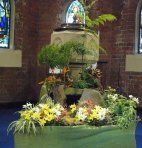
Easter garden - St Augustine's

Easter garden - St Augustine's

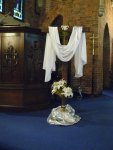
Easter - St Augustine's

Easter - St Augustine's

Easter Day 2009
John 20:1-18

Marian Free

In the name of God, as close as breath and as distant as a star. Amen.

One of the most memorable pictures of Princess Diana is that of her visiting and  touching AIDS patients. At a time when AIDS misunderstood and feared and its sufferers despised and isolated, Princess Di had both the courage to believe that AIDS was not something to be feared and she had the compassion to realize that those who had been shunned by society were in need of the touch of and the reassurance that they were valued as human beings.

Touch has always been a very confronting thing. Its intimacy not only indicates knowledge and acceptance but risks contagion from the one touched. Centuries before Diana, St Francis shocked his contemporaries by embracing a leper – equally despised by society and equally feared as presenting a risk of infection. Mother Teresa and her nuns similarly faced censure and misunderstanding when they offered touch and comfort to those rejected by their own society.

The fact that Francis’ act is remembered centuries later and that Diana’s action led to media attention around the world is evidence that in our society touch can be considered both daring and dangerous. Touch carries with it the risk not only of contamination, but also the danger of being made vulnerable in the sense of exposing oneself to another. Touch implies intimacy and knowledge and can therefore be both welcome and unwelcome. Touch can be violent and it can be gentle, it can be affectionate or demeaning, life-giving or life-destroying. Touch can be used to draw someone near or to push them away.

In our generation, touch has become a matter of such controversy and mistrust that it has had to be legislated. With good reason, boundaries have been set on how and when we touch others, especially the vulnerable.

Touch is important in Jesus’ story. Jesus touches and is touched in order to facilitate healing. He himself is touched in the most personal and intimate of ways. He is held by his parents and by Simeon, he is anointed by Mary and by an unknown woman, he is touched by the guards who flog him and the soldiers who crucify him. He is held by Joseph of Arimethea and others who took him from the cross and laid him in the tomb. Even after his resurrection, touch remains an important factor in the story. According to Matthew, the disciples grasp his feet when they see him. Next week we will hear once again that Thomas was invited to put his finger in Jesus’ wounds. Jesus is certainly not afraid to be touched by those around him –  before or after the resurrection.

This makes his statement to Mary Magdalene today all the more confusing: “Do not hold on to me” “Do not touch me.” Why, when Thomas is specifically invited to touch, is Mary specifically asked to refrain? Is it that Mary wants to hold him to herself rather than free him to do what must be done? Is it that she hasn’t grasped that while he is really alive, he has also really died and cannot stay long on this earth? Does Jesus have more compassion for Thomas’s weakness than understanding for Mary’s strength?

Of course we do not know the answers to questions such as these, but as I struggled with these conflicting stories of touch post-resurrection, it seemed to me that they illustrate something of the paradox that is Jesus. He is both God and human, both present and absent, he truly died and yet we know him to be live. He is completely known and yet utterly unknowable. He is as close as a breath and yet as distant as a star.

There is a tension then between the closeness and intimacy of our relationship with Jesus and our knowledge that Jesus is God and therefore beyond the reach of human understanding. It is important for us to understand and maintain that tension if we are not to bring Jesus down to our level and to deprive him of his Godliness. We have always to be careful lest our intimacy lead to familiarity and familiarity to a casualness which would strip the relationship of its meaning.

This tension is revealed in the different stories of Thomas and Mary. Thomas lacks the intimacy of Mary and needs the reassurance of the closeness of Jesus. Mary knows what it is to be close to Jesus and perhaps needs to understand that closeness needs to be tempered by a certain amount of detachment, a recognition that Jesus as God cannot be contained and limited, but must be set free. So Jesus comforts Thomas and challenges Mary.

We who know the risen Lord must also live with the tension with the paradox, that Jesus who is very present to us is always just beyond our grasp. We are reminded that while we can have a personal relationship with Jesus, we do ourselves, and him, a disservice if we endeavour to hold him too close and to define the relationship on our own terms. We can come know Jesus through his teaching and through our experience of him, but ultimately we have to accept that he is ultimately unknowable. Jesus is ours to know, but not ours to hold.

That Jesus is risen and alive today gives each one of us the possibility of entering into relationship with him. Our knowledge of Jesus is not based on historical recollection, but on our own present association with the risen Christ. We are not limited by stories of the past, but know Jesus through our own present experience of him.

There will be times in our lives when, like Thomas, we need and are given the comfort of Jesus’ presence and times when, like Mary we become so comfortable that we will need to be challenged to let go. Somewhere in the middle we will find the balance – one that is not made so complacent by Jesus’ presence that his divinity is obscured, and one that does not so over emphasise his divinity such that he is never near.

The risen Christ is with us now. Let us not make him so familiar that we reduce him to one of us, nor so remote that we have no relationship with him at all.

A reflection for Palm Sunday

April 4, 2009

Palm Sunday 2009

Mark 15:

Marian Free

In the name of God who calls us to give God our all. Amen.

D. H. Lawrence wrote a poem Phoenix. about the mythical bird of the same name.

Are you willing to be sponged out, erased, cancelled,

made nothing?

Are you willing to be made nothing?

dipped into oblivion?

If not, you will never really change.

The phoenix renews her youth

only when she is burnt, burnt alive,

burnt down to hot and flocculent ash.

Then the small stirring of a new small bub

in the nest with strands of down like floating ash

shows that she is renewing her youth like the eagle,

Immortal bird. Are you willing to be sponged out, erased, cancelled, made nothing?

Are you, am I willing to identify so closely with God that we would give up everything that separates us from God? Are you, am I willing to give ourselves so fully that our individuality and our humanity become absorbed into God’s divinity? Are you, am I prepared to risk everything – our hopes and aspirations, our possessions and our talents, even our lives, confident that God will give it back many times over? Are we prepared to be sponged out, so that we might rise renewed and indestructible?

Our journey of faith is a journey into God. We are here so that God can be formed in us and so that we can be formed into God. We are called to daily die to ourselves so that we can live to God. We are asked to become nothing so that in and through God we can become something. During Holy Week and Easter we are challenged to walk with Jesus to the cross, to ask ourselves once more whether we have the courage and the faith to go the distance, to consider whether, like Jesus we can submit ourselves completely to the will of God, no matter where that might lead, and whether we have the confidence to let go of everything believing that God will restore it all to us and more.

Are you willing to be sponged out, erased, cancelled,

made nothing?

It is only when we have nothing more to lose, we discover that we have lost nothing and gained everything. It is only when we are willing to become nothing. we discover that God has already given us far more than we could ever need.

Losing one’s life

March 28, 2009

Lent 5
John 12:20-33
Marian Free

In the name of God who calls us to place our trust in God and God alone. Amen.

“You can’t break me because you didn’t make me. I will live neither in their cell nor in my own heart only in my mind and in my spirit. I live for nothing, I need nothing – not tomorrow, not freedom, not justice. In the end, even the prison will vanish.”

Some of you may be familiar with the story of Ruben “Hurricane” Carter a boxer, who was imprisoned for life for murders which he did not commit. I know only the movie version of the story which may have taken some licence with the facts. Accurate or not the movie version has something to teach us.

Ruben’s story begins when he is only 11 years old. He is sent to detention for attacking a police officer. A serious crime we would agree, but what we know and the court does not, is that the young Ruben’s actions were taken in the context of protecting a younger child from the advances of a sexual predator.  After a time Ruben runs away from the detention centre and joins the army.

On returning home from a tour of duty, Ruben finds that he has not escaped his past. The police officer whom he attacked arrests him and makes him serve out his time in jail. When he is finally released, Ruben makes a career out of boxing and is poised to become a world champion when a number of people are gunned down in a bar. Ruben’s nemesis, the pedophile policeman arrests him and a young man who was driving the car. Despite substantial evidence that Ruben and his friend are innocent, the state manages to have them declared guilty and jailed for three life terms.

Another stint in jail is more than Ruben can bear. His past experiences mean that being reduced to a number, de-humanised and regimented is something that for him has become impossible to submit to. So much so, that he endures 30 days in solitude rather than wear the prison uniform and on release would rather endure 30 more days than give up his now soiled and fetid suit for the stripped pyjamas. Thankfully a compromise is reached and he is able to shower and change.

Ruben has two coping strategies. The first is to maintain a sense of self – not wear the prison uniform. The second is to detach himself from the horrendous reality of the situation in which he finds himself. He decides that his life, his attitude, his sense of worth will not be determined by his external circumstances, but by his internal resources. The fact of his imprisonment, will not determine whether he is happy or sad, content or dissatisfied, imprisoned or free.

When Ruben makes the decision to live for nothing, he sets himself free.

There is a tremendous liberation in realizing that we have it within ourselves to be happy or content. We do not need to be defined by the situations in which we find ourselves or by our education, our income or talent. We do not need to be imprisoned by false hopes or by the expectations of others and we do not need to be bound by grief and disappointment that life has not turned out the way we would like it to. Letting go of our attachment to the standards and values of this world sets us free from striving, from anxiety and despair.

This is the freedom faith in Jesus offers – freedom from the limitations of earthly life, freedom from the demands and expectations which others place upon us, freedom from the striving to achieve and freedom from the need to compete. When Jesus says:  “Those who love their life lose it, and those who hate their life in this world will keep it for eternal life,” this is what he means – giving up a reliance on the things of this world to determine our happiness and to define who and what we are. He is saying that being bound to and by the expectations of this life, may in fact deny us the possibility of eternal life. On the other hand, letting go of the values and standards of the world opens up the possibility of a life that endures forever.

Jesus is not suggesting that to be a disciple, we must actively seek death, or that we must all become like the aesthetics and reject the good things of life. “Hating our life” does not mean hating the life that God gave us, far from it. “Hating our life” means being able to sit loosely with it and not holding on to those things which do not last forever. It means understanding that this life is finite and that all that we value in this world will one day come to an end.

In the light of this reality, Jesus is encouraging us to get our priorities straight, to work out what in our lives has eternal value and what has not, to consider whether we measure our happiness or success in finite, worldly terms or whether our happiness resides deep within ourselves and is able to transcend time and place. We are challenged to seek the lasting wealth of peace, joy and happiness instead of status, wealth, honour or power which will not last forever. Instead of striving for external signs of success and identity, we are urged to build up our inner lives such that the worst life has to throw at us, will not have the power to destroy.

Ruben Carter was able to survive his incarceration, the loss of his career, his marriage and his status because he relied on his inner strength rather than on his external circumstances. Denied freedom by the world, he found freedom within himself.

If we rely on this world alone to meet all our needs, there may come a time when we find it wanting. If our identity or self of self is determined by where we fit in this world, there may come a time when there is nothing to show. If  however, we are liberated from the standards and ideals of the world, we are free to live as if life eternal were ours already.

“Those who love their life lose it, and those who hate their life in this world will keep it for eternal life.” By losing this life, we are only losing those things which will not last, in contrast we gain those things which will endure forever.

God so loved the world

March 21, 2009

Lent 4

John 3:13-22

Marian Free

In the name of God who offers life in him and with him for all eternity. Amen.

Sometimes, when I am driving, I catch the Book Reading on the ABC. It is just as frustrating to join the programme mid way as it is to reach the destination before the programme has finished. Not knowing the beginning leaves one wondering why the characters behave in a particular way, leaving before the conclusion creates lots of loose ends and unanswered questions. So it is with today’s gospel. While most of us know John 3:16 off by heart, the passage we have been given to read this morning seems to require a context. Where does this section belong in the story? How do the different components fit in to the gospel as a whole? Where is the author taking the discussion?

I am sure that most of you are well aware that the Gospel of John is quite distinct from the other three. Most notably John includes material that is found no where else – for example, the changing of water into wine, the discussion with the woman at the well and the raising of Lazarus. At the same time much that the Synoptic writers include is excluded – for example the parables, exorcisms, the institution of the last supper and more. John’s gospel is less concerned with historical fact and more concerned with theological interpretation. Written for contemporary readers, it only includes what it necessary to bring them to believe in Jesus. For the community from which the gospel emerged, it is the relationship with Jesus which is paramount. That means that for them, it is the encounter with Jesus in the present which is important NOT the words and actions of the historical Jesus limited as they are by time and place. The writer is concerned to present the gospel in such a way that those who have never met Jesus, might never-the-less be brought into a life changing relationship with Jesus – the Son of God.

Given this intention, it is not surprising that one of the techniques used to build this relationship is to present intense dialogues between Jesus and others – the woman at the well, Mary and Martha, Thomas and others. Often an initial misunderstanding of what Jesus has said provides an opportunity to elaborate on the topic, sometimes with the result that the conversation leads to understanding. The immediate context of this morning’s gospel is Nicodemus’ discussion with Jesus. Nicodemus affirms that Jesus has come from God to which Jesus replies that no one can have that understanding without having been born anew. This confounds Nicodemus as it is intended to. How can one be born again? He fails to see that Jesus means that he must be born of God, as Jesus is. At the same time, Jesus means to disconcert, to open Nicodemus to the revelation of the spirit. Jesus concludes that if Nicodemus cannot understand what is before his very eyes, that he will be unlikely to understand that Jesus, who has descended from heaven is the revealer of God and of heavenly things.

This revelation will take place when the Son of man is lifted up. Using a word which can be interpreted in two ways, the author indicates that it is on the cross that Jesus is lifted up, or exalted. He finds a precursor to this positive view of the cross, in the report of the bronze serpent of the exodus.

Jesus is lifted up (that is crucified) to demonstrate God’s love for the whole world God loves the world so much that he gave Jesus – in the Incarnation and he gave Jesus to die, in order that all who believed in this revelation could have eternal life. That is that they would understand that Jesus was the personification of God and having believed would share with Jesus in the divine life that he shares with God. By believing in Jesus, disciples are united to him and thereby become participants with him in the infinite life that he shares with God and the Holy Spirit. This is the life that Jesus had with God from the beginning and will have to the end. As God cannot die, so this life which Jesus gives is so powerful that it will triumph over death. The life that the believer shares with Jesus is eternal life. God’s gift of Jesus is the gift of God’s love which extends to the whole world.

God’s intention is not to condemn the world, but to save it. This intention does not mean that the world is saved, rather that the possibility exists for it to be saved. The choice to believe or not to believe is not imposed, but belongs to the individual. However, though the offer of eternal life seems too good to be true, there are those who refuse the gift as must be clear to the readers of the gospel. Those who do not believe are those who are unwilling to allow their true selves to be exposed to the scrutiny of God’s love and goodness. In John’s words, they choose darkness over light so that who they are will not be revealed. God does not judge them – they have already judged themselves. Because God has not judged them, the door remains open for them to enter into a relationship with Jesus.

It all depends on accepting God’s love, believing that that love extends to us in all our weakness, understanding that a relationship with Jesus is a relationship with God and that that relationship creates a union with God such that we share in the infinite, eternal life of God. For God so loved the world – the whole world not just part of it – that he gave his only Son – sent him into the world as a revelation of himself and allowed him to die – so that everyone who believes in him may not perish but may have eternal life – give up their old life so that they might share in the life of heaven that has no beginning and no end. In order to participate in that life, a person has to believe that Jesus is the revelation of God, to reorder one’s way of thinking (be born anew), to open one’s life to the brightness of God’s gaze and to enter into a lasting relationship with Jesus which leads to the indwelling of the Holy Spirit and life that never ends.

To resist God’s love is to put our lives in peril, now and for eternity.

Jesus in the temple

March 14, 2009

Lent 3 2009
John 2:13-22
Marian Free

In the name of God who, in Jesus, overturned all our expectations. Amen.

Jesus might just as well have said: “I have come to overturn all your expectations.” He was so different from what anyone expected, his teaching so radical and his death so undignified, so ungodly, that it is no surprise at all that people found him disturbing and unsettling. Here, at the start of John’s gospel he shows his true colours and demonstrates that he is not going to conform to the accepted norm. From the start, he demonstrates that he will be unable to tolerate the trivializing of faith, the desecration of the temple and the misuse of the law. All of this is made obvious in the incident in the temple. Incensed by what he sees as a blatant disregard for the holiness of the space, Jesus fashions a whip and uses it to drive the animals and the money-changers out of the temple thereby creating mayhem, inviting the disapproval of those in authority and causing confusion among the faithful.

This version of events is very different from the other gospel writers who place Jesus’ actions in the temple much later in their story. According to the Synoptic writers, the incident in the temple occurs towards the end of the story after Jesus’ triumphant entry into Jerusalem. (His only visit compared with the three he makes in John.) Their account is much less dramatic. Matthew, Mark and Luke do not mention the larger animals – the oxen and the sheep and Jesus does not go to the trouble of fashioning a whip. Jesus quotes Jeremiah: “You have made my Father’s house a den of thieves” whereas, John’s Jesus accuses them of making his Father’s house a market place” (merchants will not be found in temple on the day of the Lord according to Zechariah).

It is only in John that the reference to destroying and rebuilding the temple occurs in connection with the driving out of the money-changers and the salesmen.

Despite the difference, there is considerable consistency across all four gospel accounts. This includes Jesus’ indignation, the overthrowing of the tables of the money changers and driving the animals out of the temple. Jesus’ action must be seen against a background in which there is increasing dissatisfaction with temple worship and suspicion of the priests. Not that this is new. In the writings of the prophets and in the Psalms there are protests against the profaning of the temple and the abuses of Levitical worship which will lead to the destruction of the temple.

At the time of Jesus, the concern about the temple and temple has become so strong that groups such as the writers of the Dead Sea Scrolls have completely dissociated themselves from the Temple and Temple worship believing it to be too corrupt to be of any use to their relationship with God. For people such as those at Qumran their removal from Jerusalem was in part a protest against the abuses that they observed and also an attempt to create the purity of life and worship which they felt was missing in Jerusalem. They focused on a future heavenly temple created by God and it was for this temple that they were preparing themselves. For them the Temple in Jerusalem had become an anathema.

We can see then that Jesus’ anger was not formed in a vacuum, but against a background of discontent and a desire for a purity of worship, that represented faithful hearts turned towards God rather than cynical adherents hoping that sacrifices and other such practices would encourage God to look favourably towards them.

In some ways, Jesus was a man of his times, but his anger in the temple is also perfectly consistent with his charges of hypocrisy against the Pharisees, chief priests and scribes. Just as Jesus sees through the offering of beasts for sacrifice to the market forces beneath, so too Jesus sees through the Pharisees outward displays of piety to their shallow hearts below. Like the prophets, Jesus challenges the believers of his time, to rethink their relationship with God, to examine their self-deception, to reconsider the connection between their behaviour and their true attitude to God and to examine whether what they do reflects their desire for a relationship with God or a desire to be seen in a good light by their peers.

The gospels present a picture of a religious situation in which self-satisfaction has taken the place of self-examination, in which adherence to a system of laws has replaced a relationship with the living God, in which there is a certain smugness and complacency about one’s position before God, instead of an attitude of humility. Jesus wants to cut through this outward show to bring people back into a relationship with God which is based on a realistic view of sinfulness and a deep understanding of one’s dependence on God’s goodness and mercy. He is encouraging honesty and sincerity rather than self-deception and pretence.

In the light of today’s gospel, it is interesting to reflect on what Jesus might see were he to come to our churches today. Would he be critical that our concern for survival eclipses our concern for the gospel? Would he wonder that whether our focus is on our individual piety rather than on the needs of those around us? Would we feel the sting of the whip and feel the lash of his tongue because the state of our hearts belies our outward appearance?

The gospels record the life of Jesus, but they do so to inform and challenge us, to confront us with our own humanity and to force us to question whether we are really true to the gospel. How would Jesus respond to our practice of the faith he taught? How do we compare to the Pharisees and scribes of his time?

These are questions worth asking from time to time lest we find ourselves guilty of the same double-standards and complacency.

Let us not hide behind false piety, empty service or good works. Let it not be said that we show style not substance, but that, having a true sense of who we are and a true understanding of the gospel, we seek to build a relationship with God that is open and sincere with no false piety and no pretensions to be anything but who we really are.

Taking up our cross – Lent 2

March 7, 2009

Lent 2
Mark 1:31-38
Marian Free

In the name of God who, in Jesus, took all our burdens on himself. Amen.

Imagine the unlikely scene of a first century advertising agent speaking with a prospective client.

“Listen, I’m telling you,
it’ll never catch on!
I’m the guy with the advertising agency,
you’re the bloke with the boat, right?
You want a motif, a logo, a symbol for your set up,
and you came to me
with this crazy idea;
listen, you said your set up stands for
life, liberty, truth, love, joy, peace, hope,
all the big stuff;
well then, you’ll have to have a symbol which
a lady will wear at her wrist or her throat,
or a gent will attach to the lapel of his coat;
what d’you meant: ‘What’s a lapel?’
I mean, what set up standing for life
is going to expect its members to wear a badge
with something totally inappropriate on it,
like a, er, a guillotine,
or a gas chamber,
or an electric chair,
or a gallows?
You gotta have a symbol that’ll catch on,
a dove, an eagle,
spirit of life and freedom,
right?
Yeh, well, if that’s how you feel.

Here, George,
I just had this chap come in,
belongs to this set up,
you know, they stand for all the big ideals,
life, liberty, love, stuff like that,
and he had this idea for a logo:
a cross!
Yeh – a cross!
Your actual means of execution.
Yeh – right!
I thought what sorta lady is gonna wear a cross round
her neck!
That’s right, exactly what I said:
it’ll never catch on,
never in a thousand years!”

It is interesting that Christians have taken the sign of their greatest embarrassment and shame, the source of one of the most excruciating deaths humankind has perpetrated, and made it the most recognizable symbol of their faith – the cross. This is because the cross represents for us, not defeat, but victory. In the cross we find the source of our salvation – Jesus’ dying and rising for us. The cross for Christians is both the sign of Jesus’ total self-giving and the sign of his victory over death. The cross is empty. Jesus has risen. For us, then, the cross is a symbol of life not death, of what God gives to us, not what God demands of us.

So when Jesus says: “If any want to become my followers, let them deny themselves and take up their cross and follow me”, it is in the context that the cross is the way to life. Jesus is not insisting that his followers seek out suffering, nor is he asking them to resign themselves to the pain and loss which might come their way. He is simply encouraging them to follow his example – to actively engage in the life God has give and to willingly take on whatever God asks, confident that even the worst life has to offer will not be able to defeat them.

The popular use of this saying, “we all have our crosses to bear”, totally misrepresents Jesus’ intention here. An attitude of resignation in the face of suffering and loss implies that God imposes burdens upon us, burdens which we must accept as part of being a Christian. This completely misses the point. The cross is something that we are asked to willingly take up, not something which we are encouraged to grudgingly endure. Taking up our cross is something that Jesus asks us to do, not something which God inflicts upon us. So when Jesus asks us to take up our cross, it is not with the intention that we readily take on sickness, disability, disappointment or sorrow but rather that we follow his example and commit ourselves to living the gospel and focusing on God no matter where that road might lead us trusting that, not only will God see us through, but that God will bring something good out of the worst situation.

“Bearing one’s cross” not only contradicts Jesus’ request that we “take up the cross”, but it also risks becoming a form of self-absorption – leading to a focus on oneself and one’s forbearance. What presents as humble acceptance of one’s may really be an unconscious way of drawing attention to how long-suffering, how saintly one is. It is a long way from the self-denial which Jesus requires. The point of denying oneself and taking up one’s cross is to gain life, not to be smugly stuck in some sort of half-life. Focussing on one’s troubles, even if only to demonstrate that one accepts them, is to look inward to oneself rather than outward to God and to others and to make the cross a burden God imposes rather than a gift God offers. To create an identity of being a burden-bearer, is to miss the opportunity to be a bearer of the life which God promises.

Burden-bearing and attention seeking are two things which Jesus explicitly rejects. Elsewhere, Jesus accuses the lawyers of loading people with burdens that are hard to bear and condemns them for not lifting a finger to help them. In contrast, Jesus claims that his yoke is easy and his burden is light. Jesus is also extremely critical of the Pharisees who draw attention to their piety through their long prayers and other public displays. Taking up one’s cross he says, is not an act of public piety, but of self-denial. The verb aparneisthai (“aparneisqai”) which we translate as “to deny oneself” has the basic meaning of to act in a selfless way, to give up one’s place at the centre of things, to set one’s mind on divine things, not human things.

It would be totally out of character for Jesus to demand of his followers to do something that was difficult or burdensome, or to encourage them to make public displays of their devout behaviour.

The contradiction of the cross, which is demonstrated by Jesus’ resurrection, is that it leads not to death, not to resigned suffering but to life, fullness of life, life lived as God intends it to be lived in peace and hope and joy.

When we take up our cross we do so willingly, confidently and courageously, knowing that the road will not always be easy, but that it will lead to life in abundance and to life for eternity.

In the desert

February 28, 2009

Lent 1 2009 desert

Mark 1:9-15

Marian Free

In the name of God whose spirit calls us out of the world in order that we might more fully enter into it. Amen.

The desert can be a beautiful and terrifying place. In Australia, we know only too well the dangers that face the ill-prepared and unwary. Vast expanses emphasise isolation. Aridity and a lack of life highlight vulnerability. Absence of sound exaggerates the clamour of the voices within.

What then makes the desert or the wilderness so compelling for spiritual ascetics like John the Baptist and the Desert Fathers? What drew Jesus into the emptiness of the wilderness for 40 days? The solitude and emptiness of the desert attract those who want to withdraw from the noise and superficiality of the world to discover what is real. The barrenness of the wilderness provides a challenge for those who want to test their ability to survive without the supports offered by social structures. The loneliness of the desert offers an escape from the demands of social interaction. The lack of entertainment forces one to depend on one’s own resources. The absence of busyness allows space for reflection. The deep silence allows the voice of God to be clearly heard.

In the desert, without normal forms of identifiers, a person comes to know who they really are. In the desert with no one to affirm them, nothing external to give structure and meaning, a person is confronted with the bare facts of their existence. In the silence of the desert one is force to listen to the constant chatter of one’s own mind. In the isolation of the desert one is forced to come to terms with one’s own company. In the scarcity of the desert one identifies the demands one body makes for sustenance. In the inactivity of the desert one has to deal with boredom and lack of direction. In the absence of distraction one comes face to face with all of oneself – the dark, injured and furtive as well as the strong and respectable. In the vastness of the desert one recognises the how insignificant, how finite and how limited one is compared to the infinite majesty and power of God. Exposed to the dangers of the desert one has no choice but to be completely dependent on God.

In today’s world, in which time is at a premium, in which activity is valued over inactivity, in which social interaction takes precedence over solitude and in which even our leisure time is eaten up by demands to attain a certain level of fitness it takes a certain amount of discipline to allow oneself space to recharge and reflect. Few of us have the time, courage, resources or inclination to spend 40 days alone in the wilderness. Moreover, we tend to measure ourselves by what we do and not by what we don’t do. To do nothing is to risk being seen as lazy, or worse still as having nothing of value to offer.

As a result we continue to fill up our time to prove that our lives are worthwhile, to earn enough money to have the things we think we need, to demonstrate that we are getting the most out of life, and we pay the price in stress related diseases, broken relationships, drug dependence or depression. We become isolated from the person we really are, separated from the longing for God which is at the depth of our being.

It is important therefore, to fashion for ourselves an experience of the desert – to set aside space, to seek out the silence and solitude in which we can come to know ourselves and hear the voice of God. This takes not only discipline but courage because solitude is a place of conversion and transformation. In fact, the initial experience of silence and solitude can be truly terrifying. With nothing and no one to distract us from ourselves we come face-to-face with our deepest fears and anxieties, our longings and desires, our ambitions and strivings. Without external factors to affirm us, we may lose confidence in our own worth. With nothing to structure our time, the hours may drag on as if the day would never end. Stripped of everything that is familiar we may feel empty and alone. In the silence, the endless chatter of our inner mind may drive us crazy.

Sooner or later, we come to terms with the emptiness and even to appreciate the gifts it gives us. We become more attuned to ourselves, more aware of the world around us. We learn to be more compassionate towards ourselves and others. We learn to let go of those things we rely on to give us our identity and become more settled with the person we are. We give ourselves the freedom to re-think ourselves, to consider what is really important and to determine where and how we want to direct our energies. We give up our striving and allow ourselves to be at peace. When we have stopped trying to be who we think we should be we can become who we really are – accepting the bad with the good, the damaged with the whole. When the voices inside ourselves are finally silenced, when we are comfortable with who we are, we will finally be able to hear and respond to the voice of God.

This time of Lent is a gift, not a burden. It provides an opportunity for time out. The season of Lent gives us a pretext to reflect on our lives as they are and to ask ourselves if this is how we really want them to be. It presents us with an excuse to take stock, to test our mettle and to reflect on who we are and how that affects our relationship with God. We don’t have to take ourselves off to the desert, or go on a Retreat (though either would prove useful). Through prayer and reflection, through the discipline of fasting or simply by giving entering a desert of our own making we are asked to stop for a time to re-evaluate our lives and to rekindle our relationship with God.