Pentecost 9 – 2023
Matthew 13:44-58
Marian Free
In the name of God, Earth-Maker, Pain-Pearer, Life-Giver. Amen.
Anya Cook is an American woman living in Florida. In the past twelve months, she was well into a much-wanted pregnancy when her waters broke. She presented to hospital only to be told that under the state’s new abortion law, she could not be offered medical assistance to deliver the baby. She was sent home. The following day, when she was at a hair salon, Anya miscarried in the salon bathroom. As a consequence, she had to undergo life-saving surgery. Another woman, Amanda Zurawksi, was diagnosed with Pre-term, pre-labour rupture of membranes when she was almost 18 weeks pregnant. Like Anya, she was refused an induction – her health was not considered to be seriously at risk until she became septic – only then were the doctors willing to intervene.
These are only two of the stories coming out of the United States since the Supreme Court handed control of abortion laws back to the states . Doctors in states where abortion has been made illegal are in an invidious situation. Abortion is allowed when the life of the mother is in danger. The question is, how imminent must death be and can that be determined within six weeks of falling pregnant – assuming a woman knows she is pregnant? As Dr Lisa Harris (an obstretrics-gynacaelogist and professor at the University of Michigan) puts it: “There are many conditions that people have that when they become pregnant, they’re OK in early pregnancy, but as pregnancy progresses, it puts enormous stress on all of the body’s organ systems – the heart, the lungs, the kidneys. So they may be fine right now – there’s no life-threatening emergency now – but three or four or five months from now, they may have life-threatening consequences.”
Penalties for those conducting abortions range from 4 years imprisonment to 99 years. Specialists are leaving those states where they feel that they cannot fulfill their oath to “do no harm” and it is reported that enrolments to study obstetrics and gynaecology have dropped by 5% nationally and more in states in which abortion is illegal. The health of pregnant women has been seriously compromised.
The awful decisions that doctors are being forced to make and the extraordinary health risks that some women are facing are a consequence of the sort of black and white thinking that says: “all abortions are evil,” and the certainty that many people have that they and their world view are incontrovertibly right.
Many of those who hold rigid views of right and wrong are Christians, who can back up their views with passages from scripture – including the parable which concludes Matthew’s series of parables today. The parable of the net seems to be clear – there are good and bad fish and the bad fish (the evil) will be sorted out and thrown into the furnace of fire, where there will be weeping and wailing and gnashing of teeth. It is no wonder that on reading this that there are those who are anxious to be clear as to what is right and what is wrong, so afraid are they of the consequences of being found to be bad.
This parable has always troubled me. In chapter 13, Matthew has gathered into one place the parables he intends to include in the gospel. Here are parables about indiscriminate sowing, about a tolerance for weeds, about a kingdom that grows unseen and that is worth more than anything in the world and finally a parable about fishing. it is only this last that concludes with a commentary that is both judgemental and punitive .
Unfortunately, all too often we take the parable out of context. The parable of the wheat and weeds has already demonstrated that the lines between good and bad are blurred (see last week’s post) and the story of Jacob which has been the focus of our Old Testament readings for several weeks is retold without judgment or a belief in condemnation. Jacob is both deceitful and deceived and yet it is Jacob whom God choses to name “Israel,” and it is Jacob’s sons who become the twelve tribes of Israel.
To refresh your memory – Jacob convinces his brother Esau to give up his birthright for a bowl of lentils then, encouraged by his mother, he deceives his father into giving him the deathbed blessing that belonged to Esau. Jacob flees to his uncle to escape the wrath of his brother. There he himself is deceived when his uncle gives him the older daughter in marriage, when it was the younger with whom he was in love. Finally, Jacob returns home. Miraculously all is forgiven, Esau makes way for Jacob and Jacob becomes Israel – the one from whom a nation was formed that exists even to this day.
The Old Testament is filled with such contradictions – Moses was a murderer, David an adulterer, Job was an avoider and a sulker – and yet they and others are not thrown into a fiery furnace but are used by God and held in high esteem in the Judeo-Christian tradition.
Perhaps this is the reason that Jesus is so reluctant to judge, to draw clear lines between good and bad, why he was not afraid to associate with tax collectors, prostitutes and sinners and why he says things like: “Judge not so that you will not be judged”, “first take the log from your own eye”, and “let the one without sin cast the first stone.”
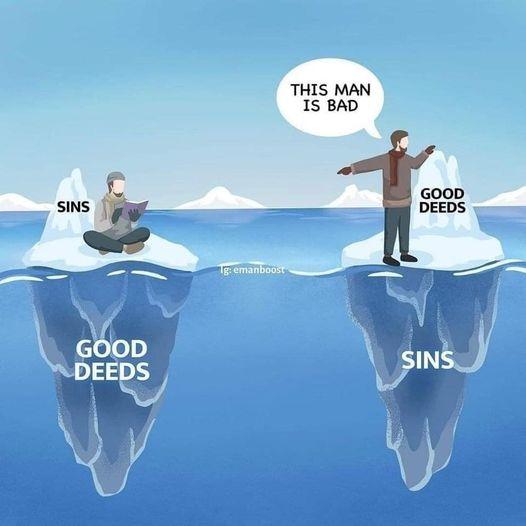
God, it seems, is able to see the good as well as the bad and to hold them in tension (as was demonstrated in the parable of the wheat and the weeds). God sees in us both the good and the bad and loves us regardless. God understands the circumstances in which we might do things that otherwise we might not do (admit that legalising abortion is essential for the health of a mother). God uses that which is good in us yet is not blind to our shortcomings. There will be a reckoning, a time when we are shriven of all that belongs in the kingdom, but until then God will let the wheat grow with the weeds and the good and bad fish will swim together.
Black and white thinking puts us in the place of God. We need to liberate ourselves from such narrow thinking, open ourselves to the possibility that not everything is as it seems, and finally not take judgment into our own hands, but leave it to God who alone sees everything as it really is.
I found this image on Facebook it was too perfect not to use, I apologise that I could not identify the source. Please let me know who created it so I can acknowledge them. (I have contacted the person who posted it.)


 Swallowsrest